

Wilson’s disease isn’t just a rare liver condition-it’s a silent copper overload that can wreck your brain, liver, and kidneys if left unchecked. It starts with a single gene mutation, ATP7B, that stops your body from getting rid of excess copper. Instead of being flushed out through bile, copper builds up in your liver, then spills into your bloodstream and settles in your brain, eyes, and kidneys. Left untreated, it’s fatal. But with the right treatment, people with Wilson’s disease can live full, normal lives. The key? Catching it early and using chelation therapy the right way.
How Copper Goes Wrong in Wilson’s Disease
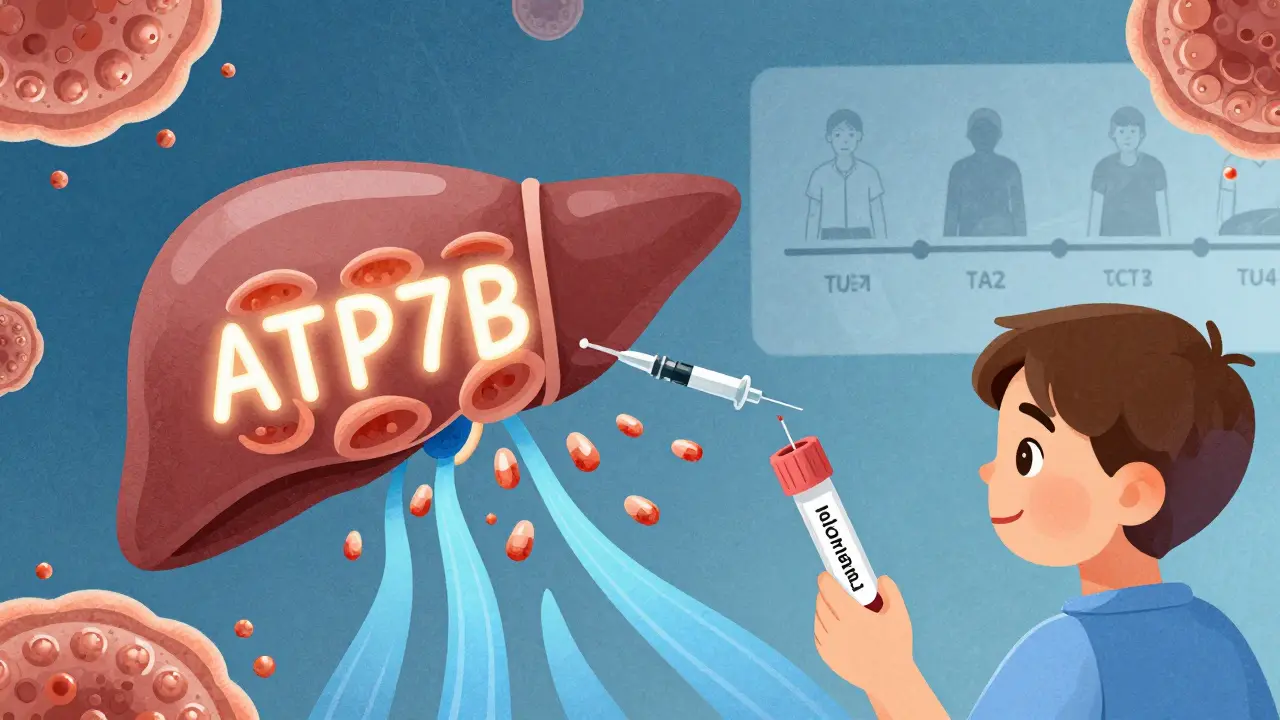
In a healthy body, copper comes in through food, gets absorbed in the small intestine, and travels to the liver. There, a protein called ATP7B does two vital jobs: it puts copper onto ceruloplasmin (the main copper-carrying protein in your blood) and pushes extra copper into bile so it leaves your body through poop. In Wilson’s disease, that protein is broken. Mutations in the ATP7B gene mean copper doesn’t get loaded onto ceruloplasmin, so serum levels drop below 20 mg/dL (normal is 20-50). And without proper bile excretion, copper piles up in liver cells.
At first, your liver tries to protect itself. Metallothionein, a copper-binding protein, soaks up the excess. But once those binding sites are full-usually after years of buildup-copper leaks out. That’s when things get dangerous. Free copper circulates and targets the brain’s basal ganglia, especially the putamen and globus pallidus. When brain copper hits 250 μg/g dry weight, neurological symptoms start. That’s when tremors, stiffness, speech trouble, or even psychiatric changes show up.
One of the clearest signs is the Kayser-Fleischer ring-a rusty brown halo around the cornea, visible only with an eye exam. It’s present in 95% of people with neurological Wilson’s disease and about half of those with liver-only symptoms. It’s not just a sign-it’s a diagnostic clue that separates Wilson’s from other liver diseases like autoimmune hepatitis, which can look identical on blood tests but doesn’t involve copper overload.
Diagnosis Isn’t Simple-But It’s Possible
Doctors don’t diagnose Wilson’s disease with one test. They piece it together. Low ceruloplasmin? Check. High urinary copper? Check. Kayser-Fleischer rings? Check. But here’s the catch: some kids under five have naturally low ceruloplasmin, and neurological cases often show lower urinary copper than liver cases. That’s why the diagnostic score system now includes genetic testing. Finding two disease-causing mutations in ATP7B gives you four points-enough to confirm the diagnosis even if other signs are unclear.
Urinary copper excretion over 80 μg/24h (updated in 2023) is now considered diagnostic for liver-presenting cases. In neurological cases, the threshold is higher-usually over 100 μg/24h. But even then, about 30% of patients with neurological symptoms don’t hit that mark. That’s why liver biopsy, showing copper levels over 250 μg/g dry weight, is still a gold standard when diagnosis is uncertain.
And here’s what many patients don’t realize: it takes years to get diagnosed. A 2022 survey from the Wilson Disease Support Group found the average delay was 2.7 years. People are misdiagnosed with autoimmune hepatitis, chronic fatigue, or even psychiatric disorders. One Reddit user spent seven years with rising liver enzymes before a 24-hour urine test revealed 380 μg/24h of copper. That’s nearly ten times the normal level.
Chelation Therapy: The Lifesaving Fix
Once diagnosed, treatment begins immediately. The goal? Remove the excess copper without starving your body of the small amount it needs to make enzymes and support nerve function. That’s where chelation therapy comes in. Chelators are molecules that bind tightly to copper and carry it out through urine.
The first-line drug for most adults is D-penicillamine. It’s been around since 1956, costs about $300 a month, and works well-except for the side effects. About 20-50% of patients get worse neurologically in the first six to eight weeks. Their tremors get worse. Their speech gets slurred. Their mood drops. Why? Because the chelator pulls copper out of tissues too fast, and it temporarily floods the brain. To prevent this, doctors often add zinc (50 mg elemental zinc three times a day) right away. Zinc blocks copper absorption in the gut and reduces the spike in free copper.
But not everyone tolerates penicillamine. About 22% develop a lupus-like syndrome-joint pain, rashes, kidney issues. Others get metallic taste, nausea, or low white blood cell counts. That’s why trientine is the go-to alternative. It’s just as effective, causes fewer neurological side effects, and doesn’t trigger autoimmune reactions. But it costs over $1,850 a month. For many, that’s a barrier.
Then there’s zinc acetate. It’s not a chelator-it’s a blocker. Zinc triggers your gut to make metallothionein, which binds copper from food and stops it from entering your blood. It’s perfect for maintenance after initial chelation. In fact, 92% of patients who stay on zinc long-term avoid neurological decline, as long as their free serum copper stays below 10 μg/dL. It’s cheaper than trientine, safer than penicillamine, and used by most patients after the first year.
What Happens After Treatment Starts?
Monitoring is non-negotiable. You can’t just start chelation and forget about it. Liver enzymes (ALT, AST) need checking every three months. Urinary copper should be tested every six months-target range is 200-500 μg/24h during active treatment. Serum free copper must stay below 10 μg/dL. If it rises above that, copper is re-accumulating. If it drops below 5, you’re risking deficiency.
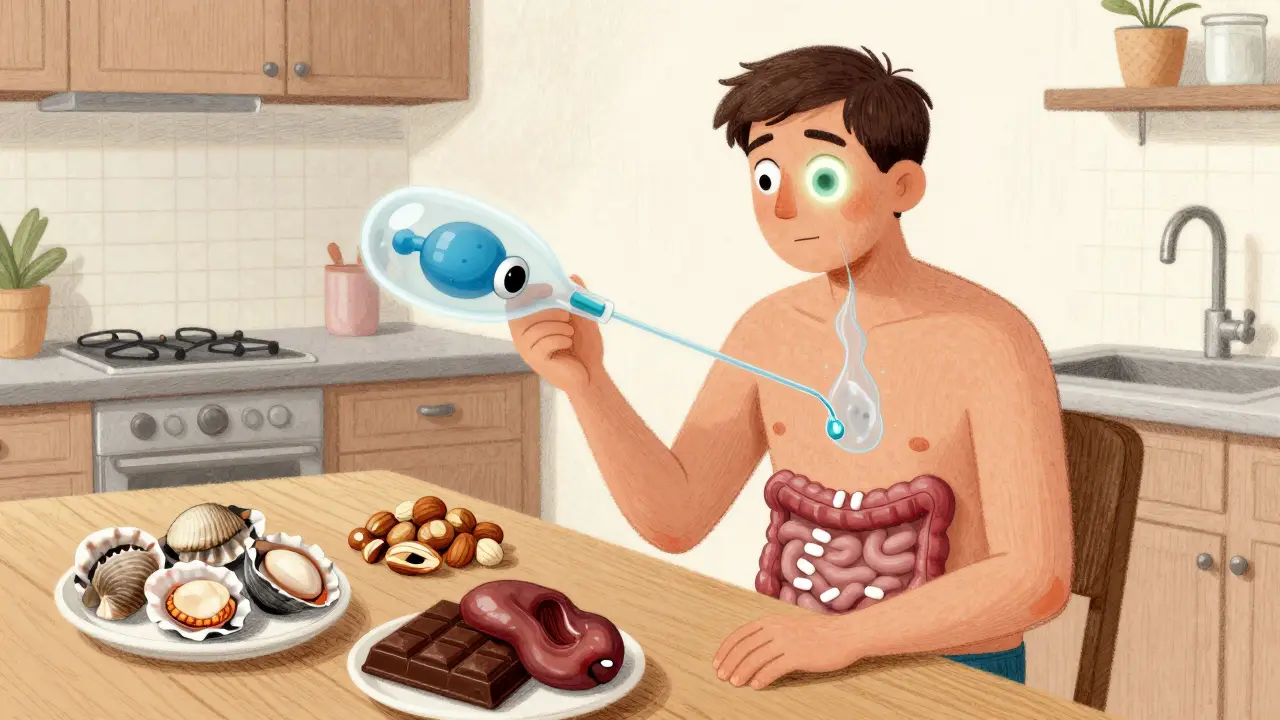
And yes, diet matters. The goal is to keep copper intake under 1 mg per day. That means avoiding organ meats, shellfish, nuts, chocolate, mushrooms, and even some tap water from copper pipes. But cutting these out without replacement can lead to iron deficiency, zinc deficiency, or protein malnutrition. Many patients struggle with this. A 2022 survey found 89% found it hard to stick to the diet long-term.
Adherence is another problem. About 35% of patients miss doses. The reasons? Nausea, metallic taste, taking meds on an empty stomach three times a day. One patient on Reddit said, “I’d forget because I was too tired. Then my liver enzymes jumped again.” It’s not laziness-it’s the burden of a lifelong, complex regimen.
New Treatments on the Horizon
The field is changing. In 2023, a new drug called CLN-1357, a copper-binding polymer, showed an 82% drop in free serum copper in 12 weeks-with zero neurological worsening. That’s huge. Another drug, WTX101 (bis-choline tetrathiomolybdate), got FDA breakthrough designation after a 2022 trial showed 91% success in preventing neurological decline, beating trientine’s 72%. It’s designed to cross the blood-brain barrier better than older drugs.
Europe approved Decuprate in 2022 specifically for neurological Wilson’s disease. And in the U.S., tetrathiomolybdate is available under compassionate use, though it carries a black box warning for bone marrow suppression.
But the most exciting development? Gene therapy. Early trials using AAV vectors to deliver a working ATP7B gene into liver cells have shown safety in six patients. If this works long-term, it could mean one-time treatment instead of daily pills.
Why This Matters
Wilson’s disease is rare-about 1 in 30,000 people. But it’s treatable. And that’s the critical point. Unlike many genetic liver diseases, this one has a clear mechanism, clear biomarkers, and proven therapies. The problem isn’t lack of treatment-it’s lack of recognition. In low-income countries, diagnostic delays can stretch to five years. By then, brain damage is often permanent.
For families with a history of unexplained liver disease, psychiatric illness, or early-onset tremors, genetic testing for ATP7B mutations is a smart move. For anyone with unexplained liver enzyme elevations, especially under 35, a 24-hour urine copper test should be routine. And for those already diagnosed? Stick with the treatment. Even if the pills taste bad, even if you forget sometimes. Your liver, your brain, your future-depends on it.
Can Wilson’s disease be cured?
No, Wilson’s disease can’t be cured-it’s a genetic condition. But with lifelong treatment, copper levels can be kept under control, organ damage can be halted, and life expectancy can be normal. Many people live into their 70s and 80s with no symptoms if they stay on therapy.
Is Wilson’s disease hereditary?
Yes. It’s autosomal recessive, meaning you need two faulty copies of the ATP7B gene-one from each parent. If both parents are carriers (which happens in about 1 in 90 people), each child has a 25% chance of having the disease. Siblings of diagnosed patients should be tested, even if they show no symptoms.
Can you take copper supplements if you have Wilson’s disease?
Absolutely not. Any extra copper-even from multivitamins or prenatal pills-can worsen the condition. Always check labels for copper content. Most supplements list it as “copper (as copper gluconate)” or similar. Avoid them unless your doctor specifically prescribes a tiny amount for deficiency, which is rare.
Why does D-penicillamine make some people worse?
D-penicillamine pulls copper out of tissues rapidly. In people with existing brain copper buildup, this can cause a temporary surge of free copper in the bloodstream, which crosses the blood-brain barrier and worsens neurological symptoms. That’s why zinc is often started at the same time-to block new copper absorption and slow the release.
How often do you need blood and urine tests?
During active chelation, liver tests every 3 months, urinary copper every 6 months, and serum free copper every 3 months. Once stable on maintenance therapy (like zinc), tests can drop to every 6-12 months. But skipping tests risks unnoticed copper buildup-leading to sudden liver or brain damage.
Can Wilson’s disease affect children?
Yes. Symptoms often appear between ages 5 and 35, but children as young as 2 can show liver problems like jaundice, swelling, or fatigue. Kayser-Fleischer rings are rare in young kids, so diagnosis relies more on liver copper levels, genetic testing, and low ceruloplasmin. Early treatment in children prevents long-term damage and leads to excellent outcomes.
Is there a difference between Wilson’s disease and Menkes disease?
Yes. Wilson’s disease is copper overload; Menkes disease is copper deficiency. Menkes is caused by a mutation in ATP7A, not ATP7B, and affects infants. Symptoms include kinky hair, seizures, and developmental delays. Serum copper is very low-under 70 μg/dL. It’s fatal without early copper injections, and it’s not treatable with chelators.
What happens if you stop chelation therapy?
Copper starts building up again within weeks. Liver enzymes rise, neurological symptoms return, and organ damage resumes. Stopping treatment-even for a few months-can lead to acute liver failure or irreversible brain injury. Lifelong therapy is not optional.
Virginia Seitz
December 16, 2025 AT 21:07amanda s
December 17, 2025 AT 09:11Brooks Beveridge
December 17, 2025 AT 21:22Anu radha
December 17, 2025 AT 23:21Jigar shah
December 19, 2025 AT 21:02Jane Wei
December 20, 2025 AT 08:11Jody Patrick
December 21, 2025 AT 00:17Philippa Skiadopoulou
December 22, 2025 AT 01:58Pawan Chaudhary
December 22, 2025 AT 14:34Jonathan Morris
December 23, 2025 AT 02:29Linda Caldwell
December 23, 2025 AT 23:09Anna Giakoumakatou
December 24, 2025 AT 19:10CAROL MUTISO
December 26, 2025 AT 13:10