
Benefit-Risk Medication Decision Tool
How This Tool Works
Based on the article, doctors weigh benefits against risks when prescribing medications. This calculator helps you understand the trade-offs of different treatment options for common conditions.
Enter your condition and treatment details below to see how benefits compare to side effects.
Your Condition
Benefit-Risk Profile
Your Personal Risk Tolerance
Your Benefit-Risk Assessment
What this means:
For you:
Key Takeaway from the Article: As mentioned in the article, doctors often focus on survival while patients prioritize quality of life. Your assessment shows you value more than survival.
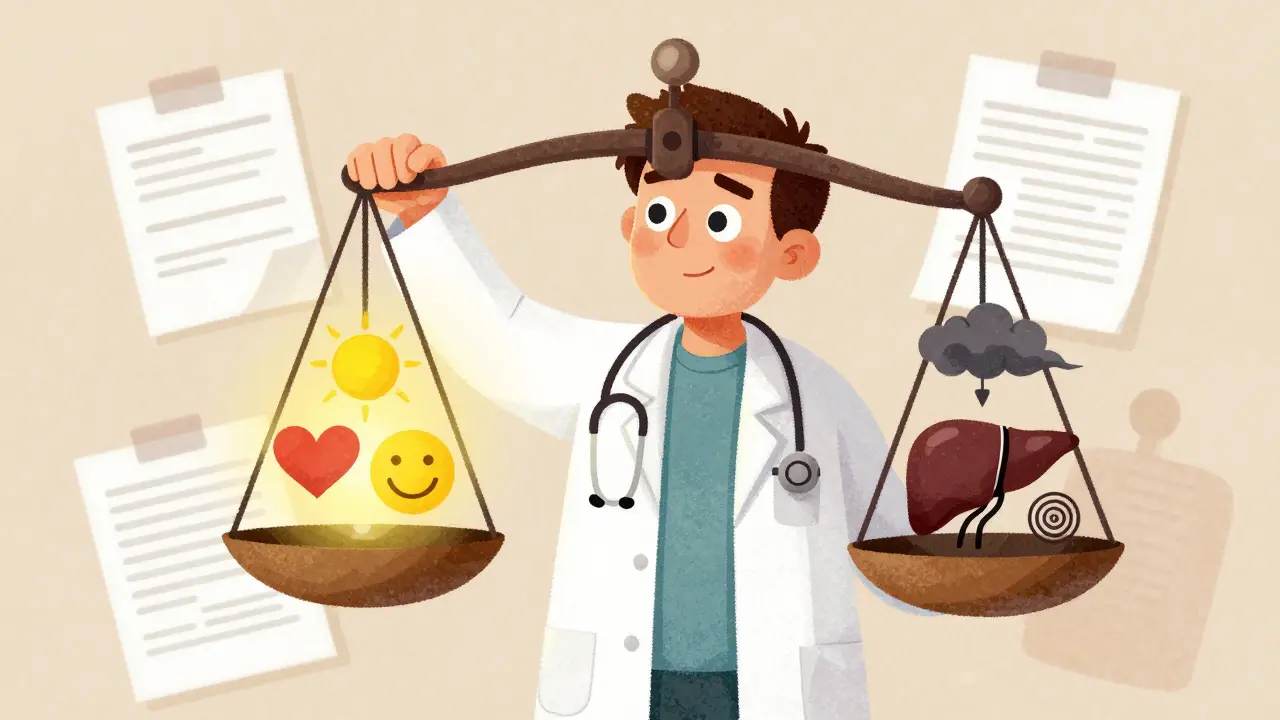
Every time a doctor prescribes a pill, they’re not just handing out a cure-they’re making a calculated bet. On one side: relief from pain, control of a chronic disease, maybe even saving a life. On the other: nausea, dizziness, liver damage, or worse. This isn’t guesswork. It’s a structured, evidence-based process called benefit-risk assessment, and it’s the backbone of modern prescribing.
It’s Not About Avoiding Side Effects-It’s About Managing Trade-Offs
People often think doctors avoid medications with side effects. That’s not true. They avoid medications where the side effects outweigh the help they provide. A drug that causes diarrhea in 20% of users might be perfect for someone with aggressive cancer. The same drug might be rejected for someone with mild high blood pressure. The difference isn’t the drug-it’s the context. The U.S. Food and Drug Administration (FDA) built its entire approval system around this idea. Since the 2013 PDUFA V plan, regulators have required a formal benefit-risk analysis for every new drug. For a medication to be approved, the FDA must be convinced that the benefits are likely to outweigh the risks. That’s not a suggestion. It’s the law. And it’s not just for new drugs. This same logic guides decisions when a patient’s condition changes, when a new side effect pops up in real-world use, or when a cheaper alternative becomes available.How Providers Actually Do the Math
Doctors don’t use spreadsheets, but they think in terms of four key areas:- What’s the condition? A life-threatening illness like metastatic melanoma changes everything. A 10% risk of serious immune reaction? Acceptable if it doubles survival chances. A mild rash from an allergy pill? Unacceptable when a safer option exists.
- What are the alternatives? If there are five other drugs for type 2 diabetes, each with different side effects, the provider picks the one that best fits the patient’s life-someone who drives for a living won’t take a drug that causes dizziness, even if it lowers blood sugar better.
- What do the numbers say? Clinical trials give hard data: 70% tumor shrinkage, 15% chance of severe liver injury, 3-month symptom relief. But real-world results are often weaker. Studies show effectiveness drops 20-30% outside controlled trials. Providers know this.
- What does the patient care about? This is where things get personal. A 2023 study from the Michael J. Fox Foundation found Parkinson’s patients were willing to accept a 20% risk of uncontrolled movements if it meant a 30% improvement in walking. Doctors estimated they’d only accept 12%. Patients value function over longevity. Doctors often focus on the reverse.
Why Patients and Doctors See Risk Differently
A 2022 study in the Journal of the American Medical Informatics Association found that only 35% of patients understand what “10% risk” actually means. Most think it’s either “rare” or “likely.” That’s a communication gap. A pharmacist on Reddit shared a common story: a patient refused an ACE inhibitor for high blood pressure because they heard about a 0.1% chance of angioedema-a rare but dangerous swelling. Meanwhile, that same drug cuts stroke risk by 25%. The patient focused on the scary word, not the numbers. Patients with chronic or terminal conditions often take bigger risks. The National Organization for Rare Disorders found that 78% of rare disease patients would accept side effects clinicians think are too dangerous. Why? Because their alternatives are worse. A parent of a child with spinal muscular atrophy might pay $2.1 million for Zolgensma, even with serious liver risks, because without it, the child won’t live past age two. Doctors, trained to minimize harm, sometimes underestimate how much patients are willing to endure for quality of life. A 2023 study showed patients with chronic pain prioritized symptom relief over long-term survival by a 3-to-1 margin. That’s not irrational-it’s human.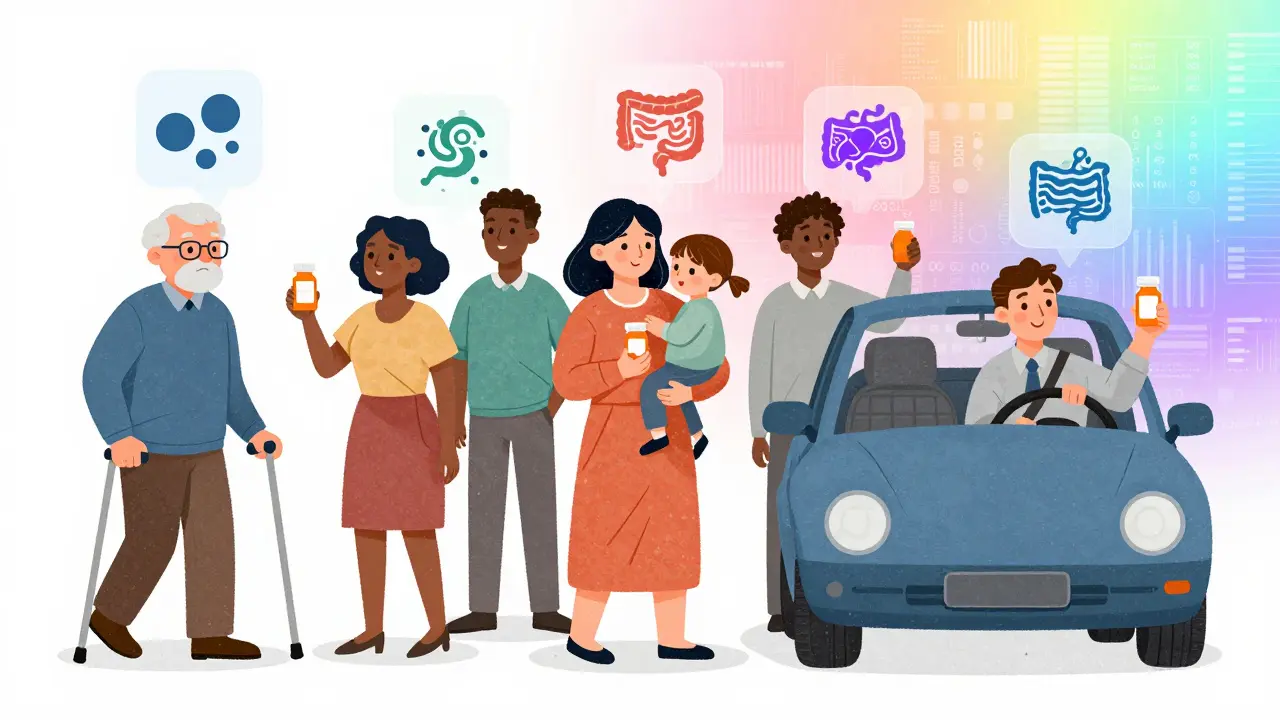
The System Isn’t Perfect-And It’s Getting More Complex
The FDA’s benefit-risk framework is detailed, but it’s not a formula. It’s a checklist of considerations, not a calculator. That leads to inconsistency. A 2020 Duke-Margolis report found 32% variation in how different FDA teams rated similar drugs. One team might see a 15% risk of heart issues as manageable; another might block approval. The system also struggles with prevention. A drug that lowers heart attack risk by 15% in healthy people might be rejected if it causes bleeding in 2% of users. That’s fair for low-risk patients-but not for someone with a genetic predisposition. The framework doesn’t yet personalize well. And then there’s data bias. Clinical trials are still dominated by white participants. A 2023 JAMA study found 75% of trial subjects were White, even though minorities make up 40% of the U.S. population. That means side effect rates for Black, Hispanic, or Asian patients are often estimated, not measured. That’s a dangerous blind spot.What’s Changing Right Now
The field is evolving fast. In 2023, the FDA started using real-world data from electronic health records to assess drug safety after approval. Instead of waiting years for reports, they can now spot patterns in millions of patient records. Roche’s ARIA platform, used by top pharmaceutical companies, uses AI to predict side effects before they become widespread-cutting prediction time by 30%. Patient input is now formalized. The FDA’s Patient-Focused Drug Development program has collected input from over 1,200 rare disease patients across 45 conditions. Their feedback has directly changed drug labeling and risk management plans. By 2030, experts predict 70% of benefit-risk decisions will include personal data-genetics, lifestyle, gut microbiome, even sleep patterns. Imagine a drug that works great for most people but causes liver damage only in those with a specific gene variant. In the future, doctors won’t just say “this drug has risks.” They’ll say, “this drug has a 2% risk for you, but a 15% risk for someone else.”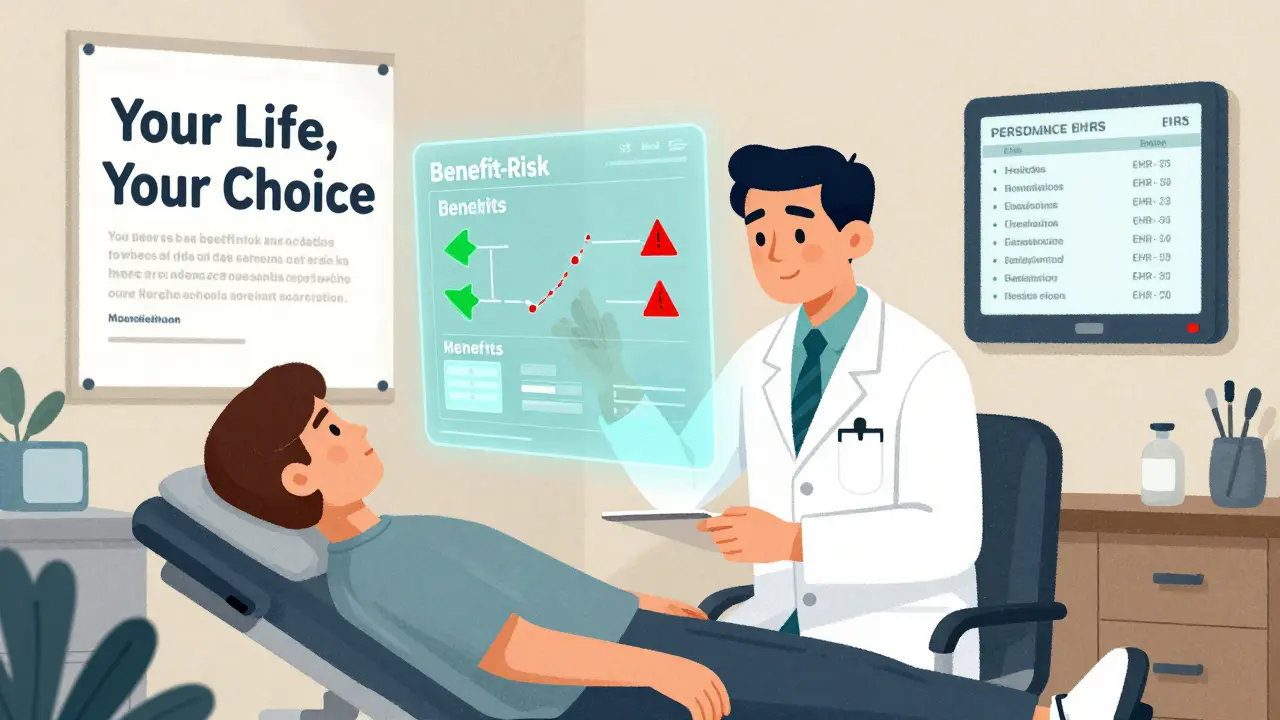
What This Means for You
If you’re prescribed a new medication, don’t just ask, “What are the side effects?” Ask:- “What happens if I don’t take this?”
- “Are there other options with fewer risks?”
- “How do the benefits compare to what I’m living with now?”
- “Have other patients like me taken this? What was their experience?”
Why This Matters Beyond the Prescription Pad
This isn’t just about pills. It’s about how medicine thinks. The shift from “one-size-fits-all” to “what’s right for this person” is transforming healthcare. Insurance companies now use benefit-risk models to decide coverage. Hospitals use them to choose which drugs to stock. Regulators use them to decide which drugs get fast-tracked. The global pharmacovigilance market-where companies monitor drug safety after launch-is worth $7.8 billion and growing. Why? Because the cost of missing a side effect can be billions in lawsuits, recalls, and lost trust. Every time a drug is approved, rejected, or labeled with a warning, it’s the result of thousands of decisions made by doctors, patients, regulators, and scientists-all trying to answer the same question: Is this worth it?Why do doctors prescribe drugs with serious side effects?
Doctors prescribe drugs with serious side effects when the condition being treated is severe and the alternative is worse. For example, chemotherapy causes nausea, hair loss, and immune suppression-but for many cancers, it’s the only thing that extends life. The decision isn’t made lightly. It’s based on data showing that the chance of survival or improved quality of life is significantly higher with the drug than without it.
How do I know if the risks of my medication are worth it?
Ask your provider to explain the benefit-risk balance in simple terms. What’s the chance the drug will help? What’s the chance it will cause harm? How does that compare to not taking it? Use tools like the FDA’s Patient Decision Aids, which offer condition-specific guides. If you’re unsure, ask for a second opinion. Your tolerance for risk matters as much as the numbers.
Are side effects always listed in the patient information leaflet?
Yes, all known side effects from clinical trials are listed. But real-world risks-like rare reactions that only appear after thousands of people use the drug-can take months or years to surface. That’s why post-market surveillance exists. If you experience something unusual, report it to your doctor and to the FDA’s MedWatch program. Your report helps improve safety for everyone.
Why do some people have bad reactions while others don’t?
Genetics, age, other medications, liver and kidney function, and even gut bacteria affect how your body processes drugs. That’s why a side effect that’s rare for most people might be common for you. Doctors are starting to use genetic testing to predict risk, especially in areas like mental health and cancer treatment. In the future, prescriptions will be tailored to your biology, not just your diagnosis.
Can I refuse a medication because of the side effects?
Absolutely. No one can force you to take a medication. But it’s important to understand the consequences. If you refuse a blood thinner for atrial fibrillation, your stroke risk might double. If you skip insulin for type 1 diabetes, you could go into diabetic ketoacidosis. Talk to your provider about alternatives-there’s almost always another option, even if it’s less effective or more expensive.
Benefit-risk assessment isn’t a cold, robotic calculation. It’s a human conversation between science and lived experience. It’s about balancing hope against fear, data against desire, and survival against quality of life. And in the end, the best decision isn’t always the safest one-it’s the one that lets you live the life you want.
Joe Bartlett
December 16, 2025 AT 01:57Man, in the UK we just get told what to take and shut up. Over here it’s all ‘risk-benefit’ this and ‘patient-centered’ that. We’ve got NHS doctors who’d rather prescribe paracetamol and a cuppa than risk a lawsuit.
Peter Ronai
December 17, 2025 AT 14:21Oh wow, another sanctimonious op-ed about how doctors are ‘trained to weigh risks.’ Newsflash: most of them don’t even read the full FDA briefings. They skim the summary, check the formulary, and hand you a script like it’s a vending machine snack. And don’t get me started on how they ignore real-world data because ‘clinical trials say otherwise.’ You’re not a statistic, you’re a person with a liver and a job and a kid who needs you alive.
And yes, I’ve had three meds pulled from my chart because I asked ‘what happens if I don’t take this?’ Turns out, two of them were just for ‘potential’ issues that never existed. They were prescribing fear, not medicine.
Also, ‘patient input’? Please. The FDA’s ‘Patient-Focused Drug Development’ program is a PR stunt. They invite five people who already love the drug to a focus group and call it ‘diverse input.’ Meanwhile, the guy who had a stroke on the trial? Never heard from again.
And the ‘AI predicting side effects’? Roche’s ARIA? It’s trained on biased data. 75% white participants? So my Black ass gets a drug that’s never been tested on melanin-rich livers? Thanks for the life-saving algorithm, bro.
Stop romanticizing ‘human conversation.’ It’s a profit-driven, bureaucratic circus with a white coat.
Michael Whitaker
December 19, 2025 AT 14:12While I appreciate the conceptual framework presented herein, I must respectfully posit that the underlying epistemological assumption-that benefit-risk assessment is a ‘human conversation’-is fundamentally flawed. It presumes agency where institutional inertia reigns. The FDA’s checklist is not a deliberative process; it is a compliance artifact, optimized for liability mitigation rather than clinical wisdom. Moreover, the notion that ‘your values matter’ is a neoliberal fiction peddled to absolve systemic failure. When a patient is presented with a $2.1M gene therapy and told ‘it’s your choice,’ they are not exercising autonomy-they are being coerced by the absence of alternatives.
Furthermore, the assertion that ‘doctors underestimate patient tolerance for discomfort’ presumes a shared lexicon of suffering. But how many clinicians have sat with a family watching their child convulse from spasticity, knowing the only intervention is a drug that may kill them? That is not a ‘trade-off.’ It is a moral abyss.
Brooks Beveridge
December 21, 2025 AT 03:43Hey everyone-just wanted to say this post really hit home. I’ve been on three different meds for my chronic pain, and honestly? The one that helped the most made me feel like a zombie for six months. But I kept it because I could finally hug my daughter without crying. No one told me that might happen. No one said, ‘this might make you numb to joy.’
Doctors focus on the numbers. But we’re not numbers. We’re people who still want to laugh, dance, or sit on the porch with coffee. If a pill lets me do that-even with side effects-I’ll take it. Not because I’m reckless. Because I’m alive.
And if you’re scared to ask your doc ‘what happens if I don’t take this?’-just say it. They’ve heard it before. They just forget to say it back.
You’re not asking for permission to feel better. You’re claiming your right to live. 💪❤️
Jigar shah
December 21, 2025 AT 07:40This is a well-structured analysis, but I would like to clarify a point regarding real-world effectiveness. The 20-30% drop in efficacy outside clinical trials is not solely due to patient non-adherence; it is also influenced by comorbidities, polypharmacy, and socioeconomic factors that are often excluded from trial cohorts. For instance, in low-income populations, the inability to store medications properly or access follow-up labs significantly diminishes therapeutic outcomes. The benefit-risk calculus must therefore be contextualized within structural determinants of health, not merely individual preferences.
Additionally, while genetic testing is promising, its accessibility remains highly inequitable. In India, for example, pharmacogenomic testing is available only in private urban hospitals. The global north’s ‘personalized medicine’ future risks exacerbating global health disparities unless addressed proactively.
Josh Potter
December 22, 2025 AT 10:00bro i got prescribed this thing for anxiety and it made me feel like a robot who forgot how to cry. i didn’t tell my doc because i was scared they’d think i was weak. then i found a reddit thread where 200 people said the same thing. so i switched. now i’m on a cheaper drug that gives me dry mouth but i can still laugh at my cat. stop letting fear decide for you. ask dumb questions. your life is yours.
Jody Patrick
December 23, 2025 AT 17:55Medicare won’t cover half these drugs. So the ‘choice’ is between bankruptcy and death. That’s not risk-benefit. That’s extortion.
Anna Giakoumakatou
December 25, 2025 AT 07:53How quaint. The ‘human conversation’ between doctor and patient. Tell me, when did your doctor last sit with you while you cried because your insurance denied the only drug that didn’t make you vomit? Or was that just a plot point in the pharmaceutical ad you watched during your 12-minute appointment?
Oh, but don’t worry-the AI will fix it. Right after it learns how to price a pill at $12,000 and call it ‘innovation.’
Donna Packard
December 25, 2025 AT 17:52I just wanted to say thank you for writing this. My mom was on a drug that made her dizzy, but it kept her from falling. She didn’t want to stop. She said, ‘I’d rather be dizzy than broken.’ I didn’t understand until I saw her walk again. Sometimes the ‘risk’ is just the price of being able to live your life the way you want. Not perfect. Just yours.
Patrick A. Ck. Trip
December 25, 2025 AT 19:15Really appreciate this breakdown. I’ve been a caregiver for my brother with MS, and the one thing I’ve learned is that ‘best decision’ isn’t always the one with the least side effects-it’s the one that lets him feel like himself again. Even if it means he needs help eating now. We talked it through, we looked at the numbers, and we chose. No one made us feel guilty. That’s what good care looks like.
Just… please, let’s make sure this kind of conversation isn’t a luxury. Everyone deserves to have their life, not just their lab results, matter.