

When you’re running a clinical trial, every patient reaction matters-but not every reaction needs to be reported the same way. Confusing a serious adverse event with a mild headache might sound harmless, but it’s actually one of the most costly mistakes in clinical research. Thousands of reports flood regulatory systems every year that don’t meet the legal definition of seriousness, wasting time, money, and attention that should be focused on real dangers.
What Makes an Adverse Event "Serious"?
An adverse event (AE) is any unwanted medical occurrence during a clinical trial, whether or not it’s linked to the drug or device being tested. But not all AEs are created equal. Only a subset qualifies as serious adverse events (SAEs), and that distinction isn’t about how bad the symptoms feel-it’s about what happens to the patient.
The U.S. Food and Drug Administration (FDA) and the International Council for Harmonisation (ICH) define a serious adverse event by six specific outcomes:
- Death
- Life-threatening condition
- Requires hospitalization or prolongs an existing hospital stay
- Results in persistent or significant disability or incapacity
- Causes a congenital anomaly or birth defect
- Requires medical or surgical intervention to prevent permanent harm
That’s it. No more, no less. A severe migraine that knocks someone out for a day? Not serious. A broken rib from a fall? Not serious-unless it causes lung collapse and requires ICU care. A rash that itches? Mild. But if that same rash leads to toxic epidermal necrolysis? That’s serious.
Many people mix up "severe" with "serious." Severe describes intensity: a 10/10 pain score. Serious describes outcome: did it kill, disable, or hospitalize? A patient with stage IV cancer might have a "severe" cough from their disease-but if it doesn’t lead to hospitalization or breathing failure, it’s not a serious adverse event. That confusion is so common, the FDA has publicly called it out as a top error in safety reporting.
When Do You Have to Report a Serious Adverse Event?
If an event meets any of the six criteria above, you report it fast. Not tomorrow. Not at the end of the week. Within 24 hours.
Investigators-doctors, nurses, or coordinators on the ground-must notify the trial sponsor immediately upon learning about the event. That’s the rule under 21 CFR 312.32. The sponsor then has 7 days to report life-threatening SAEs to the FDA, and 15 days for others. For the Institutional Review Board (IRB), most sites require SAE reports within 7 days, even if the event isn’t thought to be caused by the study drug.
Why so fast? Because safety signals can emerge from just one or two cases. If a new drug causes unexpected liver failure in three patients across three different sites, and those reports are delayed because someone thought "it was just a bad reaction," the next patient might die.
Real-world data shows how messy this gets. At the University of California, San Francisco, over 40% of adverse event reports submitted in 2022 needed clarification because the seriousness wasn’t clear. One case involved a patient who went to the ER for chest pain after taking a study drug. The ER ruled it out as indigestion, sent them home. The site didn’t report it. Weeks later, the patient had a heart attack. Turns out, the drug affected cardiac conduction. That’s the kind of signal you miss if you don’t report every possible red flag.
What About Non-Serious Adverse Events?
Non-serious adverse events are everything else. Mild nausea. Temporary dizziness. A bruise from an IV. A headache that goes away with ibuprofen. These don’t meet the six serious outcome criteria.
They still need to be recorded-just not rushed. They go into the Case Report Form (CRF) and are summarized in routine safety reports: monthly, quarterly, or at the end of the trial. Some protocols even say only moderate or severe non-serious events need documentation, depending on the risk profile of the drug.
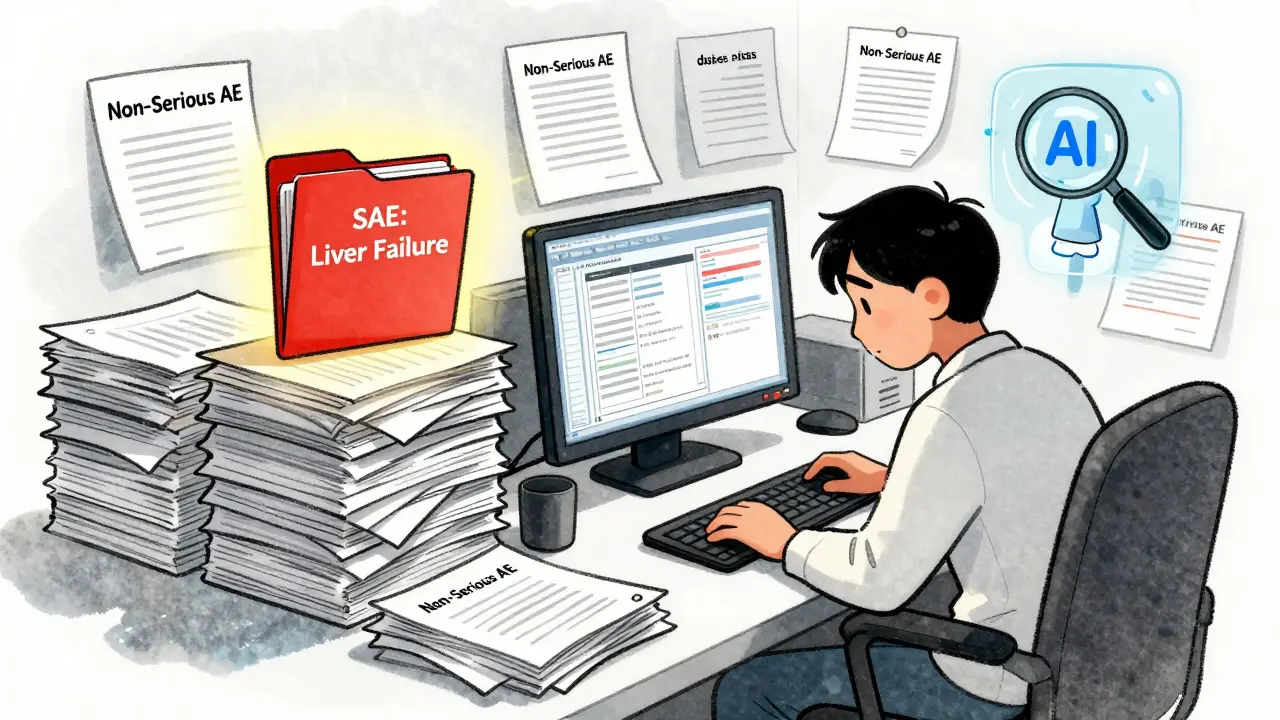
Here’s the catch: some researchers report every single symptom as "serious" just to be safe. That’s a problem. In 2019, nearly 37% of reports labeled as SAEs by IRBs turned out not to meet the definition. That’s tens of thousands of unnecessary reports clogging the system. When regulators get flooded with noise, they miss the signal.
Dr. Janet Woodcock, former director of the FDA’s drug center, said it plainly: "The current system is overwhelmed by non-serious events reported as serious, diluting attention from truly critical safety signals."
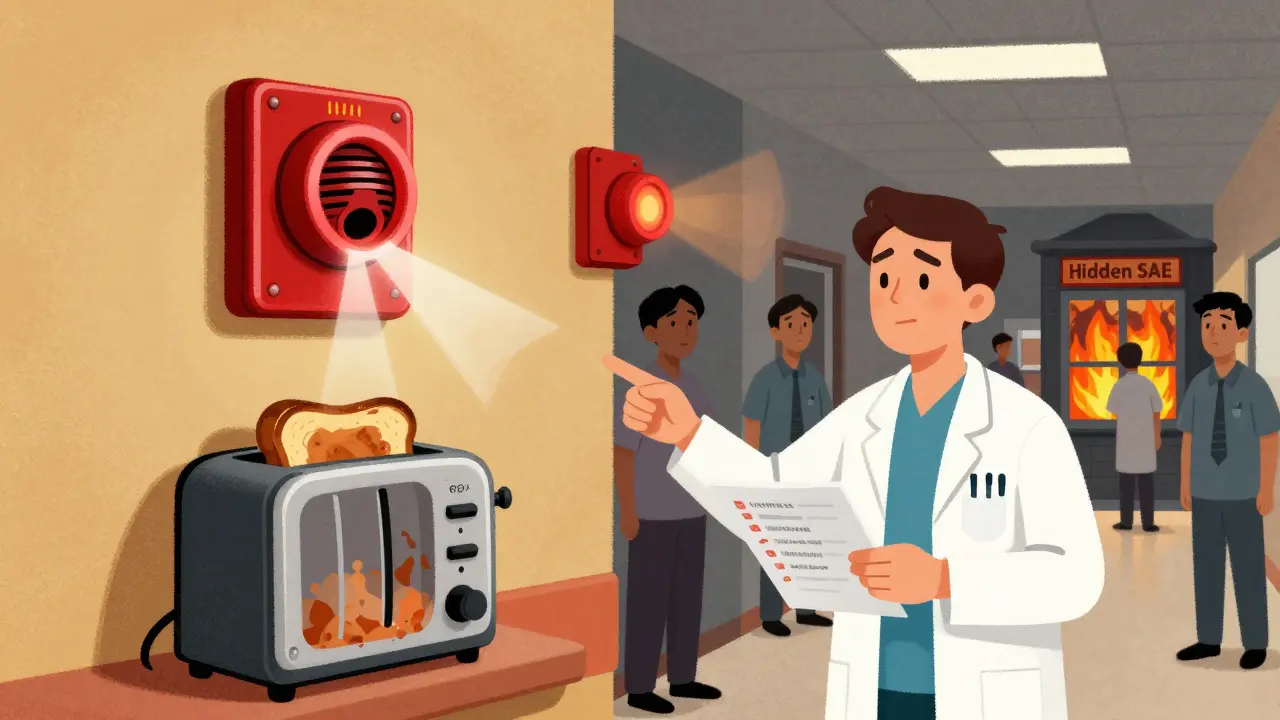
Imagine a fire alarm going off every time someone burns toast. Eventually, no one pays attention when the real fire starts.
How Do You Actually Decide? A Practical Decision Tree
There’s no guesswork. The NIH and ICH offer a simple four-question flow:
- Did the event cause death?
- Was it life-threatening? (Meaning the patient was at immediate risk of death-not just "could have died if untreated.")
- Did it require hospitalization or extend a hospital stay?
- Did it result in permanent disability, birth defect, or require intervention to prevent it?
If the answer to any of these is "yes," it’s serious. Report it now.
If the answer is "no" to all four, it’s non-serious. Document it in the CRF, follow the protocol’s reporting schedule, and move on.
Tools like the Common Terminology Criteria for Adverse Events (CTCAE) help grade severity (Grade 1 to 5), but severity doesn’t override seriousness. A Grade 3 (severe) rash that doesn’t hospitalize or disable? Still non-serious. A Grade 1 (mild) drop in blood pressure that triggers cardiac arrest? That’s serious.
Many sites now use electronic systems with built-in logic checks. If a coordinator tries to mark a "headache" as serious, the system flags it and asks: "Did this lead to hospitalization? Death? Permanent damage?" If not, it won’t let them submit it as an SAE.
Why This Matters Beyond Compliance
It’s not just about avoiding fines. Misclassifying events has real consequences.
In 2022, the pharmaceutical industry spent $1.89 billion on adverse event reporting. Over 60% of that went toward handling non-serious events mislabeled as serious. That’s billions of dollars spent chasing ghosts while real risks go unnoticed.
And it’s not just money. It’s trust. When regulators see the same site submitting dozens of false SAEs, they start doubting every report. That delays approvals, increases scrutiny, and makes it harder for legitimate breakthroughs to get through.
On the flip side, getting it right builds credibility. Sites with clean, accurate reporting get faster IRB approvals, more trial opportunities, and better relationships with sponsors.
Artificial intelligence is stepping in to help. AI tools now correctly classify seriousness in 89.7% of cases, compared to 76.3% for humans. But AI still needs a human to review. You can’t outsource judgment. You need trained people who understand the difference between intensity and outcome.
Training and Common Pitfalls
ICH E6(R2) requires all study staff to be trained on SAE criteria before starting a trial. And it’s not a one-time thing. 98.7% of top research institutions require annual refreshers.
Still, mistakes happen. Here are the top three:
- "Severe" = "Serious": A patient has a Grade 4 anxiety episode. They’re crying, can’t sleep, feel hopeless. But if they’re not suicidal, hospitalized, or at risk of self-harm? Not serious. This is the most common error, especially in mental health trials.
- "I reported it just in case": Over-reporting isn’t safer. It’s dangerous. It hides the real signals.
- "The patient was already sick": In cancer trials, patients often have multiple symptoms. Just because a patient had low blood counts before doesn’t mean a new drop isn’t serious. You have to assess change, not baseline.
One oncology site in Australia found that 78% of their SAE reports in hematology trials were flagged for incorrect classification because they didn’t compare lab values to pre-treatment baselines. They fixed it with a simple checklist. Reporting errors dropped by 65% in six months.
What’s Changing in 2025?
Regulations are catching up. The FDA’s May 2023 draft guidance wants to standardize seriousness definitions across disease areas. The EU’s Clinical Trials Regulation, in full effect since 2022, already did this across 27 countries.
The ICH is rolling out E2B(R4) by 2025-a new global electronic format for safety reports. It will make it harder to misclassify events because the system forces you to select the exact seriousness criterion that applies.
And in 2024, the FDA plans to pilot an AI system that reads narrative descriptions in adverse event reports and auto-sorts them by seriousness. Early tests show it could cut processing time by nearly half.
But technology won’t replace judgment. Only trained humans who understand the six criteria can make the final call.
Is a hospital stay always considered a serious adverse event?
No. Only if the hospitalization was caused by the investigational product or was necessary to prevent permanent harm. If a patient is admitted for a scheduled surgery unrelated to the study drug, it’s not an SAE. If they’re admitted because of a reaction to the drug, then yes.
Can a non-serious adverse event become serious later?
Yes. If a mild rash develops into Stevens-Johnson syndrome, or a headache turns into a stroke, you must update the report immediately. The initial classification was correct at the time. But new information changes the outcome, so you update the seriousness status and report it as a follow-up SAE.
Do I report adverse events that happen after the study ends?
Yes, if they’re serious and you become aware of them within the protocol’s follow-up period. Most trials require safety monitoring for 30 to 90 days after the last dose. If a patient dies from a heart attack 45 days after the last pill, and you believe it’s related, you must report it as a serious adverse event.
What if I’m not sure whether an event is serious?
Report it as serious. It’s better to over-report than under-report. But make sure you flag it as "uncertain" and document your reasoning. The sponsor’s safety team will review it and reclassify if needed. Never assume it’s fine because "it didn’t seem bad enough."
Are adverse events from placebo groups reported the same way?
Yes. Adverse events are reported regardless of whether the patient received the study drug or placebo. The goal is to understand all safety signals in the trial population. A serious event in the placebo group might point to a flaw in the trial design, patient selection, or an underlying condition in the population.
Final Takeaway: Clarity Saves Lives
Reporting adverse events isn’t paperwork. It’s patient protection. Getting the difference between serious and non-serious right means regulators can spot real dangers faster. It means sponsors can make better decisions. It means patients in future trials are safer.
Train your team. Use the checklist. Don’t confuse severity with seriousness. And when in doubt-report it as serious, then let the experts sort it out. Because in clinical research, the cost of a mistake isn’t just financial. It’s human.
Nancy Kou
December 20, 2025 AT 04:57This is exactly why so many trials get bogged down. I've seen sites report a sprained ankle as an SAE because the patient missed a follow-up. No hospitalization. No disability. Just inconvenience. The system is broken when mild events drown out life-threatening ones.
Tim Goodfellow
December 21, 2025 AT 20:35Man, I used to work at a CRO in London and we had a guy who labeled every migraine as serious because his sister had one once and ended up in the ER. Turned out she had a brain tumor unrelated to the trial. But he kept doing it. We spent six months cleaning up his reports. The noise is real.
Emily P
December 22, 2025 AT 17:28What about events that happen after the 90-day window? If a patient gets liver failure 120 days post-last-dose but the trial protocol says 90, do we still report it?
Hussien SLeiman
December 24, 2025 AT 16:13Let me be blunt-this whole system is a farce. You think regulators care about your checklist? They don’t. They care about liability. If you report a non-serious event as serious, you’re safe. If you miss a real one, you’re fired. That’s why everyone over-reports. It’s not ignorance-it’s survival. The FDA knows this. They just pretend they don’t.
And don’t get me started on AI. You train a model on 10 years of garbage data? You get garbage output. AI doesn’t understand context. It doesn’t know that a patient with stage IV cancer having a fever isn’t the drug-it’s the disease. But the system will flag it anyway because the algorithm sees ‘fever’ and ‘hospitalization’ and screams ‘SAE!’
Training? Sure. But if your site is underfunded and your coordinators are working 80-hour weeks just to keep the trial alive, you’re not going to spend 45 minutes debating whether a bruise is ‘significant.’ You’ll mark it serious and move on. The system rewards laziness disguised as caution.
And the industry spends $1.89 billion on this? That’s not inefficiency. That’s a tax on innovation. Every dollar spent chasing false signals is a dollar not spent on real science. But hey, at least the compliance officers get bonuses.
They say ‘clarity saves lives.’ But the truth? The system is designed to protect institutions, not patients. The patient dies? Too bad. The audit passed? Everyone gets a pat on the back.
holly Sinclair
December 25, 2025 AT 18:45It’s not about the six criteria. It’s about the silence between them. The unspoken assumption that death is the only metric that matters. But what about the person who survives but loses their ability to hold their child? Or the mother who can’t work again because of neuropathy? Those aren’t listed. They’re just… invisible. We measure outcomes, not lives. And that’s the real tragedy.
Kinnaird Lynsey
December 27, 2025 AT 18:04Interesting how the article says ‘report it as serious if unsure’ but then later says over-reporting is dangerous. That’s not a guideline-it’s a contradiction. You can’t have it both ways. Either you trust the system to sort it out, or you trust the people on the ground. Pick one.
And for the record-placebo events matter. I’ve seen trials where the placebo arm had more SAEs than the drug arm. Turns out the screening process was flawed. The drug wasn’t the problem. The population was. But we almost killed the trial because of noise.
Andrew Kelly
December 29, 2025 AT 14:14AI is going to replace humans in clinical trials next. Next thing you know, a bot will decide if your grandma’s cough is ‘serious’ based on a 2018 dataset. And if you complain? They’ll say ‘the algorithm is 89.7% accurate.’ Translation: we don’t care if your loved one dies because a machine misread ‘cough’ as ‘indigestion.’
This isn’t science. It’s bureaucracy with a lab coat. And the worst part? The people who wrote this guide have never seen a real patient. They’ve only seen spreadsheets.
Moses Odumbe
December 30, 2025 AT 04:28Bro. I work in oncology. A patient gets a Grade 3 nausea. We don’t report it as SAE. But if they throw up once and miss a dose? That’s a protocol deviation. Now we have to document that. Which is more important? The nausea or the missed dose? The system says the missed dose. That’s insane.
Also 🤡
Takeysha Turnquest
December 30, 2025 AT 09:12They say ‘clarity saves lives’ but the truth is clarity is a luxury. In the real world, you’re tired, you’re overworked, and you’ve got three patients waiting for their IVs. You don’t have time to parse ICH guidelines. You just hit ‘serious’ and move on. The system doesn’t reward wisdom. It rewards speed. And that’s why people die.
shivam seo
December 30, 2025 AT 09:27Look, I’m Australian and I’ve seen this crap. We had a trial where a guy got a sunburn from walking to the clinic. They reported it as an SAE because ‘it required topical steroid treatment.’ Topical. Steroid. Not even oral. But hey, the sponsor got a nice audit finding. Classic Aussie overcompensation. We don’t need American rules. We need common sense.
Kelly Mulder
December 31, 2025 AT 13:48One must interrogate the epistemological foundations of the regulatory framework. The dichotomy between severity and seriousness is not merely semantic-it is ontological. The very act of categorizing human suffering into discrete buckets is a form of epistemic violence. The FDA, as an institution, imposes a Cartesian taxonomy upon the lived, embodied experience of patients, reducing their pain to a checkbox. This is not compliance. This is dehumanization masquerading as science.
Elaine Douglass
January 1, 2026 AT 22:34Just wanted to say thank you for writing this. I’m a nurse on a trial and I used to panic every time someone got a headache. Now I know the difference. It’s made my job so much less stressful. And honestly? I think more patients are safer because of it.
Carolyn Benson
January 3, 2026 AT 07:30They forgot the seventh criterion: Did the event cause the sponsor to lose money? If yes, it’s serious. If no, it’s noise. Everything else is theater.