

Imagine sitting at a busy restaurant, trying to follow a conversation while the clatter of dishes, laughter, and background music drown out the person across from you. For someone with hearing loss, this isn’t just frustrating-it’s exhausting. Hearing aids help, but they don’t fix everything. That’s where remote microphone systems come in. These small, smart devices are changing how people with hearing loss experience conversations in noisy places. They don’t just make sound louder-they make speech clearer, even when it’s buried under noise.
How Remote Microphone Systems Work
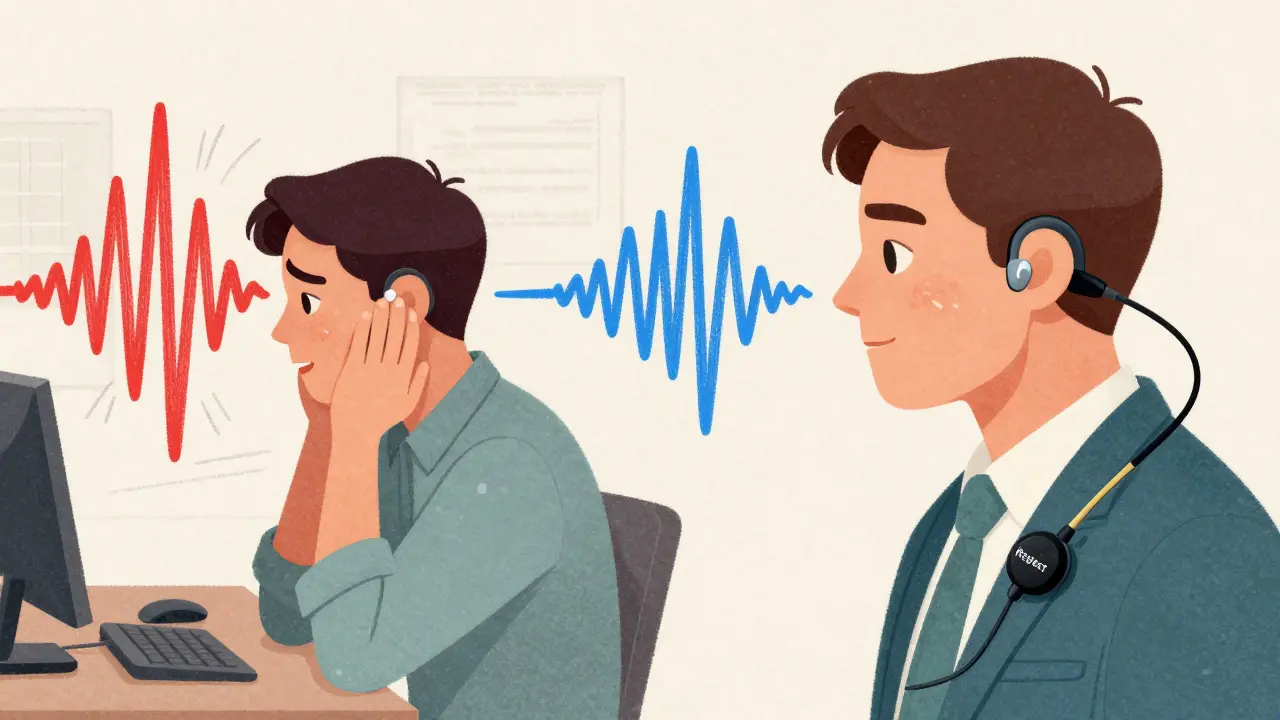
At its core, a remote microphone system is simple: one person wears a tiny microphone, and the sound from that mic goes straight to your hearing aids or cochlear implants. The mic picks up speech just 6 to 8 inches from the speaker’s mouth-far closer than your ears ever could in a noisy room. That’s the key. Sound weakens as it travels. Every time you double the distance from a speaker, the volume drops by about 6 decibels. In a restaurant at 70 dBA, that means if someone is five feet away, their voice might as well be half as loud. The microphone solves that by bringing the speech signal right to your ears.
Modern systems like Phonak Roger Select or ReSound Multi Mic use 2.4 GHz radio frequencies, not the old FM bands from the 1980s. This means they’re less likely to pick up interference from other devices. They also hop between frequencies automatically, so if one channel gets noisy, it switches to another-like a radio that finds the clearest station on its own. The signal is delivered wirelessly through Bluetooth Low Energy or proprietary connections built into your hearing aids. No extra headphones. No bulky receivers. Just your hearing aids doing their job, with a huge boost.
Why They Work Better Than Hearing Aids Alone
Hearing aids today have smart features: noise reduction, directional mics, AI speech enhancement. But even the best ones struggle when multiple people are talking or the room is loud. A 2019 study by Dr. Linda M. Thibodeau found that people using remote microphone systems understood speech up to 61% better than with hearing aids alone in 75 dBA noise-about the level of a busy street or crowded café.
Another way to think about it: in noisy environments, remote microphone systems improve the speech-to-noise ratio by 11 to 19.5 decibels. That’s like turning up the volume on speech while turning down the noise-not just cranking up the overall sound. For kids in classrooms, that means understanding 80% of what the teacher says instead of 40%. For adults at work meetings, it means not missing critical details.
Dr. Harvey Dillon, former director of Australia’s National Acoustic Laboratories, called remote microphone systems the single biggest improvement in speech understanding for hearing aid users-outperforming even the best noise-reduction algorithms by 300%. That’s not hype. It’s data from real-world testing.
Types of Systems and How They Compare
Not all remote microphones are the same. There are two main types: directional and omnidirectional.
- Directional systems like the Phonak Roger Select and ReSound Multi Mic focus on the speaker in front of them and ignore noise from the sides and back. They’re ideal for one-on-one conversations or small groups. Studies show they improve speech recognition by 15-20 percentage points over omnidirectional mics in 65-70 dBA noise.
- Omnidirectional systems like the Roger Pen pick up sound from all directions. They’re simpler and cheaper, but less effective in noisy places. They’re better for situations where you’re listening to one person in a quiet room or walking side by side.
Then there’s the difference between fixed-gain and adaptive-gain systems. The Roger Pen has a fixed volume boost. The Roger Select adjusts automatically-louder when it’s noisy, quieter when it’s calm. In simulated restaurant environments, users understood 16% more speech with the adaptive system than with the fixed one.
And then there’s the latest: Roger Focus II, released in 2023. This system can connect to multiple microphones at once. So if you’re at a family dinner with three people talking, each can wear a mic, and your hearing aids blend the signals. Phonak’s 2023 field study showed this gives 45% better speech recognition than hearing aids alone in multi-speaker settings.
Real People, Real Results
Users don’t just report better scores-they report better lives.
On Reddit, u/HearingHelp123 said: “I went from understanding 20% of conversation at family dinners to 85% with Roger Select.” Another user, u/AudiologyPatient, shared: “My Phonak Roger Pen added five years to my working life as a nurse.”
A 2023 survey of 1,247 hearing aid users found 87% said listening in restaurants became significantly easier. Seventy-eight percent said they could follow group conversations better. On Trustpilot and Amazon, average ratings hover around 4.6 out of 5. Starkey’s 2023 report showed 89% of users would recommend these systems to others.
But it’s not perfect. Some users feel awkward asking people to wear a mic. One review said: “People think I’m recording them when I ask them to wear the mic at meetings.” That’s a social hurdle-not a technical one. And it’s real.

Cost, Coverage, and Getting Started
Price is the biggest barrier. Basic models like the ReSound Mini Mic start at $499. Advanced ones like the Roger Select cost $799. Most insurance plans, including Medicare, cover only 15% of the cost. That means most people pay out of pocket. In 2023, 42% of negative Amazon reviews cited cost as the main reason for dissatisfaction.
You can’t just buy one online and plug it in. These systems need professional fitting. An audiologist programs the receiver to match your hearing loss, sets the mic sensitivity, and trains you on how to use it. Most people need 2-3 visits. The learning curve is moderate-it takes 2-4 weeks of consistent use to feel natural.
Pro tips: Keep the mic 6-8 inches from the speaker’s mouth. Use a lanyard so it doesn’t get lost. Charge it every night. Keep a spare battery. Most systems last 8-12 hours on a charge.
What’s Next for Remote Microphone Systems
The future is integration. Right now, you need a separate mic and a receiver built into your hearing aids. But that’s changing. Oticon’s 2024 More hearing aid has Roger technology built right in-no extra device needed. Phonak’s 2024 Roger X uses AI to separate speech from background noise even better, improving recognition by 9% in crowded rooms. Starkey’s Evolv AI platform, launching late 2024, will automatically boost speech when it detects multiple voices.
By 2027, the Hearing Industries Association predicts 60% of new hearing aids will have remote microphone tech built in. When that happens, prices will drop. Economies of scale could bring costs down by 25-30%. That’s huge for accessibility.
For now, if you struggle to hear in restaurants, meetings, or group settings, this isn’t a luxury-it’s a tool that works. The science is clear. The users agree. And the technology keeps getting smarter.
Do remote microphone systems work with all hearing aids?
No. They only work with hearing aids that have wireless connectivity for 2.4 GHz or Bluetooth Low Energy. Most modern hearing aids from Phonak, ReSound, Oticon, and Starkey support them, but older models or basic devices may not. Check with your audiologist to confirm compatibility.
Can I use a remote microphone system without hearing aids?
Not directly. These systems are designed to send sound to hearing aids or cochlear implants. However, some models come with a separate receiver that can connect to headphones or a speaker, but that’s not the standard use. For best results, you need hearing devices that can receive the wireless signal.
Are remote microphone systems covered by Medicare?
Medicare rarely covers remote microphone systems. As of 2024, it pays only about 15% of the cost for qualifying individuals. Most users pay out of pocket. Some private insurers or state programs may offer partial coverage, so it’s worth checking with your provider.
How do I know if I need one?
If you understand speech well in quiet rooms but struggle in restaurants, meetings, or group settings-even with hearing aids-you’re a good candidate. If you find yourself nodding along in conversations because you can’t catch what’s being said, or you avoid social events because listening is too hard, a remote microphone system could make a real difference.
Do I need to wear the microphone all the time?
Only when you need to hear someone clearly in noise. You don’t wear it during quiet conversations, while watching TV, or when alone. It’s a situational tool. Most users keep it in their pocket or bag and hand it to the person they want to hear-like a remote control for conversation.
Can multiple people use the same microphone?
Not at the same time. One mic works for one speaker at a time. But newer systems like the Roger Focus II let you connect multiple mics to your hearing aids. That way, each person in a group can wear their own mic, and your device blends the signals. It’s not perfect, but it’s a big step forward.
How long do the batteries last?
Most remote microphones last 8 to 12 hours on a full charge. That’s enough for a full workday or a long dinner out. They charge via USB-similar to wireless earbuds. Spare batteries are recommended, especially if you use the system daily.
Hadi Santoso
December 15, 2025 AT 13:41Arun ana
December 15, 2025 AT 22:16Kayleigh Campbell
December 16, 2025 AT 02:14Kim Hines
December 16, 2025 AT 17:19Randolph Rickman
December 18, 2025 AT 06:37Tiffany Machelski
December 19, 2025 AT 04:33SHAMSHEER SHAIKH
December 20, 2025 AT 15:46Souhardya Paul
December 21, 2025 AT 03:42anthony epps
December 22, 2025 AT 11:31Andrew Sychev
December 23, 2025 AT 14:23Dan Padgett
December 25, 2025 AT 06:33sue spark
December 26, 2025 AT 12:12Colleen Bigelow
December 27, 2025 AT 05:20Billy Poling
December 28, 2025 AT 23:22