
Field Medication Viability Estimator
Deployment Scenario
Analysis Report
Enter your scenario parameters to analyze potential potency loss and safety risks.
Status:
Risk Level:
Est. Potency Loss:
The Invisible Threat to Combat Readiness
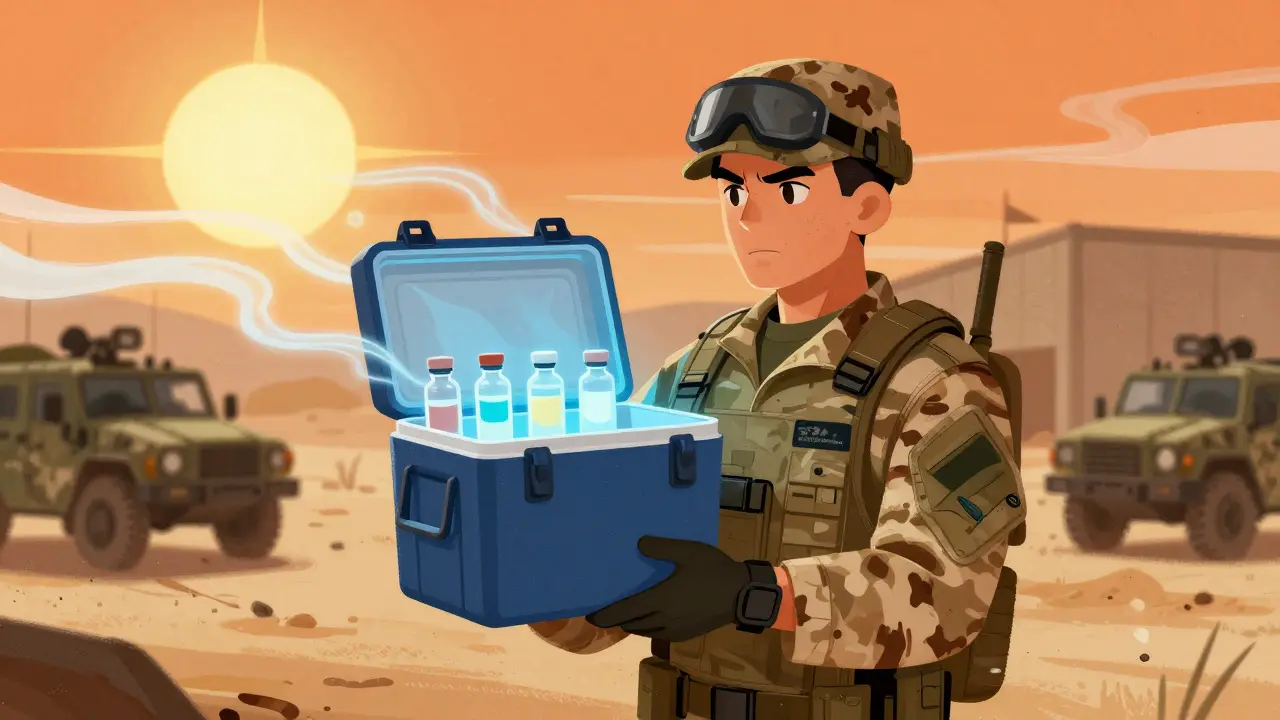
When you think about medical risks in a war zone, you imagine blood, shrapnel, and trauma. But there is another enemy that operates silently, often invisible until it’s too late: heat. In the world of military operations, keeping medicine effective is just as critical as delivering it. If a vaccine loses potency because a cooler leaked, or if antibiotics degrade before they reach the forward operating base, you aren't just losing medicine. You are losing soldiers. This isn't theoretical. Recent data shows that exposure to temperatures outside recommended ranges can reduce vaccine potency by up to 50% within 30 minutes in extreme conditions. For the military, this translates directly to mission risk. We need to look at why Military Deployment creates a uniquely hostile environment for pharmaceuticals, and exactly how logistics teams manage Medication Safety under pressure.
The Science of Storage: What Makes Medicine Brittle?
The first thing you have to understand is that modern medicine is incredibly sensitive. We aren't talking about aspirin here; we are dealing with Temperature-Sensitive Medical Products (TSMPs). These are the vaccines and biologics that require strict thermal regulation from the moment they leave the factory until the needle hits the arm. Temperature-Sensitive Medical Products (TSMPs) refers to vaccines and pharmaceuticals requiring specific thermal control to maintain efficacy. Key examples include Anthrax, Rabies, Smallpox, and COVID-19 vaccines. Also known as Time-Sensitive Pharmaceuticals, they are the backbone of preventive health in high-threat zones. According to guidelines from the United States Pharmacopeia (USP)-the gold standard for drug specifications-the margins are razor-thin. Refrigerated storage must stay between 2°C and 8°C (36°F to 46°F). Go higher than 8°C, even for an hour, and proteins inside the vial start to unravel. If you freeze something meant for refrigeration, you destroy the structure entirely. For ultra-cold storage, such as certain mRNA formulations, the window is even colder, often needing -90°C to -60°C (-130°F to -76°F). There is no "close enough" when your patient is 50 kilometers behind enemy lines.
| Storage Type | Required Temperature Range | Critical Risk Factor |
|---|---|---|
| Refrigerated | 2°C to 8°C (36°F to 46°F) | Protein denaturation above threshold |
| Frozen | -50°C to -15°C (-58°F to 5°F) | Ice crystal formation damaging molecules |
| Ultra-Cold | -90°C to -60°C (-130°F to -76°F) | Power loss leads to rapid degradation |
| Room Temperature | 15°C to 30°C (59°F to 86°F) | Ambient humidity and light exposure |
Monitoring the Chain: From Factory to Trench
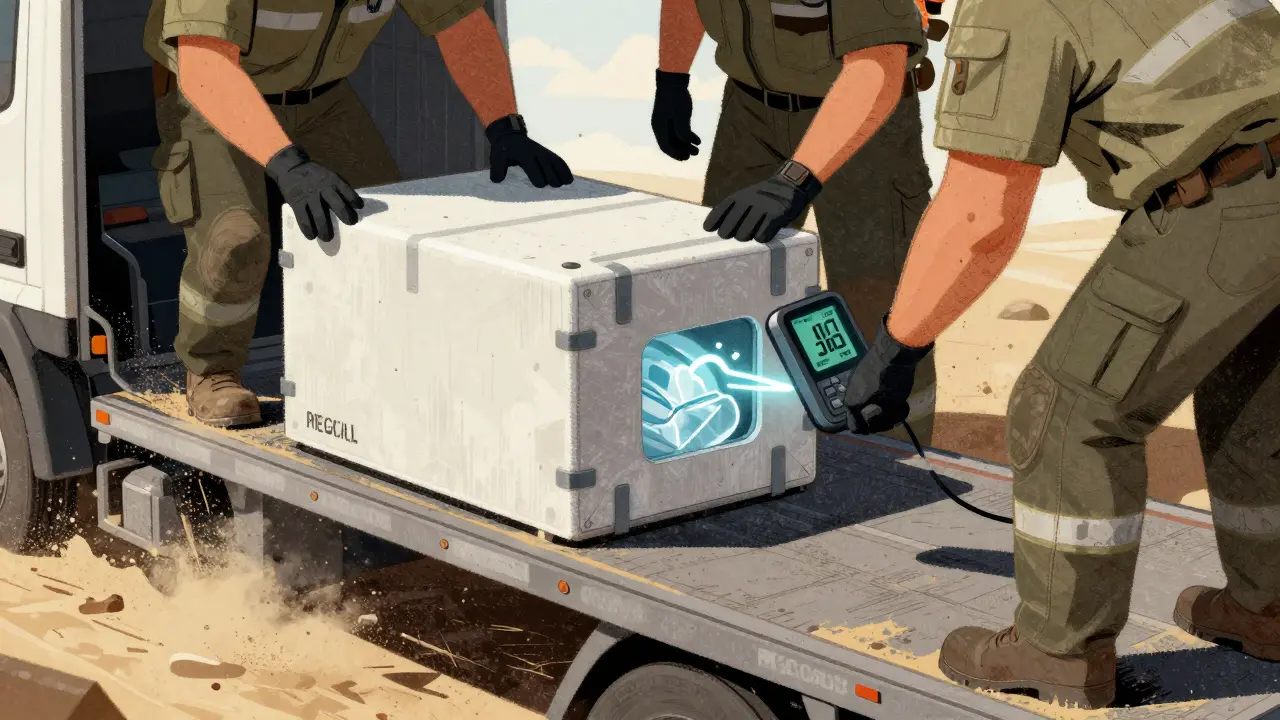
You can't manage what you don't measure. That's why the military employs rigorous Cold Chain Management (CCM) protocols. These protocols ensure that every shipment is tracked continuously. It sounds simple, but in practice, it involves a system where technology meets bureaucracy. Cold Chain Management (CCM) is defined as a temperature-controlled supply chain that maintains quality and efficacy. Implemented by Department of Defense, it ensures compliance with TB MED 507/AFPAM 48-152(I) guidelines. Recent updates from 2025 introduced AI-powered predictive modeling. In the past, medics relied on physical logs-writing down temperatures twice a day. Today, most advanced units use digital sensors like the "Temp-Tale." These devices record the entire journey. If a crate spends four hours at 35°C during transport to a base in Iraq, the sensor tells you exactly when it happened and for how long. According to the 2024 update from the Defense Health Agency, adoption rates for these digital monitoring systems hit 100% across all combatant commands. That represents a $47 million investment in infrastructure alone. However, technology brings its own friction. The rules require a dual verification system. You need both a physical check and a digital readout. If one disagrees with the other, the rule states you must assume the worst-case scenario and discard the product. This strictness prevents bad drugs from reaching patients, but it also means waste is a constant headache for logistics managers. Dr. Sarah Chen, Director of the Walter Reed National Military Medical Center Pharmacy, published findings in 2024 showing that nearly 18% of antibiotics sent to Middle Eastern theaters showed signs of reduced efficacy after heat exposure exceeding 30°C for more than two days. That number drives home the point that shipping containers aren't always perfect vacuums. They are vulnerable to external shock, vibration, and ambient spikes.
The Last Mile Problem: Field Reality
The statistics look great on paper, but ask any medic who has worked the perimeter, and you'll hear a different story. The "last mile"-transporting meds from a secure warehouse to a tactical vehicle-is where the cold chain usually breaks. A survey of 327 deployed medics conducted by the Army Medical Department revealed that 68% reported at least one incident of medication compromise due to heat exposure. Insulin and epinephrine were cited in 83% of these cases. Why? Because these are often personal carry items or small emergency stocks that can't wait for a climate-controlled truck. Field adaptability becomes the new standard operating procedure. We've seen accounts of units modifying Meal Ready-to-Eat (MRE) coolers with phase-change materials. They strap them into vehicles that sit baking in the sun. Some units managed to keep their kits at 4°C for 12 hours in 45°C environments, but that requires constant vigilance. It's not science anymore; it's survival engineering. There is a time penalty, too. During high-heat operations (above 35°C), the average delay in administering medication jumps from 12 minutes to 47 minutes. Why the lag? Personnel are spending time checking thermometers, verifying seals, and managing the inventory because they fear a heat spike. Every minute spent worrying about drug stability is a minute not spent triaging wounded. Colonel Michael D. April, Commander of the US Army Medical Research Institute of Chemical Defense, noted in a May 2024 briefing that a single temperature excursion event during transport could reduce vaccine efficacy by 30-40%. In other words, one hot ride ruins the protection for the whole squad.
Policy, Compliance, and the Human Element
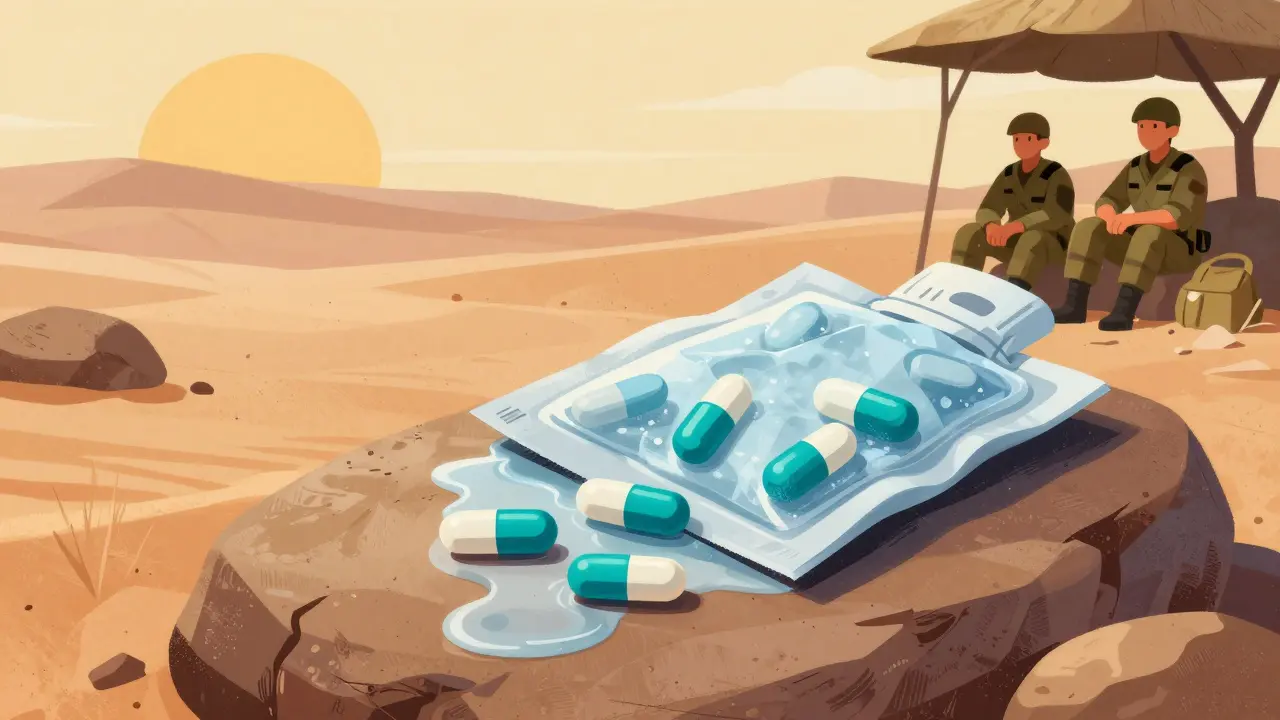
Protocols exist to protect the soldier, but they also impose heavy burdens on the providers. The Central Command (CENTCOM) issued updated policies in December 2024 mandating immediate resolution of any temperature excursions. If a fridge hits 9°C, you can't just put it back in the box. You have to document it, analyze the root cause, and correct it immediately. This level of accountability is good for safety but expensive for morale. Data shows that manual temperature logging takes about 45 minutes a day for medics. With 57% reporting this interferes with other critical medical duties, there is a clear trade-off between safety compliance and clinical care. Despite the stress, the results show value. Units using the new digital monitoring systems reported a reduction in temperature-related medication waste of over $2.3 million annually. When you consider that replacing a lost vaccine batch costs millions and risks lives, the cost of the monitoring equipment is negligible. Yet, gaps remain. Generator failures account for 37% of refrigeration outages in forward facilities. Standard procedures say you must transfer meds to an alternate site within 30 minutes. In a combat zone, getting to an alternate site might take longer. It creates a grey area where medics have to make judgment calls without the luxury of a backup power grid.
Looking Ahead: Stable Drugs and AI Forecasting
We are standing on the edge of a shift in how military medicine is engineered. The problem isn't just about better coolers; it's about designing medicines that can survive the desert without help. DARPA launched a program called StablePharm recently, investing $28 million to develop medications stable at temperatures up to 65°C by 2027. Early trials suggest a 40% improvement in heat stability for antibiotics. Imagine a pill that doesn't need a fridge. That changes everything. Climate change is accelerating the urgency. Climate Central analysis indicates that Middle Eastern deployment locations saw 23 more days above 40°C in 2024 compared to 2020. As the planet heats up, the logistical window for traditional cold chains shrinks. Without significant investment in next-generation formulations, assessments predict a potential 15-20% decline in medication efficacy by 2030 in high-temperature scenarios. Artificial Intelligence is stepping in to fill the gap. The April 2025 update to Cold Chain Management Principles introduced predictive modeling that anticipates temperature spikes before they happen. By integrating weather data with transport schedules, the system warns logisticians that a truck route will become dangerous at noon, allowing them to reroute or shade the cargo proactively. Initial tests at Fort Bragg showed a 22% reduction in temperature excursions using this method. Ultimately, the goal is readiness. Whether it's through AI sensors, improved gel packs, or heat-stable chemistry, the military is fighting a battle against physics itself. Until the last soldier receives their dose intact, the fight continues.
What are the standard temperature requirements for military medication storage?
Standard refrigerated storage must maintain 2°C to 8°C (36°F to 46°F). Frozen storage requires -50°C to -15°C, and ultra-cold storage necessitates -90°C to -60°C. Room temperature should remain between 15°C to 30°C. Manufacturers' package inserts always take precedence over general guidelines.
How does heat affect vaccine potency in the field?
Exposure to temperatures outside recommended ranges can reduce vaccine potency significantly. Data indicates a loss of up to 50% potency within 30 minutes in extreme conditions. Even short excursions can drop efficacy by 30-40%, compromising unit readiness for critical missions.
What monitoring technologies are used for military pharmaceuticals?
Units utilize NIST-certified thermometers for local checks and digital recording devices like 'Temp-Tale' for transit tracking. Recent policies mandate mandatory digital temperature recording for all shipments, eliminating paper logs to ensure accurate real-time data.
Which medications are most vulnerable to heat damage?
Insulin and epinephrine auto-injectors are the most vulnerable, cited in 83% of heat compromise incidents. Other at-risk products include Anthrax, Rabies, and Smallpox vaccines, which require strict thermal regulation throughout their lifecycle.
Are there new developments in heat-stable medication?
Yes, DARPA's StablePharm program aims to develop medications stable at temperatures up to 65°C by 2027. Preliminary results show 40% improved stability for heat-sensitive antibiotics, which would drastically reduce the reliance on cold chain logistics.
Divine Manna
April 1, 2026 AT 23:40It is evident that modern warfare logistics have been severely underestimated in public discourse regarding pharmaceutical integrity. The article correctly identifies the critical threshold temperatures which dictate the efficacy of biologics in theater conditions. Most civilians fail to grasp that protein denaturation is a non-linear process once thermal limits are breached. We must acknowledge that the United States Pharmacopeia standards are merely baseline recommendations that often fall short in dynamic combat zones. If a single vaccine vial reaches 9°C for merely twenty minutes, the antibody response capability drops precipitously. This negligence directly endangers personnel who rely on immunization for survival against biological agents. The proposed Cold Chain Management protocols are insufficient without continuous real-time telemetry. Furthermore, the dual verification system creates an administrative burden that distracts medics from primary triage duties. We cannot allow bureaucratic inefficiency to compromise operational readiness. It is imperative that future deployments prioritize heat-stable formulations over reliance on fragile refrigeration infrastructure.
Beth LeCours
April 2, 2026 AT 17:09Too much reading for me just to see we lose vaccines in the heat.
Goodwin Colangelo
April 4, 2026 AT 05:05I think the data on temperature excursions is actually really useful for anyone working in supply chains. Even outside of the military context, keeping track of sensitive meds is super important. It is wild to think that insulin breaks down that fast in a hot car during summer. I would love to see more info on how the new AI models help predict these spikes before they happen. The Temp-Tale sensors seem like a game changer too. Hopefully the budget allows for more units to get these installed everywhere soon.
Joseph Rutakangwa
April 5, 2026 AT 11:39The logistical challenge here is significant yet solvable with proper tech integration. Climate change exacerbates existing vulnerabilities in global health supply chains. We must adapt.
Sakshi Mahant
April 6, 2026 AT 08:55In India, we face similar issues with our own vaccination drives during monsoon seasons. The heat is relentless even indoors sometimes. Respecting the cold chain is vital for our rural communities who depend on these medicines. It is an honor to serve people, but equipment failure is a serious risk we all share globally. We hope international cooperation improves stability for everyone involved.
HARSH GUSANI
April 7, 2026 AT 19:41Our nation faces extreme heat daily yet we lack this advanced tracking! 😡🇮🇳 These Western technologies are amazing but why do we wait so long? 💪 Everyone needs access to these stable drugs immediately! 🛑 No excuses! 🔥🔥
Branden Prunica
April 9, 2026 AT 04:01This is absolute madness what I am hearing right now! Do you realize how many lives hang in the balance due to a broken cooler? I mean literally soldiers dying because the fridge broke! It is a tragedy of epic proportions waiting to unfold in every forward base! The silence from the command structure is deafening when you consider the stakes. Imagine the pain of a medic knowing their epinephrine is useless! The desperation in those final moments must be unimaginable for everyone involved. And yet here we discuss paperwork and logs as if they matter more than human breath. We need revolutionary action before the next deployment begins!
Will Baker
April 10, 2026 AT 01:46Calm down drama queen, not everything is a tragedy waiting to happen. You sound like you're trying to sell tickets to a disaster movie. The systems work fine most of the time. Stop feeding into the fear narrative. Nobody cares about your emotional breakdown over logistics. Just ignore the stats and assume the best.
Dee McDonald
April 10, 2026 AT 11:18We absolutely cannot afford to ignore these risks any longer! Every delay costs lives and we have to push harder for better tech. It is time to stop making excuses and start fixing the infrastructure now! I refuse to accept that we are losing medicine to bad weather and faulty fridges. We need to rally behind the medics who are doing the impossible daily. Their dedication deserves better support systems and tools. Don't let bureaucracy win against human ingenuity. Push for the DARPA program funding immediately! We can solve this together and keep our teams safe!
Sam Hayes
April 11, 2026 AT 06:21I hear you loud and clear. Supporting the frontline staff is super important. They really need reliable gear to feel secure. I hope the new investments kick in soon. Good luck to the logistics teams.
Hudson Nascimento Santos
April 12, 2026 AT 03:40The philosophical implication here touches upon the fragility of human intervention in nature. We attempt to control biological matter through artificial means which often fail. Perhaps the true solution lies in acceptance of environmental variance rather than constant fighting against entropy. Our desire to impose order on chaos creates its own set of complexities. We must find a middle ground between preservation and adaptability.
sophia alex
April 12, 2026 AT 14:30How utterly trivial to discuss entropy in such a practical realm. Only those lacking basic scientific literacy resort to metaphysics instead of engineering. We require precision not poetry. Your sentiment is irrelevant compared to the rigorous data presented earlier. We must prioritize the material over the abstract.
Joey Petelle
April 13, 2026 AT 18:54Look at these folks sweating bullets over thermometers like it is a religious ritual. They throw money at fancy sensors but forget that old ice blocks worked wonders back in the day. Modernizing everything is just corporate greed disguised as safety. Who really benefits from $47 million worth of trackers? Probably not the grunt on patrol. We should trust common sense over algorithms telling us to throw away perfectly good pills because a machine glitched.
Vicki Marinker
April 15, 2026 AT 00:57Common sense is rarely sufficient in high-stakes medical environments where margins for error are negligible. The assumption that older methods were adequate is historically inaccurate.
The Charlotte Moms Blog
April 15, 2026 AT 07:33Yes,,, precisely,,, the historical record demonstrates catastrophic failures repeatedly,,,, ignoring these lessons is irresponsible behavior!,,,, We simply cannot afford complacency again,,,, every degree matters,,,, please read the report carefully!!!