
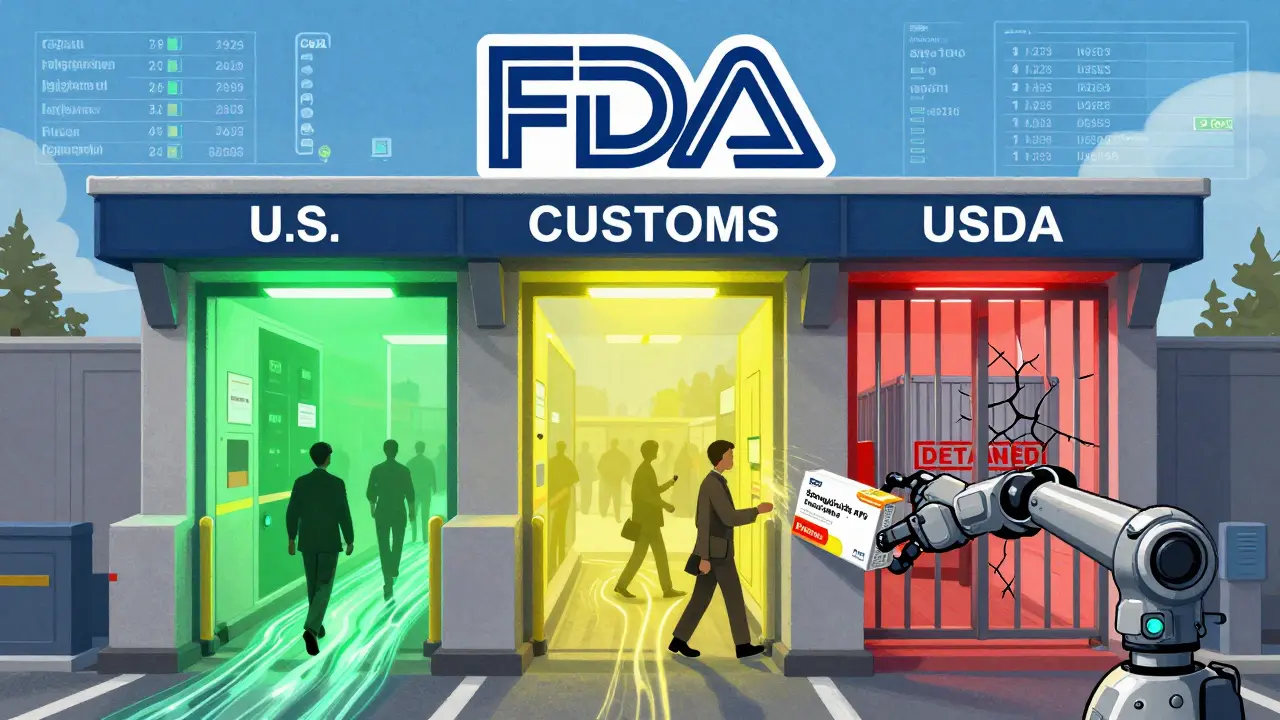
The U.S. Food and Drug Administration (FDA) doesn’t wait for a single bad batch of medicine to hit pharmacy shelves before acting. Instead, it uses a powerful, automated system called Import Alerts to stop entire shipments from manufacturers with a history of violations. This isn’t a slow, paperwork-heavy process-it’s a real-time enforcement tool that blocks drugs at the border before they even get near consumers. Since September 2025, this system has been sharpened dramatically with the launch of Import Alert 66-80, targeting active pharmaceutical ingredients (APIs) for weight-loss drugs like semaglutide and tirzepatide. If your facility isn’t on the Green List, your shipment gets automatically detained. No inspection. No warning. Just stopped.
How Import Alerts Work: The Green, Yellow, and Red System
The FDA’s Import Alert system runs on a color-coded tier structure. It’s simple: Green means you’re cleared. Yellow means you’re under watch. Red means you’re blocked. There’s no gray area. Manufacturers on the Green List-those with proven, documented compliance-see nearly 99.2% of their shipments pass through U.S. customs without delay. Those not on the list? Around 98.7% of their shipments get refused on the spot. This isn’t random. The FDA’s PREDICT algorithm, which powers this system, scans over 150 data points: past inspection results, refusal rates, facility history, even the track record of the importer. If a manufacturer has had three failed inspections in the last year, or if their Certificates of Analysis (CoA) keep being flagged as fake, PREDICT flags them. The system then auto-detects future shipments from that source and holds them under Detention Without Physical Examination (DWPE). That means customs agents don’t even open the box-they just reject it based on the data. The Green List was introduced in September 2025 specifically to cut through the chaos of the GLP-1 drug boom. With demand for semaglutide and tirzepatide skyrocketing, unapproved versions flooded the market. Many came from facilities with no real quality control. The FDA’s response? Not just to warn-but to shut the door. Now, if you’re not on the Green List, your shipment gets held at any of the 328 U.S. ports of entry.What Gets You on the Red List
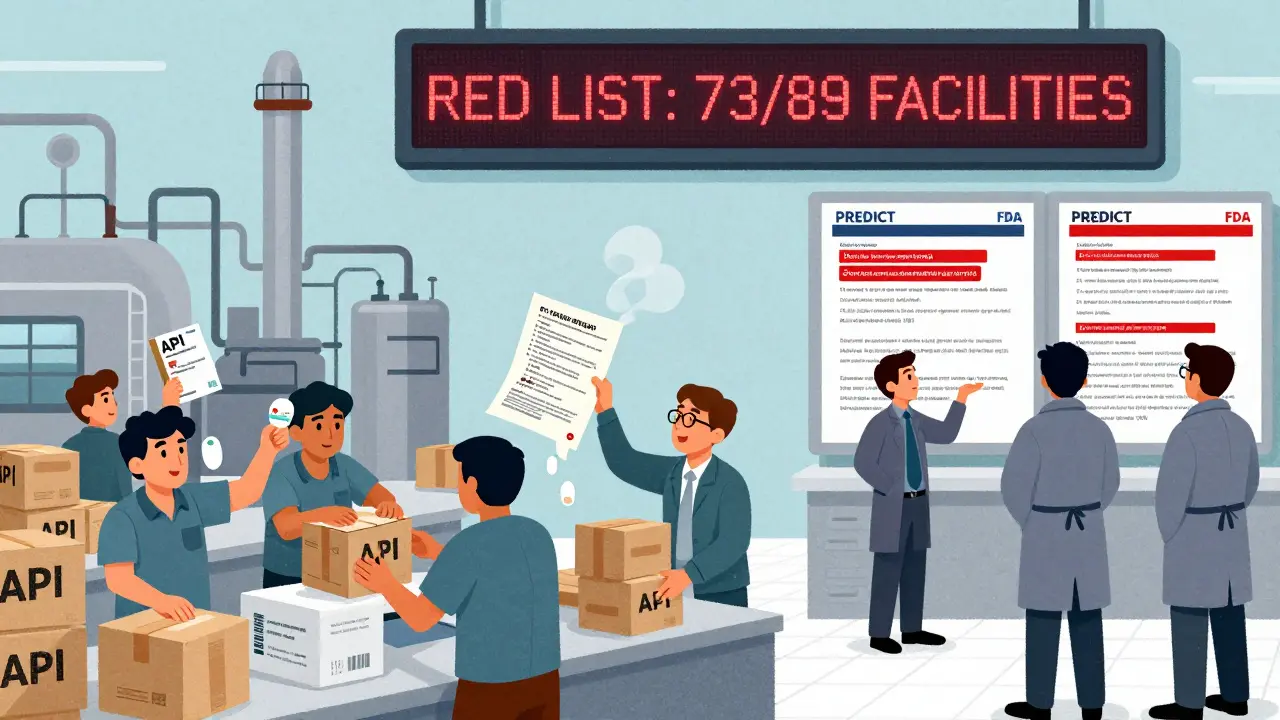
Being placed on the Red List isn’t about one mistake. It’s about patterns. The FDA looks for:- Repeated failures in facility inspections
- False or incomplete Certificates of Analysis
- Missing or falsified batch records
- Raw material traceability gaps
- Failure to correct violations after a warning letter
Why the Green List Is the Only Path Forward
Getting on the Green List isn’t easy. It requires:- A full FDA inspection of your facility (minimum 5 days)
- A root cause analysis with a detailed Corrective and Preventive Action (CAPA) plan
- Three consecutive shipments that pass inspection without issue
- Executive certification that your quality system is fully compliant
- Third-party audits from FDA-recognized auditors (cost: $45,000-$68,000)
- Stability testing across three temperature zones (2-8°C, 25°C/60% RH, 40°C/75% RH)
- Blockchain traceability systems to track each batch from raw material to finished product
Who’s Being Hit the Hardest
The impact isn’t evenly distributed. Indian manufacturers are bearing the brunt. Of the 89 facilities affected by the GLP-1 import alert, 82% are in India. The Indian Pharmaceutical Alliance estimates 28,500 jobs are at risk. Meanwhile, Chinese manufacturers, who had been quietly filling the gap, now face new rules too. Starting January 1, 2026, China’s NMPA will require all API exporters to meet FDA-equivalent certification standards just to ship to the U.S. In Europe, the EMA still relies on random physical inspections of 10-15% of high-risk shipments. The FDA’s DWPE system cuts inspection time by 78%. But it’s not perfect. A November 2025 study found the FDA’s system has a 17% false positive rate-meaning some clean shipments get caught in the net because of paperwork errors. That’s why the FDA quietly added a new expedited Green List pathway in November 2025: if you use an FDA-recognized auditor, your application can be approved in 45 days instead of 90.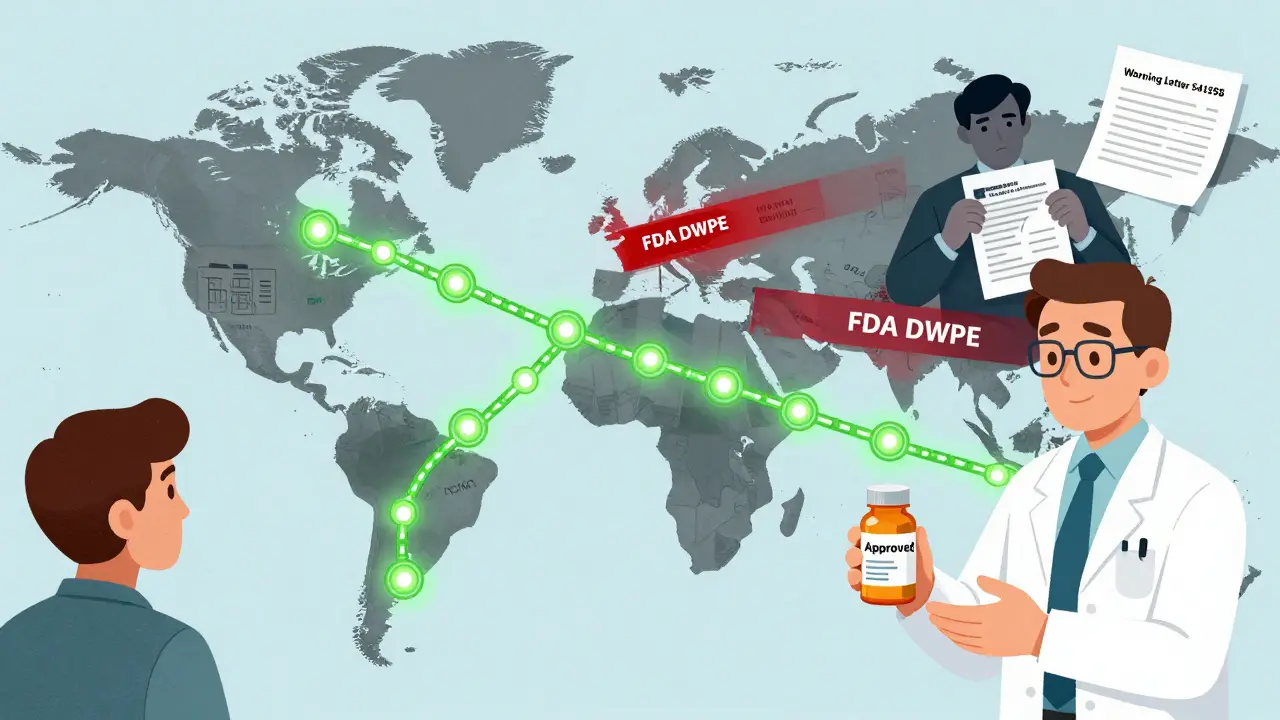
What Happens When You Can’t Get On the List
Some companies are cutting corners. ProPublica’s investigation found that since 2013, 157 products received enforcement discretion exemptions-even from facilities with repeated violations. Mylan/Viatris’ endoscopy equipment was exempted 14 times. Shilpa Medicare’s diabetes meds got seven exemptions in 2024 alone. That’s not fairness-it’s inconsistency. And it’s creating a black market. According to a Regulatory Focus interview, some firms are now paying brokers to falsify export documents so they can ship to third countries and relabel the drugs as “overseas formulations.” The FDA issued Warning Letter 541598 in October 2025 to a Singapore-based intermediary caught doing exactly that. The result? U.S. pharmacies are seeing 14.3% price hikes on compounded GLP-1 formulations. Patients are paying more. And the supply chain is tightening around just a few compliant manufacturers.The Future: It’s Getting Bigger
The GLP-1 alert was just the start. In November 2025, FDA Commissioner Dr. Robert Califf announced the system will expand to all high-risk biologics starting in Q1 2026-beginning with monoclonal antibodies. That means drugs for cancer, autoimmune diseases, and rare conditions will soon face the same scrutiny. By 2027, McKinsey predicts 65-75% of global API manufacturers will need to spend $500,000 to $2 million upgrading their compliance systems to stay in the U.S. market. The days of shipping APIs with a PDF and a prayer are over. The new standard is transparency: real-time data, blockchain traceability, verified audits, and full facility accountability. If you’re a manufacturer, your choice is clear: invest in compliance or lose access to the world’s largest pharmaceutical market. If you’re a pharmacy, hospital, or patient-this system is designed to keep unsafe drugs out. It’s not perfect. But right now, it’s the only thing standing between you and a batch of medicine that could be contaminated, underdosed, or worse.What is an Import Alert?
An Import Alert is a formal notice issued by the FDA that authorizes U.S. customs officials to automatically detain shipments from manufacturers with a history of violations. These alerts are based on patterns of non-compliance, not single incidents. Once issued, shipments from flagged sources are held without physical inspection-known as Detention Without Physical Examination (DWPE).
What’s the difference between the Green, Yellow, and Red Lists?
The Green List includes manufacturers with verified compliance who are exempt from automatic detention. Yellow List means the facility has recent violations but is under review; shipments may be inspected. Red List means the facility has repeated, serious violations and all shipments are automatically detained. Only Green List manufacturers enjoy near-100% clearance rates.
How can a manufacturer get on the Green List?
To get on the Green List, a manufacturer must undergo a full FDA inspection, submit a detailed Corrective and Preventive Action (CAPA) plan, prove three consecutive compliant shipments, and receive executive certification of compliance. They must also use FDA-recognized third-party auditors and provide full supply chain traceability, including raw material sources.
What happens if a shipment is refused?
Refused shipments must be exported from the U.S. or destroyed within 90 days under FDA and Customs and Border Protection (CBP) supervision. Failure to comply can lead to liquidated damages up to three times the commercial value of the goods. For a $900,000 shipment, that could mean penalties exceeding $2.7 million.
Are there exemptions to Import Alerts?
Yes, but they’re rare and controversial. Since 2013, the FDA has granted 157 enforcement discretion exemptions-some to facilities with ongoing violations. Examples include Mylan/Viatris’ endoscopy equipment and Shilpa Medicare’s diabetes products. These exemptions raise concerns about fairness and enforcement consistency.
Will other countries adopt similar systems?
Yes. The European Medicines Agency (EMA) announced in November 2025 that it will adopt similar API screening protocols by Q2 2026. China’s NMPA will require FDA-equivalent certifications for all API exporters starting January 1, 2026. This signals a global shift toward stricter, data-driven import controls.
tatiana verdesoto
March 3, 2026 AT 06:52Just read this and felt my shoulders drop. I work in a small pharmacy that sources generics, and I’ve seen how much stress these delays cause on the ground. Nurses calling, patients panicking because their refill got stuck at customs-it’s not just policy, it’s human. I’m glad the FDA’s stepping up, even if it’s messy. We need this kind of rigor.
Also, shoutout to the teams doing the audits and paperwork. Those folks are the real unsung heroes.
Darren Torpey
March 4, 2026 AT 01:05Bro, this is like watching a superhero movie where the villain is a PDF with a fake CoA. The FDA didn’t just upgrade their system-they dropped a whole damn exosuit on the global pharma scene. Green List? More like the VIP lounge of compliance. Red List? That’s the dungeon where your $900k shipment goes to die with a side of liquidated damages. I’m low-key impressed.
Also, blockchain traceability? Yes. Please. I want to know where my semaglutide was born, baptized, and certified by a guy in a lab coat with a clipboard.
Lebogang kekana
March 4, 2026 AT 06:55Let me tell you something-this isn’t regulation, this is WAR. And the battlefield? A shipping container in Chennai with 500kg of API that smells like hope and expired ethanol. India’s been the backbone of global generics for decades, and now they’re being treated like a suspect in a heist they didn’t commit. I get safety, but this feels like a chokehold wrapped in a PowerPoint.
82% of facilities hit? That’s not enforcement. That’s a cultural purge. And don’t get me started on the $68k audits-this isn’t leveling up, it’s a pay-to-play system where only the rich get to live.
Jessica Chaloux
March 4, 2026 AT 17:56Ugh. 😩 I just spent 3 hours on the phone with a wholesaler who said my insulin shipment is ‘under review.’ I’m not mad, I’m just… emotionally drained. Why does this feel like dating someone who ghosted you but left a 12-page PDF explaining why? 💔
Also, if I have to hear ‘blockchain traceability’ one more time, I’m moving to a cabin in Maine and growing my own herbs. 🌿
Mariah Carle
March 4, 2026 AT 23:20There’s a metaphysical truth here: compliance is the new spirituality. We used to worship efficiency, now we bow before the altar of documentation. The Green List isn’t a registry-it’s a sacrament. To be on it is to be purified. To be on the Red List is to be exiled from the temple of modern medicine.
And yet, the real miracle? That any of it works at all. In a world of counterfeit vitamins sold on Instagram, maybe this is the only prayer left.
Justin Rodriguez
March 5, 2026 AT 13:42Just wanted to add a practical note: the 17% false positive rate isn’t just a number-it’s real companies losing months and millions because someone mislabeled a batch number. The system’s good, but it’s brittle. The expedited pathway (45 days) is a start, but we need automated document validation. AI that checks CoA format against FDA templates? That’s the next step. Not more audits. More machines.
Also, if your auditor isn’t FDA-recognized, you’re already behind. No amount of ISO 9001 fixes that.
Raman Kapri
March 5, 2026 AT 14:47Let’s be honest-this is economic colonialism disguised as public health. The FDA, with its $4 billion budget and 18,000 staff, has decided that only American-approved standards matter. Meanwhile, Indian manufacturers produce 40% of the world’s generic drugs at 1/10th the cost. Now you want them to spend $2 million on blockchain just to ship a vial of metformin?
Who benefits? Not patients. Not even American pharmacies. Big pharma in the U.S. does. This isn’t safety. It’s market control.
Tildi Fletes
March 7, 2026 AT 05:11Regulatory compliance is not a suggestion. It is the foundational architecture upon which public health trust is built. The FDA’s enforcement mechanisms, while seemingly draconian, are demonstrably aligned with the statutory mandate under the Federal Food, Drug, and Cosmetic Act, Section 801. The data presented-98.7% refusal rate for non-listed manufacturers-is not an anomaly; it is a statistically validated outcome of systemic non-conformance.
Furthermore, the assertion that ‘international certifications don’t cut it’ is empirically accurate. ISO 9001, while globally recognized, does not encompass GMP requirements for pharmaceutical manufacturing. The burden of proof lies with the applicant. There is no ambiguity in this framework. The system is not broken. It is functioning as designed.
Siri Elena
March 8, 2026 AT 16:35Oh sweet summer child. You think the FDA is protecting you? 😏 Honey, they’re protecting Pfizer’s stock price. The Green List? A velvet rope at a club where only the rich get in. Meanwhile, patients are paying 14% more for their weight-loss meds because ‘infrastructure’ is now a buzzword instead of a solution.
And blockchain? For a pill? 🤡 Next they’ll require a QR code on Tylenol that plays a lullaby when scanned. I miss the days when ‘FDA approved’ meant ‘not poison.’ Now it means ‘you paid extra for paperwork.’
Levi Viloria
March 9, 2026 AT 05:26As someone who’s worked in pharma logistics across three continents, I’ve seen how this plays out on the ground. The real story isn’t just the Green List-it’s the quiet shift in global supply chains. Chinese manufacturers? They’ve been quietly upgrading for years. Now they’re shipping with full FDA documentation. Indian factories? Many are crumbling under the cost. But here’s the twist: African and Southeast Asian manufacturers are stepping in. Not with cheap APIs-but with lean, digital-first compliance.
This isn’t the end of globalization. It’s the birth of a new kind of global standard. One that’s data-driven, not geography-driven. And honestly? It’s kind of beautiful.