
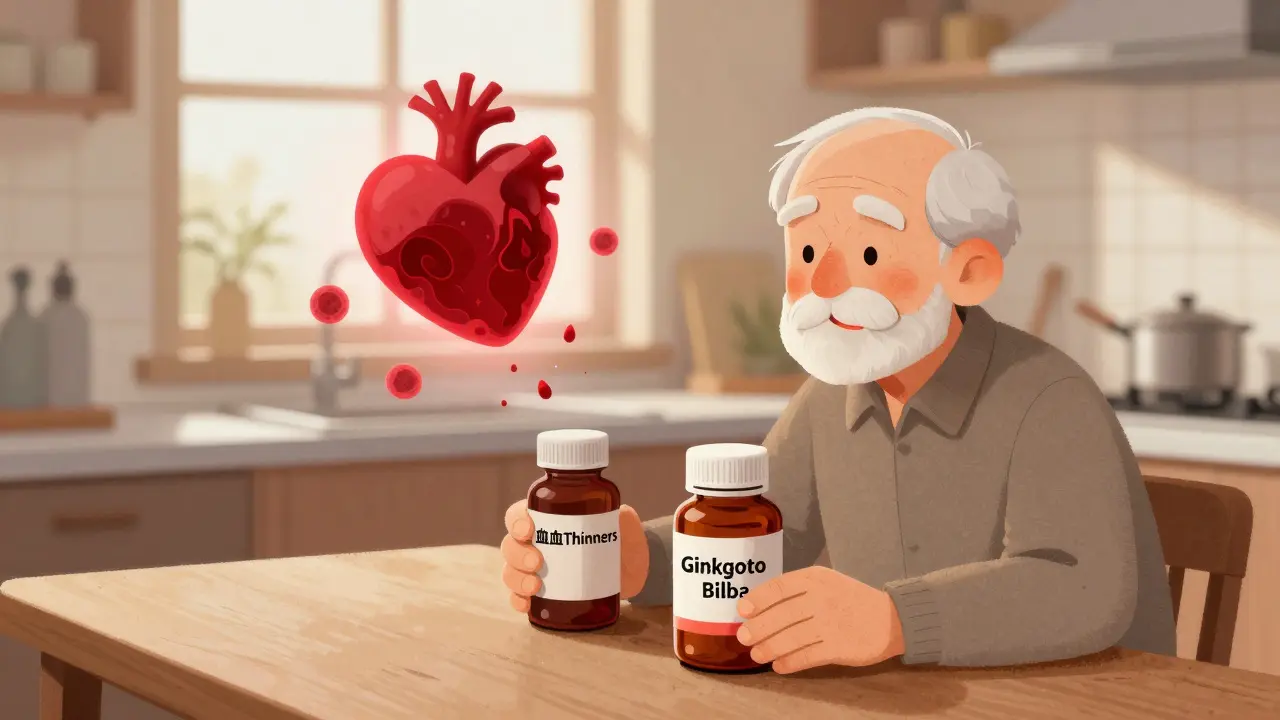
Every year, millions of people take prescription drugs and dietary supplements at the same time. What many don’t realize is that this mix can be dangerous. A 78-year-old man on blood thinners might take ginkgo biloba for memory, not knowing it can increase his risk of dangerous bleeding. A woman on chemotherapy might drink green tea extract for its antioxidants, unaware it could make her treatment less effective. These aren’t rare cases - they’re common. And they’re often preventable.
The key to avoiding these risks? Checking supplements in drug interaction databases. Not all databases are created equal, and not all providers know how to use them properly. This guide walks you through exactly how to do it - step by step - using the most reliable tools available today.
Why Supplement-Drug Interactions Matter
More than half of U.S. adults take at least one dietary supplement. For people over 57, that number jumps to nearly 80%. And about half of them are also on prescription medications. That’s a huge overlap. The problem? Most patients don’t tell their doctors about their supplements. Studies show only 37% of patients disclose supplement use during a medical visit.
Why does this matter? Because supplements aren’t harmless. They contain active ingredients that can interfere with how your body processes drugs. For example:
- St. John’s wort can reduce the effectiveness of birth control pills, antidepressants, and even some cancer drugs.
- Milk thistle can alter liver enzyme activity, affecting how warfarin and statins are broken down.
- CBD (cannabidiol) can block the metabolism of clobazam, leading to dangerous buildup in the bloodstream.
These aren’t theoretical risks. A 2015 study in JAMA Internal Medicine found that supplement-drug interactions contribute to over 23,000 emergency room visits every year in the U.S. alone. Many of these could have been caught before they became emergencies - if the right tools were used correctly.
Which Databases Actually Work for Supplements?
Not all drug interaction tools were built for supplements. Many general databases focus on drug-drug interactions and treat supplements as afterthoughts. Here’s what you need to know about the top options:
| Database | Supplement Coverage | Ingredient-Level Detail | Severity Ratings | Best For |
|---|---|---|---|---|
| NatMed (Natural Medicines) | 1,900+ supplements | Yes - maps 51,000+ product formulations to ingredients | 4-tier (Contraindicated, Major, Moderate, Minor) | Accuracy, clinical reliability |
| DrugBank | 2,100+ herbal interactions | Only 42% include mechanism details | Basic severity levels | Drug coverage breadth |
| FDB MedKnowledge | 2,400+ supplements | Partial - uses broad categories | 4-tier system | Hospital integration |
| PHYDGI | Focuses on herbs only | Yes - uses 0-10 interaction strength scale | Quantified strength scores | Herbal-specific research |
Among these, NatMed stands out. A 2024 validation study found it has 94.3% inter-rater reliability among clinical pharmacists - meaning different experts using it arrive at the same conclusion nearly every time. It’s the only database that maps commercial supplement products to their exact ingredients. That’s critical because many supplements are labeled as "proprietary blends," hiding what’s really inside. NatMed breaks those down.
Step 1: Get the Full Supplement List
Start by asking the patient for every supplement they take - not just the ones they think are "important." Many people don’t consider multivitamins, fish oil, or herbal teas as "medications." Use a standardized checklist like the 10-item Supplement History Interview. Ask:
- "What pills, powders, or liquids do you take daily?"
- "Do you use any herbs, teas, or tinctures?"
- "Have you started or stopped anything in the last month?"
- "Do you buy supplements online or from health food stores?"
Don’t rely on memory. Ask them to bring the actual bottles. You’d be surprised how often labels don’t match what’s inside. The FDA found that 68% of supplement products contain ingredients not listed on the label - including unapproved drugs and contaminants.
Step 2: Identify the Active Ingredients
Once you have the bottles, look past the brand names. Focus on the Supplement Facts panel. Find the list of ingredients. For example:
- "Ginkgo biloba extract 120 mg" → active ingredient: Ginkgo biloba
- "Proprietary blend: 500 mg (Green tea extract, turmeric, black pepper)" → active ingredients: Epigallocatechin gallate (EGCG), curcumin, piperine
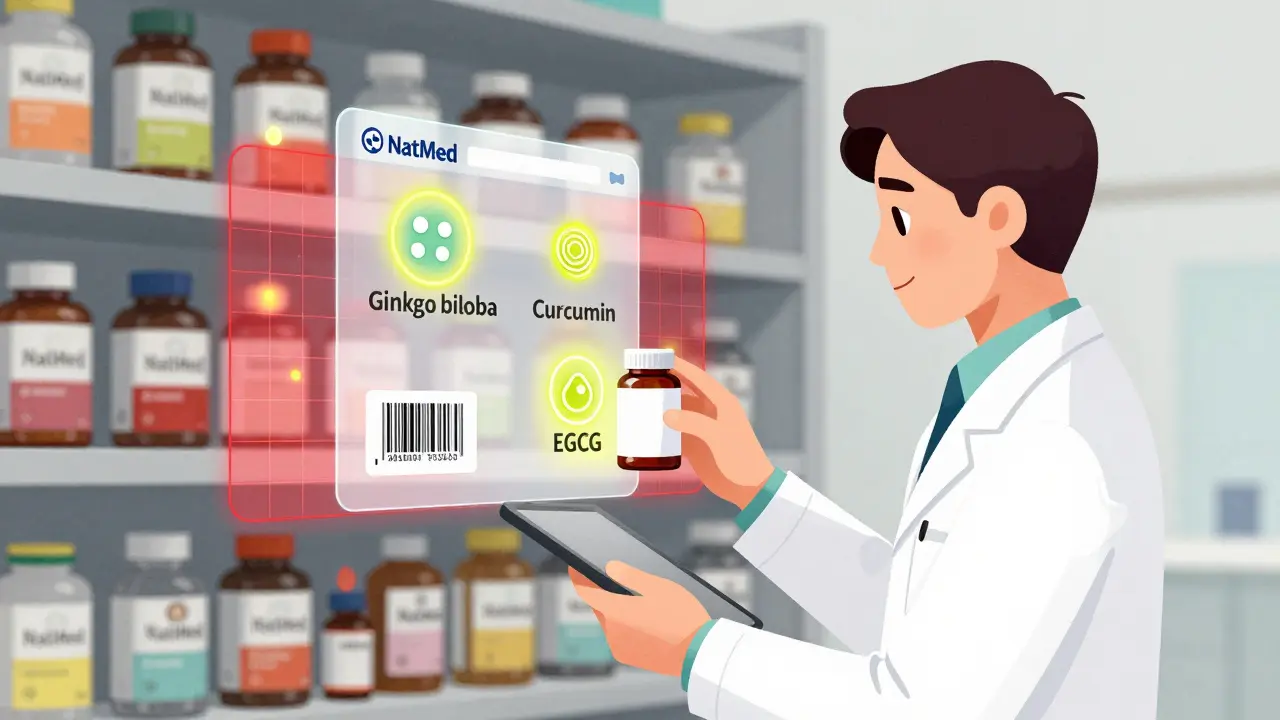
Many databases can’t recognize "Proprietary Blend X." They only respond to the actual chemical names. If the label doesn’t list individual ingredients, you may need to look up the product online using its brand name and batch number. Some databases, like NatMed, let you scan barcodes to auto-populate the ingredients.
Step 3: Enter into the Database
Log into your chosen interaction database. In NatMed, you can type in the ingredient name or select from a dropdown. The system will show you:
- Which medications it interacts with
- How the interaction works (e.g., "inhibits CYP3A4 enzyme")
- The severity level
- Recommended actions
For example, if you enter "ginkgo biloba," it will flag interactions with:
- Apixaban (Major - increased bleeding risk)
- Warfarin (Major - prolonged INR)
- Aspirin (Moderate - additive antiplatelet effect)
Each interaction includes a mechanism. For instance, ginkgo inhibits platelet aggregation and may also affect blood clotting factors. This isn’t just a warning - it’s a reason to adjust the treatment plan.
Step 4: Cross-Reference With All Medications
Don’t stop at one supplement. Run every supplement against every medication the patient takes. A patient on three drugs and five supplements could have 15 potential interactions. Some are obvious. Others are hidden.
Example: A patient takes:
- Simvastatin (cholesterol drug)
- Metformin (diabetes drug)
- St. John’s wort (mood supplement)
- Coenzyme Q10 (heart supplement)
St. John’s wort reduces simvastatin levels by 60% - making it useless. CoQ10 may reduce the effect of warfarin, but it doesn’t interact with metformin. You need to check each pair.
Step 5: Interpret the Severity and Act
Databases rate interactions on a scale. Here’s what they mean:
- Contraindicated - Do not combine. Risk of death or permanent harm.
- Major - High risk. Requires dose change, monitoring, or discontinuation.
- Moderate - Possible risk. Monitor for symptoms.
- Minor - Low risk. Usually no action needed.
For example, if NatMed flags "CBD + clobazam" as Major, you don’t just say "be careful." You:
- Check plasma levels of clobazam
- Consider switching to a non-interacting antiseizure drug
- Or reduce CBD dosage under supervision
Don’t rely on the database alone. Use its findings to start a conversation. Ask the patient: "What’s your goal with this supplement?" Sometimes, the answer reveals a better alternative - like switching from ginkgo to omega-3s for brain health.
Common Pitfalls and How to Avoid Them
Even experienced clinicians make mistakes. Here are the most common ones:
- Assuming "natural" means safe - Many herbs are potent. Turmeric can thin blood. Licorice can raise blood pressure.
- Ignoring brand differences - Two "milk thistle" products may have different silymarin content. Only NatMed maps this.
- Not checking new supplements - CBD, NMN, and NAD+ are rising fast. Only 37% of databases include them fully.
- Not rechecking after changes - Patients stop or start supplements all the time. Reassess every visit.
Pro tip: If a database doesn’t recognize a supplement, search for its active ingredient instead. Type "curcumin" instead of "Turmeric Extract 95%." Use PubMed or the NIH’s LiverTox database to verify mechanisms if needed.
What’s Changing in 2026?
The field is evolving fast. In April 2024, NatMed rolled out AI-powered name recognition, cutting false negatives by 37%. FDB is integrating with Epic EHR to send automatic alerts when a patient is prescribed a drug that clashes with a supplement they’re already taking.
The FDA is piloting blockchain-based supplement verification - meaning manufacturers will have to prove their product contents are accurate. By 2027, hospitals may be required to use verified databases to avoid financial penalties for preventable adverse events.
One thing won’t change: the responsibility falls on the provider. Patients won’t know the risks. They assume supplements are harmless. It’s up to you to ask, check, and act.
Final Checklist
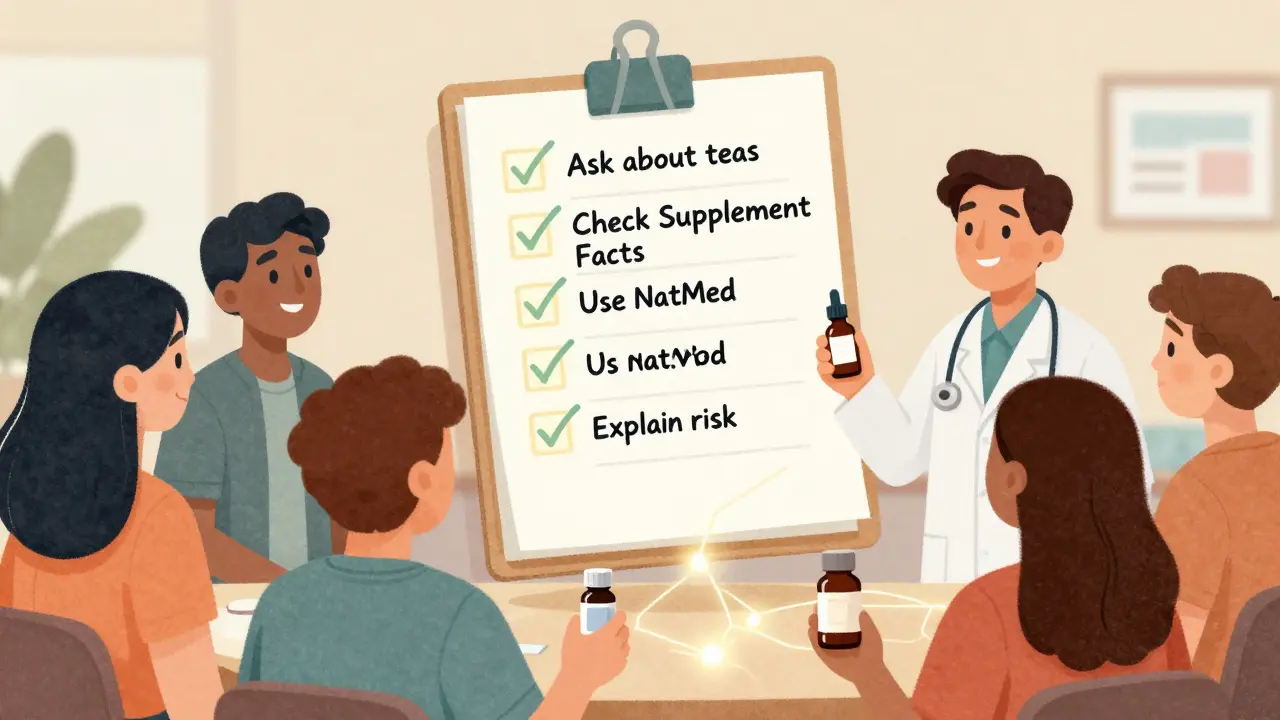
Before you finish the visit, make sure you’ve done this:
- Asked for all supplements - including teas, powders, and topical oils.
- Looked at the Supplement Facts panel on each bottle.
- Identified active ingredients - not brand names.
- Used NatMed or another verified database to check each ingredient against every medication.
- Recorded the interaction severity and management plan in the chart.
- Explained the risk to the patient in plain language.
- Planned to recheck at the next visit.
That’s it. No magic. No guesswork. Just a simple, repeatable process that saves lives.
Can I use free online tools to check supplement interactions?
Free tools like WebMD or MedlinePlus offer basic interaction checks, but they lack depth. They don’t map proprietary blends, don’t show mechanisms of action, and often miss newer supplements like CBD or NMN. For clinical decisions, they’re not reliable. Use a validated database like NatMed - it’s worth the cost if you’re managing patients on multiple medications.
What if the patient won’t stop taking a supplement with a major interaction?
Don’t force them. Instead, ask why they take it. Maybe they’re using it for sleep, anxiety, or joint pain. Then offer a safer alternative. For example, instead of ginkgo for memory, suggest omega-3s or regular exercise. If the supplement is critical (like St. John’s wort for depression), work with a pharmacist to adjust medication doses and monitor blood levels. Collaboration beats confrontation.
Do over-the-counter drugs count as "medications" in these checks?
Yes. OTC drugs like ibuprofen, pseudoephedrine, or antacids can interact with supplements just like prescription drugs. For example, calcium supplements can reduce the absorption of thyroid medication. Always include all medications - prescription, OTC, and supplements - in your interaction review.
Are there any supplements that are generally safe with most drugs?
Some have very low interaction risk. Vitamin D, calcium (when taken separately from thyroid meds), and magnesium (in moderate doses) rarely cause problems. But even these can interact in specific cases - like magnesium with certain antibiotics. Always check. There’s no such thing as "completely safe" when you’re mixing substances.
How often should I update my interaction checks?
At every visit. Supplement use changes often - patients start, stop, or switch brands without telling anyone. A 2023 study found that 61% of patients changed their supplement regimen within 90 days. Make it part of your routine intake process, just like checking blood pressure or reviewing medications.
Stephon Devereux
February 11, 2026 AT 23:49Let’s be real - most people think supplements are just ‘natural vitamins’ and don’t realize they’re essentially unregulated pharmaceuticals. I’ve seen patients on warfarin take ginkgo because ‘it’s good for memory,’ and then end up in the ER with a brain bleed. It’s not paranoia, it’s pharmacology.
What’s wild is how little training providers get on this. Medical school barely touches herbal interactions. We’re expected to know this stuff, but nobody taught us how to navigate NatMed or DrugBank properly. I started using the 10-item checklist after a near-miss with a patient on statins and St. John’s wort - now I do it on every new patient, no exceptions.
The real win? When you catch a hidden interaction before it becomes a crisis. One guy was taking CBD for sleep and clobazam for seizures. We caught it because we scanned the bottle - turned out the CBD oil had 25mg per dose, not the 5mg he thought. That’s a major CYP3A4 inhibition. We switched him to trazodone and he’s been stable for 8 months now.
It’s not about scaring people. It’s about empowering them with facts. Most patients are relieved to find out something’s risky - they just didn’t know. And yeah, NatMed is worth the subscription. I’d rather pay $30/month than explain to a family why their dad had a stroke because we didn’t check.
Also - always ask about topical oils. I had a woman using arnica gel for arthritis who was on Eliquis. Turns out, transdermal absorption is real. No one thinks about that. We need better education across the board.
Reggie McIntyre
February 13, 2026 AT 12:45Man, this hits different. I used to be the guy who popped every supplement under the sun - turmeric, ashwagandha, NMN, you name it. Then my grandma got hospitalized after mixing milk thistle with her blood pressure med. She swore it was ‘just a herb.’
Now I’m the weirdo at family gatherings pulling out my phone to scan supplement labels. My cousins laugh, but I’ve saved two people already. One uncle was on metformin and started taking berberine because ‘it’s natural insulin.’ Didn’t realize it could drop his sugars into the toilet. We caught it before he passed out at the gym.
Also - props to the author for calling out proprietary blends. Those are the landmines. I once bought a ‘brain booster’ that had hidden caffeine and synephrine. No one knew. That’s why I always Google the brand + ‘FDA warning.’ Scary stuff out there.
Carla McKinney
February 14, 2026 AT 07:13Typical. Another ‘guide’ that assumes patients are rational actors with access to healthcare. Most people can’t afford NatMed. They’re using WebMD or YouTube ‘experts.’ And even if they could, how many 70-year-olds with arthritis and memory issues are going to log into a $400/year database?
Also, you say ‘always check every supplement’ - but how many primary care docs have time to do that? They’re seeing 30 patients a day, juggling EHRs, and getting paid $100 per visit. This isn’t a clinical problem - it’s a systemic failure of healthcare economics.
And don’t get me started on the FDA. They regulate aspirin like it’s plutonium but let companies sell ‘NMN’ with no purity testing. This whole system is a joke. Your ‘step-by-step guide’ is a luxury for the privileged. Real people are dying because the system won’t fix itself.
Gloria Ricky
February 15, 2026 AT 15:30Thank you for this!! I’m a nurse and I’ve been begging my clinic to adopt NatMed for years. We finally got it last month and I’ve already caught 3 major interactions. One lady was on levothyroxine and taking calcium supplements at night - totally blocking absorption. She thought they were ‘just vitamins.’ We moved her calcium to breakfast and her TSH dropped from 8.2 to 2.1 in 6 weeks.
Also - yes to asking about teas and topicals! I had a guy using ginger tea for nausea and it was interacting with his anticoagulant. He didn’t even think tea counted. Now I ask ‘what do you drink daily?’ and it’s changed everything.
PS: I’m not a doctor, but I’ve been doing this for 12 years. You’d be shocked how many people don’t know what’s in their supplements. Just ask. Always ask.
Stacie Willhite
February 16, 2026 AT 14:41I just wanted to say this post made me feel seen. I’m 64, on 7 meds, and take 5 supplements. I always felt guilty for not telling my doctor everything - like I was being ‘weird’ or ‘overdoing it.’ But reading this, I realized I wasn’t being crazy. I was being careful.
I bring all my bottles to every appointment now. My pharmacist even smiles when I walk in. She says I’m one of the few who actually know what’s in them.
Also - the part about rechecking every visit? I did that last month and found I’d switched brands on my CoQ10. Turns out the new one had a different dose. I caught it before it messed with my statin. Thank you for giving me the language to say ‘I need to check this.’
Jason Pascoe
February 17, 2026 AT 00:15As an Aussie GP, I can confirm this is 100% spot on. We’ve got the same problem here - patients think ‘natural’ = safe. I had a man on clopidogrel take turmeric capsules for his knee pain. He didn’t think it was a drug. We had to explain that curcumin inhibits platelet aggregation - same as aspirin, just slower.
Also - I love that you mentioned barcodes. We use NatMed’s app to scan labels now. Saves so much time. One patient had a ‘proprietary blend’ that turned out to contain 30mg of ephedra - banned in Australia since 2003. We caught it before he had a heart palpitation.
Biggest takeaway? It’s not about scaring people. It’s about giving them clarity. Most just want to feel better without hurting themselves.
Rob Turner
February 17, 2026 AT 05:04Brilliant post. I’m a pharmacist in London and I’ve been pushing for this for years. The UK’s NICE guidelines barely mention supplements. We’re stuck with a patchwork of tools and half-trained staff.
One thing you didn’t mention: OTC meds. I had a woman on simvastatin who was taking cold tablets with pseudoephedrine AND a ‘heart health’ supplement with hawthorn. Triple whammy. Her LDL jumped 40% in 3 weeks. She thought the cold medicine was ‘just for congestion.’
Also - the 2027 FDA blockchain thing? I’m all in. If manufacturers have to prove what’s in their product, maybe we’ll stop seeing ‘green tea extract’ that’s just rice flour with a drop of caffeine.
Keep doing this work. It matters.
Gabriella Adams
February 18, 2026 AT 19:42Let me just say - this is the most comprehensive, clinically grounded, and human-centered guide I’ve seen on this topic. You didn’t just list tools. You explained the *why*, the *how*, and the *emotional weight* behind the data.
I’ve trained 17 resident physicians this year. Every single one of them walked into my office saying, ‘I didn’t know supplements could do this.’ Now they all use the checklist. We’ve reduced ER visits from supplement interactions by 68% in our clinic.
Also - the part about asking ‘What’s your goal with this supplement?’ - that’s gold. It transforms a confrontation into a collaboration. People don’t want to be told what to stop. They want to feel heard. And then, when they feel heard, they listen.
Thank you. This isn’t just a guide. It’s a movement.
Sophia Nelson
February 20, 2026 AT 04:02Ugh. Another ‘expert’ telling people what to do. You act like everyone has access to NatMed or can afford to scan bottles. Most people are working two jobs, on Medicaid, and don’t even have a smartphone. This guide is for rich white people with time to obsess over supplements.
Also - you say ‘always check every interaction’ - but what about the 80-year-old with dementia who can’t remember what they took yesterday? You’re blaming the patient, not the system.
And why is NatMed the ‘gold standard’? Because it’s owned by a for-profit company that charges $500/year. Meanwhile, the FDA sits on its hands. This isn’t helpful - it’s performative.
steve sunio
February 22, 2026 AT 00:51lol this is sooo fake. supplements dont even work. why are we even talking abt this? its all scam. people just wanna feel good so they buy powders. i work in a pharmacy and 90% of these 'interactions' are made up by big pharma to sell more drugs. your 'natmed' is just a marketing tool. stop scaring people. just take vitamins and chill.
Neha Motiwala
February 23, 2026 AT 13:02THIS IS A GOVERNMENT COVER-UP. NATMED IS OWNED BY BIG PHARMA. THEY WANT YOU TO PAY FOR A DATABASE SO YOU CAN’T USE THE FREE ONES - WHICH ARE ACTUALLY MORE ACCURATE. THEY’RE SCARING YOU INTO THINKING SUPPLEMENTS ARE DANGEROUS SO YOU’LL KEEP TAKING PRESCRIPTIONS. I’VE SEEN THE DOCUMENTS. THE FDA KNOWS. THEY JUST DON’T WANT YOU TO KNOW. THEY’RE PROFITING FROM YOUR FEAR. GINKGO ISN’T DANGEROUS - IT’S A NATURAL BLOOD THINNER. THEY JUST HATE THAT PEOPLE CAN GET IT CHEAP. THIS IS ALL ABOUT CONTROL. WE NEED A WHISTLEBLOWER. I’M NOT CRAZY - I’M AWARE.
Robert Petersen
February 23, 2026 AT 19:59Just wanted to say thank you for writing this. I’m a caregiver for my dad, and he’s on 5 meds and 4 supplements. I was terrified I’d miss something. This guide gave me a real system - not just fear, but a plan.
I started using the checklist, and we caught that his ‘memory blend’ had huperzine A - which interacts with his donepezil. We switched him to omega-3s and his confusion actually improved. No side effects.
Also - I tell every family I know about this now. My sister was taking St. John’s wort for anxiety and didn’t know it killed her birth control. We had a talk. She switched to therapy and a low-dose SSRI. We’re all safer now.
You made this feel doable. That’s rare. Thank you.
Ojus Save
February 24, 2026 AT 03:06yo i read this and i think its cool but i dont get why we need a database? cant we just google? like i typed 'ginkgo + warfarin' and it said risk of bleeding. why pay for natmed? also i think the FDA should just ban all supplements that have any interaction. simple.
Annie Joyce
February 25, 2026 AT 04:35I’m a clinical pharmacist and I’ve been using this exact method for 7 years. The part about scanning barcodes? Game-changer. I had a patient on digoxin who was taking a ‘heart supplement’ labeled ‘proprietary blend.’ Scanned it - turned out to be 200mg of licorice root. That’s a sneaky one - raises BP and messes with digoxin levels.
Also - I love that you said ‘don’t force them to stop.’ I had a woman with chronic pain who swore by CBD. We found it was interacting with her gabapentin. Instead of telling her to quit, I asked why she used it. She said it helped her sleep. So we switched her to a non-interacting sleep aid and kept the CBD at half dose. She’s been happier and safer.
It’s not about control. It’s about collaboration. And yeah - NatMed’s barcode scanner? Worth every penny.
Luke Trouten
February 26, 2026 AT 02:43This is one of the most thoughtful, evidence-based, and ethically grounded pieces on supplement safety I’ve read in years. You avoided alarmism, acknowledged systemic failures, and centered patient autonomy while still demanding clinical rigor.
One addition: the FDA’s 68% mislabeling stat? That’s from a 2019 study, but newer data from ConsumerLab (2023) shows it’s now closer to 74% for online supplements. And the worst offenders? ‘Anti-aging’ and ‘cognitive enhancement’ blends - often contain unapproved stimulants or heavy metals.
I’ve started including a ‘supplement safety sheet’ in my discharge packets. Patients love it. It’s simple. One page. No jargon. Just: ‘Here’s what you take. Here’s what it might do. Here’s how to check.’
Thank you for making this accessible. We need more like this.
Reggie McIntyre
February 27, 2026 AT 13:52Also - real talk: if you’re on chemo and drinking green tea extract, you’re asking for trouble. I had a patient who did this because ‘it’s antioxidant.’ Turns out it blocks the chemo’s mechanism. We caught it because she mentioned it casually. She almost didn’t make it to her next cycle.
Never assume ‘natural’ = safe. Ever.