
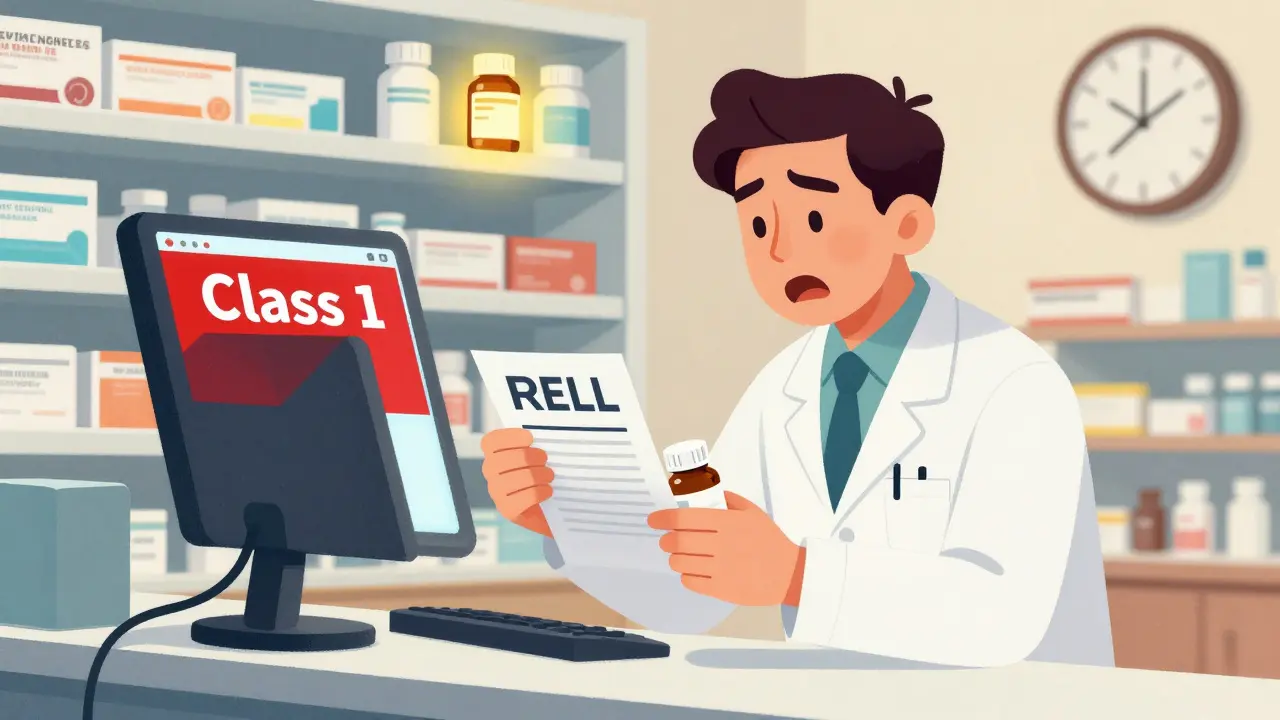
When a drug recall happens, your pharmacy’s response can mean the difference between a patient getting safe medication-or being exposed to something dangerous. It’s not just about removing a bottle from the shelf. It’s about acting fast, accurately, and with confidence. In Australia, the Therapeutic Goods Administration (TGA) follows similar protocols to the FDA, and pharmacies are legally required to respond to recalls within strict timeframes. But how do you actually check for these notifications? And more importantly, how do you make sure you don’t miss one?
Understand the Three Types of Drug Recalls
Not all recalls are the same. They’re grouped into three classes based on risk level, and your response time changes with each one.- Class I - The most serious. These involve products that could cause serious harm or death. Think contaminated antibiotics, pills with toxic levels of a chemical, or missing active ingredients. You have 24 hours to verify and remove these from inventory.
- Class II - These might cause temporary health problems or a low risk of serious harm. Maybe a label is wrong, or the pill strength is slightly off. You have 72 hours to respond.
- Class III - The least urgent. These are unlikely to cause harm but violate FDA or TGA labeling rules. Think incorrect packaging or missing inserts. You have up to 10 days to act.
Knowing the class tells you how fast you need to move. But how do you even find out about them?
Set Up Your Primary Notification Channels
Relying on one way to get recall alerts is like driving with only one tire. You need redundancy. The most reliable systems combine three methods:- Regulatory agency alerts - In Australia, subscribe to TGA notifications. In the U.S., register for FDA MedWatch email alerts (free, requires an account). These go out weekly and include all new recalls, but they’re not real-time.
- Wholesaler notifications - Your main distributor (like McKesson, Cardinal Health, or local Australian suppliers) sends direct alerts. Most offer email, fax, or portal access. These are faster than government alerts and often include batch-specific details.
- Integrated pharmacy management software - This is the game-changer. Systems like QS/1, PioneerRx, FrameworkLTC, or even Australian platforms like MedTech or PharmAssist automatically cross-reference incoming recall data with your inventory. They flag exact lot numbers, NDC codes, and even patient records if the drug was dispensed.
A 2023 study from the University of Melbourne found that pharmacies using all three methods reduced missed recalls by 94%. Those relying on just one - like email alone - had a 37% failure rate.
Verify the Recall with Exact Product Details
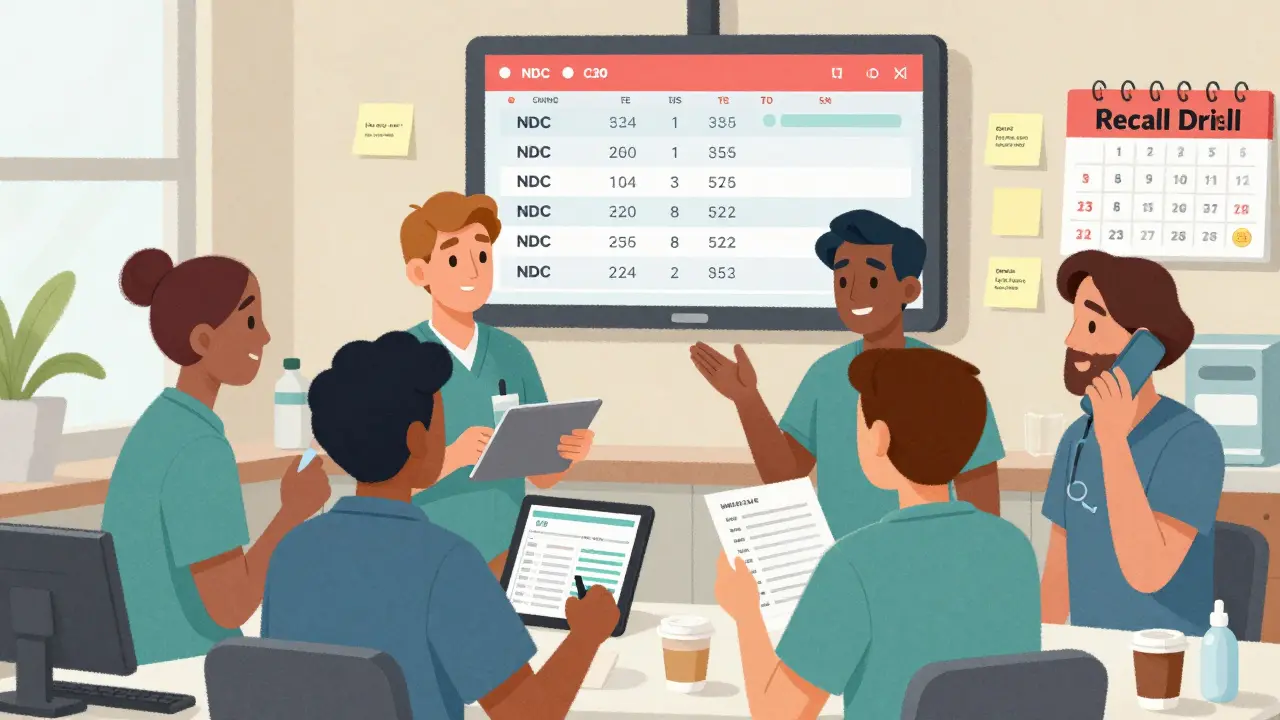
A recall notice says “Lisinopril 10mg.” But which batch? Which manufacturer? Which lot number? You need to match exactly.Every recall includes:
- National Drug Code (NDC) - A unique 11-digit identifier for each drug formulation.
- Lot number - The batch identifier printed on the packaging.
- Expiration date range - Some recalls only affect specific expiration batches.
Don’t guess. Pull up your inventory system and search for every bottle of that drug. Check the physical packaging. Compare the lot number to the recall notice. If they don’t match perfectly, it’s not affected. A 2022 audit at a Sydney pharmacy found that 43% of recalled items they pulled were false positives because they didn’t check the lot number.
Pro tip: Keep a printed copy of your current inventory’s NDC and lot numbers on file. When a recall comes in, you can cross-check faster.
Check Patient Records - Especially for Long-Term Medications
Here’s where most pharmacies fail. A recall isn’t just about what’s on the shelf. It’s about what’s in a patient’s medicine cabinet.If you dispensed a recalled drug in the last 30 days - especially for chronic conditions like blood pressure, diabetes, or epilepsy - you need to notify those patients. The TGA and FDA require this for Class I and Class II recalls. But here’s the catch: if a patient is on a medication synchronization program (getting 90-day supplies), you might have given them 3 months’ worth of the bad batch.
Use your pharmacy software to pull dispensing records for the affected NDC and lot number. Call or text patients. Don’t rely on mail. Email works, but phone calls are faster and more reliable. A 2023 report from the Australian Community Pharmacy Association showed that pharmacies that called patients directly had 89% compliance with return or replacement requests. Those that only mailed letters had 41%.
Document Everything - And Keep It for 3 Years
You can’t just act. You have to prove you acted.Every recall response must be documented. That includes:
- The date and time you received the notice
- How you verified the product (which inventory system, which lot numbers checked)
- Which products were removed from shelves
- Which patients were contacted
- Any follow-up actions taken
These records must be stored electronically for at least three years. The TGA and FDA can audit you at any time. If you can’t produce proof, you could face fines or lose your license. Most modern pharmacy systems auto-log this. If you’re still using paper logs, you’re at risk.
Train Your Team - And Test the System
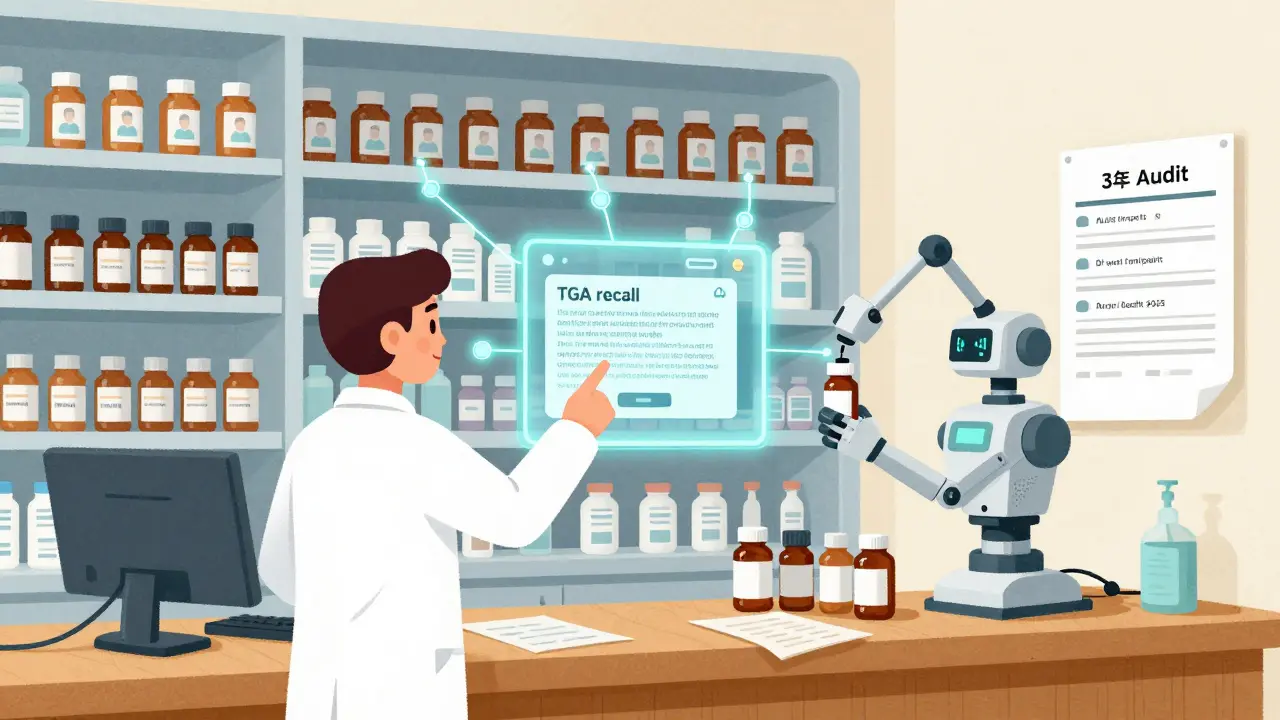
Recall response isn’t the job of one pharmacist. It’s a team effort. Your techs, assistants, and even front desk staff need to know what to do.Here’s a simple training routine:
- Quarterly drill: Simulate a Class I recall. See how long it takes to identify affected inventory.
- Assign roles: Who checks inventory? Who calls patients? Who files paperwork?
- Test your systems: Turn off email alerts for a week. See if your wholesaler alerts or software still catch a real recall.
A 2023 survey of 187 Australian pharmacies found that those with regular drills reduced response time by 62%. Those that never trained took over 8 hours to respond - way past the 24-hour limit.
Watch for the Big Changes Coming
The system is getting smarter. By 2025, the FDA and TGA will require:- All Class I recalls to include patient risk data - so you know exactly who’s at risk.
- Structured digital formats (like HL7 or XML) so software can auto-match recalls to inventory.
- Blockchain-based tracking pilots - meaning you’ll be able to trace a pill from manufacturer to patient.
These changes will cut manual work by 70%. But only pharmacies that upgrade their software will benefit. If your system can’t import digital recall feeds, you’re falling behind.
What to Do If You Miss a Recall
It happens. You’re busy. A notice slips through. Here’s what to do:- Stop dispensing the drug immediately.
- Call your wholesaler and the TGA/FDA to report the lapse.
- Check all inventory - even expired stock.
- Notify all patients who received the drug in the past 90 days.
- Document everything and review your notification system to prevent it again.
Transparency saves you. The regulators appreciate honesty. Hiding it doesn’t.
How often do pharmacy recalls happen?
On average, there are about 4,000 drug recalls each year in the U.S. and Australia combined. Most are Class II (67%), meaning they’re not life-threatening but still need action. Class I recalls - the urgent ones - happen about 150-200 times per year. Independent pharmacies typically get 2-5 relevant recalls per year, while hospital pharmacies may see 10-20.
Do I need to pay for recall notification services?
FDA and TGA alerts are free. Wholesaler notifications are usually free if you’re a contracted customer. But advanced pharmacy software with automated recall matching can cost $2,000-$5,000 per year. For small pharmacies, this is expensive. But if you only get 1-2 recalls a year, you can manage manually - as long as you use at least two notification channels.
Can I rely on my pharmacy tech to handle recalls?
Only if they’re trained. Techs can check inventory and print labels, but the pharmacist must verify and approve the recall response. The law holds the pharmacist responsible. Never delegate final decision-making.
What if a recall notice has a typo?
Always double-check. A single digit wrong in a lot number can lead to a false positive - or worse, a missed recall. Contact the wholesaler or regulatory agency to confirm the details. Never act on a notice that looks inconsistent.
Do I need to return recalled drugs to the wholesaler?
Usually, yes. Most wholesalers will arrange return shipping. Some will even send replacement stock. Never destroy recalled drugs yourself - they need to be tracked for regulatory purposes. Keep them locked in a separate area until the wholesaler collects them.
Shameer Ahammad
March 19, 2026 AT 07:30Let me be perfectly clear: relying on email alerts from the TGA or FDA is nothing short of professional negligence.
It’s not merely inadequate-it’s a systemic failure waiting to happen. I’ve seen pharmacies shut down over this. One misplaced lot number. One delayed verification. One untrained tech thinking ‘close enough’ is good enough.
And yet, here we are, still clinging to paper logs and manual cross-referencing like it’s 1998.
The software exists. The integration is seamless. The cost? A fraction of a single malpractice claim.
If you’re not using QS/1, PioneerRx, or MedTech with auto-flagging, you’re not a pharmacist-you’re a liability.
And don’t get me started on those who say, ‘I can handle it manually.’ You can’t. Not reliably. Not consistently. Not under pressure.
The 2023 Melbourne study didn’t just say 94% reduction-it said 94% of pharmacies that didn’t use integrated systems had at least one missed recall in the last year.
That’s not statistics. That’s a death sentence waiting to be delivered.
Train your staff? Of course. But don’t train them to compensate for your outdated tech. Train them to use the system that saves lives.
And if your wholesaler doesn’t send batch-specific alerts? Switch wholesalers. Immediately.
This isn’t opinion. It’s protocol. It’s regulation. It’s ethics.
And if you’re still reading this and thinking ‘I’ll look into it later’-you’ve already failed.
Go update your software. Now.
Robin Hall
March 19, 2026 AT 15:40Have you ever stopped to wonder who controls the recall data in the first place?
Big Pharma. The same corporations that lobbied against blockchain tracking for years.
Now they’re pushing ‘digital feeds’ and ‘structured XML’-but only after they’ve already shipped millions of doses with hidden flaws.
Think about it: if the system were truly transparent, why would we need pharmacies to cross-check lot numbers manually?
Why not have the manufacturer’s blockchain log auto-populate every pharmacy’s inventory in real time?
Because they don’t want you to know how often they mess up.
The TGA and FDA? They’re just the public-facing PR arm.
The real power lies with the distributors-McKesson, Cardinal-who have full access to every batch, every shipment, every expiration date.
And they’re not sharing it with you unless you pay for premium access.
This isn’t safety.
This is control.
And you’re being trained to believe you’re part of the solution.
You’re not.
You’re the last line of defense against a system designed to fail.
Michelle Jackson
March 20, 2026 AT 03:01So let me get this straight-we’re supposed to call every single patient who got a recalled drug, even if they’ve been on it for 3 years?
And if they’re on a 90-day sync, we gotta track them down?
Who has time for this?
I’ve got 12 patients waiting for their blood pressure med, 3 new scripts to fill, and my boss just asked if I can cover the weekend shift because ‘someone else called out.’
And now I’m supposed to be a detective, a nurse, a lawyer, and a telemarketer?
Yeah, I’ll get right on that.
Meanwhile, the guy who wrote this article probably doesn’t even work in a pharmacy.
He’s a consultant.
And he’s selling software.
Suchi G.
March 20, 2026 AT 07:06I just want to say how deeply emotional this entire system makes me feel.
Every time I think about a patient-maybe someone’s grandmother-getting a pill that’s been contaminated, I feel this physical ache in my chest.
And then I think about how many times we’ve almost missed something because the email got buried under 47 other newsletters.
Or because the tech thought ‘it looked fine’ and didn’t check the lot number.
Or because we didn’t have the budget for the fancy software.
And I wonder-how many people have we already hurt without knowing?
I’ve lost sleep over this.
I’ve cried after shifts.
I’ve stared at my inventory screen for 20 minutes, just hoping I didn’t miss something.
I’m not a robot.
I’m a person.
And this job? It’s not just about pills.
It’s about trust.
And right now, the system is breaking that trust.
And I’m tired.
I’m so, so tired.
becca roberts
March 20, 2026 AT 11:58Oh wow, a 70% reduction in manual work by 2025? How revolutionary.
Let me guess-the same ‘advanced’ software that costs $5K/year is going to magically fix everything?
Meanwhile, rural pharmacies in Nebraska and Tasmania are still using Excel sheets and fax machines.
And somehow, we’re supposed to believe this is ‘equitable’?
It’s not innovation.
It’s exclusion.
They’re building a system for big chains, not for the little guy.
And when the little guy fails? They’ll blame the pharmacist.
Not the FDA.
Not the wholesaler.
Not the $200M lobbying budget.
Us.
Again.
Andrew Muchmore
March 21, 2026 AT 14:58Use three channels. Verify lot numbers. Document everything. Train quarterly.
That’s it.
No fluff.
No jargon.
Just do the work.
If you can’t, get help.
If you won’t, get out.
Paul Ratliff
March 23, 2026 AT 07:43Class I = 24 hrs? Bro, I had one last month and we didn’t even know until day 3.
Turns out the email went to spam.
Wholesaler? Forgot to update our contact.
Software? Didn’t have the patch.
We got lucky.
Not everyone will.
Just saying.
SNEHA GUPTA
March 24, 2026 AT 09:01There’s a deeper philosophical question here: when does a system designed to protect life become a mechanism of control?
We are told to trust the TGA, the FDA, the wholesalers, the software vendors.
But who trusts them?
And who audits the auditors?
The reliance on documentation-three years of logs-is not just compliance.
It’s a performance of accountability.
A ritual.
Where the act of recording replaces the act of preventing.
We are not curing the system.
We are merely documenting its failures.
And in doing so, we are made complicit.
Is this safety?
Or is it the illusion of safety?
Perhaps the real recall isn’t of the drug.
But of our faith in the institutions that claim to protect us.
Gaurav Kumar
March 25, 2026 AT 14:26India has been doing this right for decades.
No fancy software. No $5K subscriptions.
Just trained staff. Strict protocols. And respect for the law.
Here in the West, you turn everything into a corporate circus.
‘Blockchain this.’ ‘XML that.’
Meanwhile, Indian pharmacies check lot numbers by hand-and they’ve had fewer recalls per capita than the U.S. for 15 years.
It’s not about tech.
It’s about discipline.
And you Americans? You’ve lost it.
Stop outsourcing responsibility to machines.
Train your people.
And stop whining.
David Robinson
March 26, 2026 AT 11:04So you say ‘document everything’?
Then why are audits so rare?
And why do pharmacies get fined only after someone dies?
This isn’t prevention.
This is damage control dressed up as protocol.
You’re not protecting patients.
You’re protecting yourselves.
From lawsuits.
From liability.
From the truth.
And the truth is: this system is broken.
And you’re just the ones cleaning up the mess.
Jeremy Van Veelen
March 27, 2026 AT 01:23Do you know what it feels like to hold a bottle of recalled medication in your hands?
To see the lot number.
To know that this exact pill-this one right here-could have killed someone?
It’s not a spreadsheet.
It’s not a checklist.
It’s a soul.
And every time you miss one, you’re not just failing a procedure.
You’re failing humanity.
I’ve done it.
Once.
And I’ve never forgiven myself.
So don’t give me your ‘best practices.’
Don’t give me your ‘cost-benefit analyses.’
Give me a system that doesn’t let this happen.
Because I’m done being the last line of defense.
I’m done being the one who has to cry after work.
I’m done.
Laura Gabel
March 28, 2026 AT 04:48Class III recalls? Missing inserts?
Who cares?
Let’s focus on the drugs that actually kill people.
Stop wasting time on paperwork.
Just fix the real problems.
jerome Reverdy
March 28, 2026 AT 08:11Look-I’ve been in this game for 22 years.
I’ve seen recalls come and go.
Some pharmacies panic.
Some ignore.
The ones that survive? They build culture.
Not software.
Not alerts.
Culture.
Where the tech says, ‘Hey, this lot’s flagged.’
And the pharmacist says, ‘Let me double-check.’
And the front desk says, ‘I’ll call the patient.’
And no one gets blamed when they mess up.
They get helped.
That’s the difference.
Systems fail.
People don’t.
Unless you treat them like machines.
Which you are.