
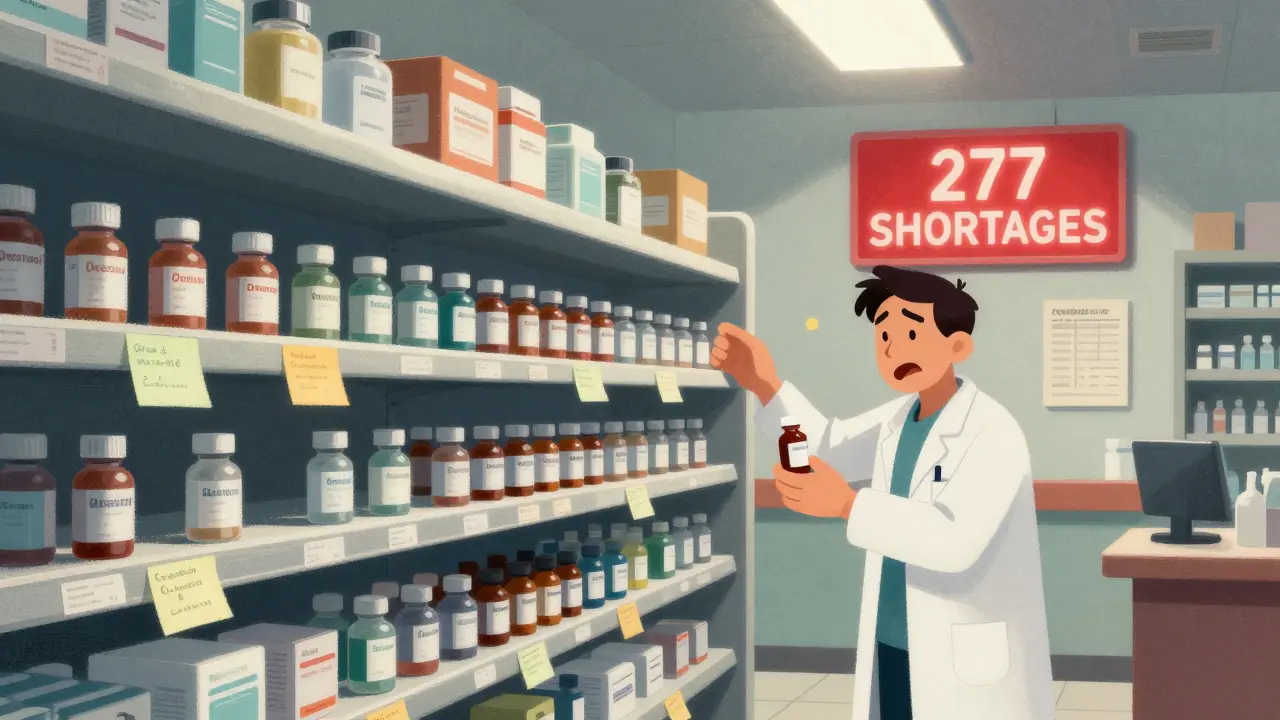
By the end of 2024, more than 277 drugs remained in short supply across the U.S., according to Global Biodefense. That’s not a glitch-it’s a pattern. Hospitals are rationing life-saving antibiotics. Oncologists are delaying chemotherapy because the vials won’t arrive. Pharmacies are patching together meds from five different manufacturers in a single week. And the federal government’s response? It’s reactive, fragmented, and missing the root causes.
The Strategic Active Pharmaceutical Ingredients Reserve (SAPIR)
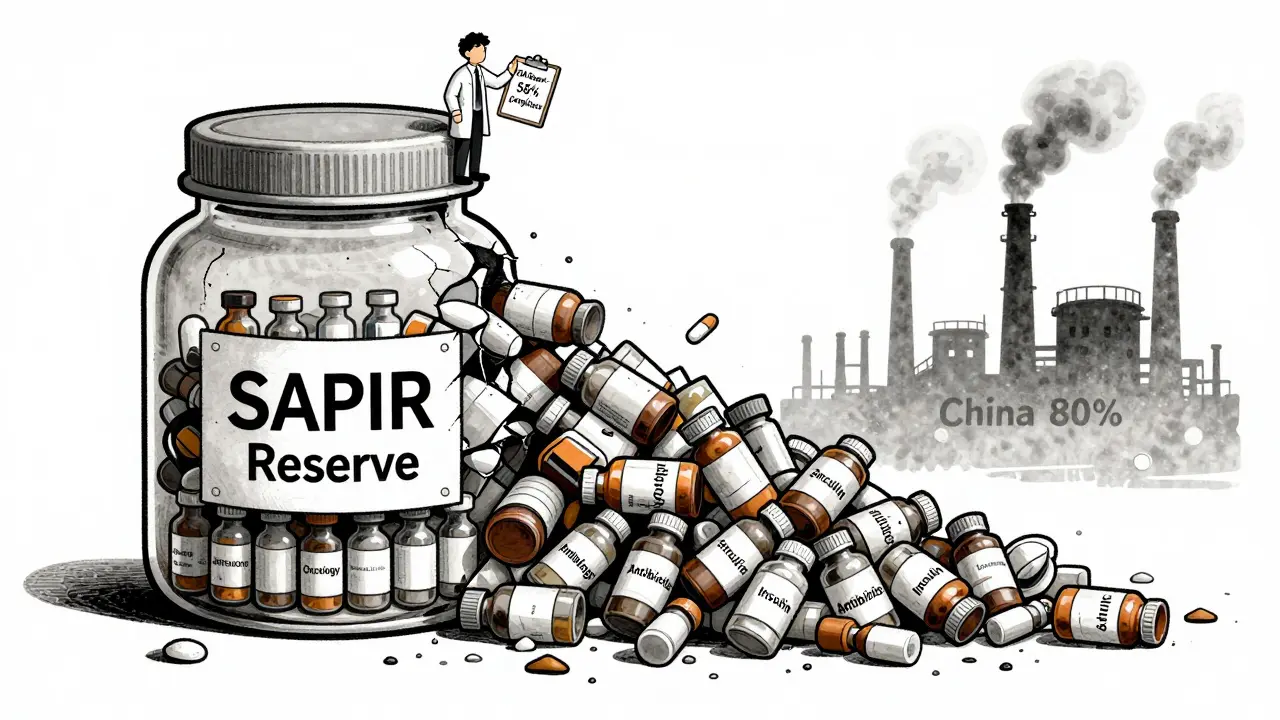
In August 2025, President Trump signed Executive Order 14178, expanding the Strategic Active Pharmaceutical Ingredients Reserve (SAPIR). This program now stockpiles raw chemical ingredients-APIs-for 26 critical drugs, including anesthetics, antibiotics, and cancer treatments. The logic is simple: APIs cost 40-60% less than finished drugs, last 3-5 years longer, and take up less space. The goal is to reduce dependence on China, which supplies about 80% of the U.S.’s APIs.
But here’s the problem: 98% of drug shortages involve medications not on this 26-drug list. The FDA’s own data shows oncology drugs make up 31% of all shortages, yet only 4% of SAPIR’s targets are cancer meds. Stockpiling a few key ingredients doesn’t fix a broken system. It just moves the crisis down the road.
Why Reporting Still Fails
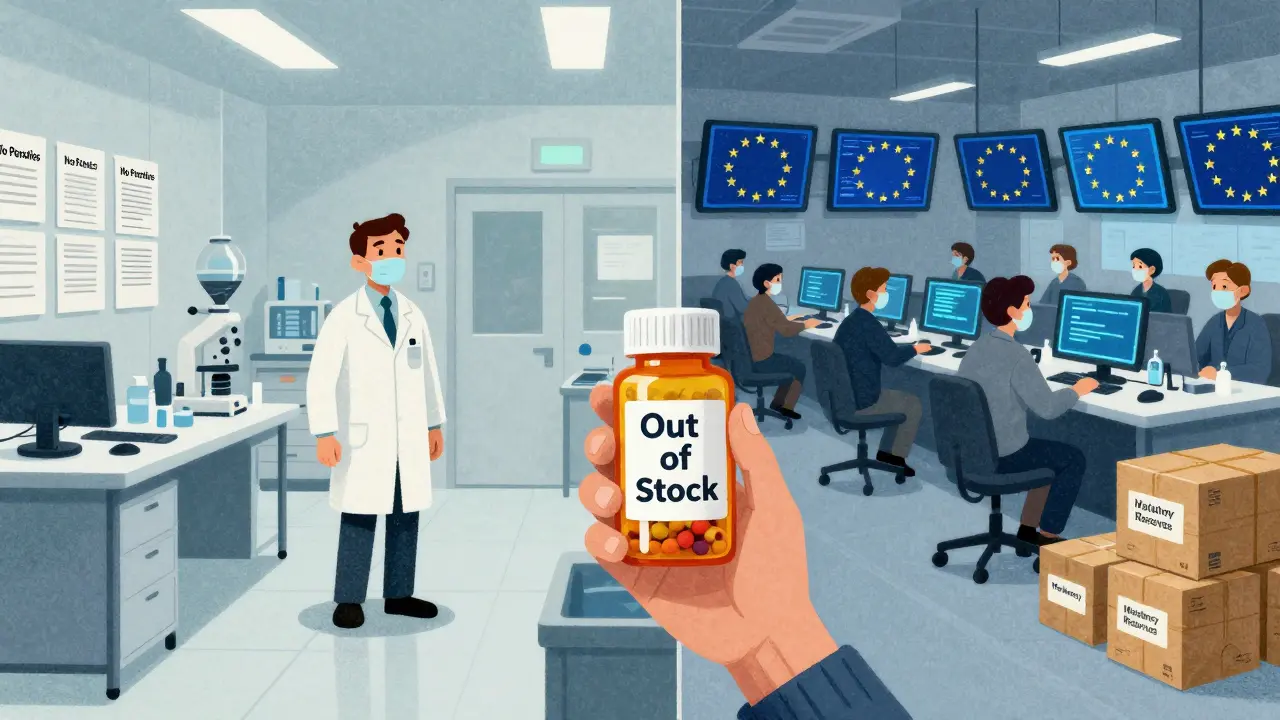
Since 2012, manufacturers have been legally required to report potential drug shortages six months in advance. But compliance? Only 58%. Small companies-those with fewer than 50 employees-skip reporting at an 82% rate. Why? There’s no penalty. No fine. No consequence.
The FDA issued just 17 warning letters between 2020 and 2024 for failure to report shortages. In the EU, under similar rules, they issued 142. The U.S. system relies on trust. The EU relies on enforcement. The result? The FDA’s public shortage database has received over 3,200 reports since April 2025, but 62% of them were duplicates-doctors and pharmacists reporting drugs already listed because they didn’t know the system existed.
The Manufacturing Bottleneck
Just five facilities in the U.S. produce 78% of all sterile injectables. Three companies control 68% of that market. That’s not competition-it’s a chokehold. When one plant shuts down for an inspection or a power outage, hospitals across the country feel it.
The FDA approved 56 new manufacturing sites for critical drugs in 2024. But 42% of them were overseas-in Ireland and Singapore. Even with $285 million in CHIPS Act funding announced in September 2025, industry analysts say it covers less than 5% of the $6 billion needed to build enough domestic capacity. And even if you build it, approval takes 28-36 months in the U.S. In the EU? 18-24 months.
The Real Cost: Hospitals, Pharmacists, Patients
Hospitals are spending an average of $1.2 million a year just managing shortages. That’s not drug cost-that’s labor, overtime, emergency orders, staff training, and clinical monitoring. Pharmacists are spending 10+ hours a week tracking down alternatives. Nearly half report near-miss errors because they had to swap a drug they didn’t fully understand.
Patients are skipping doses. A September 2025 survey by Patients for Affordable Drugs found 29% of Americans skipped medication because it wasn’t available. For cancer patients, that number jumps to 68%. One Reddit user wrote: "We compounded cisplatin from raw powder because the vial didn’t come. No one had training for that. We were terrified."
What’s Working? The Early Notification Pilot
There’s one federal program that actually works: the FDA’s Early Notification Pilot. Hospitals and manufacturers that join voluntarily share early warnings about supply risks. Hospitals in the program see shortages last 28% less time. Why? Because they get ahead of the crisis.
But here’s the irony: the current administration has weakened mandatory reporting rules. The pilot was voluntary. Now, even that voluntary access is under threat. The Government Accountability Office found only 35% of HHS’s recommended interventions have been implemented across agencies. Coordination? Poor. Accountability? Missing.
The European Difference
While the U.S. is stockpiling a handful of ingredients, the EU is mandating stockpiles for all member states and running a centralized monitoring system through the European Medicines Agency. Between 2022 and 2024, EU drug shortages dropped by 37%. They don’t wait for a crisis. They plan for it.
The U.S. has a database. Europe has a system. One tracks problems. The other prevents them.
Why Funding Cuts Undermine Progress
In 2026, the HHS budget proposes cutting $1.2 billion from FEMA’s emergency response and $850 million from state public health grants. BARDA, the agency that funded breakthrough manufacturing tech like continuous production, saw its budget drop 22% from 2024 to 2025. NIH’s drug development funding fell 18%.
Meanwhile, the government is spending hundreds of millions on stockpiling APIs-but not on the innovation that could stop shortages before they start. Continuous manufacturing can turn production from months to days. But it needs funding. It needs regulatory support. It needs long-term vision.
The Path Forward
Stockpiling APIs is not the answer. It’s a Band-Aid on a broken artery.
What would work?
- Penalize non-reporting: Fine manufacturers who fail to report potential shortages. Make it costly to stay silent.
- Fast-track second-source manufacturers: The FDA’s new expedited review pathway is promising. But it needs teeth. Speed up approvals for any company that can make the same drug as the one in shortage.
- Incentivize low-margin drugs: Medicare should pay more for essential, low-profit drugs like saline and insulin. Right now, companies make more money selling luxury drugs than lifesaving ones. That’s not a market failure-it’s a policy failure.
- Build domestic capacity, not just stockpiles: $285 million won’t fix the problem. We need $6 billion in sustained investment over five years to diversify manufacturing.
- Adopt the EU model: Centralized monitoring, mandatory reserves, and cross-border coordination. The U.S. doesn’t need to reinvent the wheel.
The Strategic API Reserve might prevent a few shortages. But it won’t stop the next one. And the one after that. Until we fix the economics, the regulations, and the accountability, drug shortages will keep getting worse-not better.
What’s Next?
The Drug Shortage Act (H.R.5316) is now in Congress. It could help patients access compounded drugs during shortages. But it doesn’t fix manufacturing. Doesn’t fix reporting. Doesn’t fix funding.
The FDA’s new AI-powered monitoring system, launched in November 2025, predicts shortages with 82% accuracy 90 days ahead. That’s powerful. But if no one acts on the predictions, it’s just noise.
The data is here. The tools are here. The will? Still missing.
Why are drug shortages getting worse in the U.S.?
Drug shortages are worsening because the U.S. relies on a fragile, concentrated supply chain with too few manufacturers, weak reporting rules, and no financial incentive to produce low-profit but essential drugs. Over 80% of active pharmaceutical ingredients come from overseas, mainly China. When one plant shuts down, hundreds of hospitals feel the impact. Federal efforts like the API reserve address symptoms, not causes.
What is the Strategic Active Pharmaceutical Ingredients Reserve (SAPIR)?
SAPIR is a federal stockpile of raw chemical ingredients (APIs) for 26 critical drugs, expanded by executive order in August 2025. It’s designed to reduce dependence on foreign suppliers and respond faster to shortages. APIs are cheaper and last longer than finished drugs, making them easier to store. But it only covers a small fraction of the drugs that actually go into shortage.
How many drugs are currently in shortage?
As of late 2024, there were 277 active drug shortages in the U.S., according to Global Biodefense. The FDA reported 98 active shortages at the end of 2024, but their count only includes drugs they’ve officially confirmed. The discrepancy comes from different reporting standards. The FDA’s public database tracks over 1,200 total shortages-both active and resolved-since 2012.
Are drug shortages affecting cancer treatment?
Yes. Oncology drugs make up 31% of all drug shortages, even though they represent only 4% of the drugs targeted by the SAPIR program. A September 2025 survey of 1,200 oncology practices found 68% of patients had their treatment delayed, changed, or reduced due to drug unavailability. Some hospitals are forced to compound drugs from raw materials, which increases risk and workload.
What can hospitals do to manage drug shortages?
Hospitals are using alternative medications, rationing supplies, and increasing staff time to track inventory. Some participate in the FDA’s Early Notification Pilot, which reduces shortage duration by 28%. But most lack the staff, training, or technology to respond effectively. Community hospitals, in particular, struggle with limited pharmacy resources and outdated IT systems.
Is the U.S. government doing enough to fix drug shortages?
No. While initiatives like SAPIR and AI forecasting show promise, they’re not backed by strong enforcement, consistent funding, or structural reforms. Mandatory reporting is weak. Domestic manufacturing is underfunded. Economic incentives favor high-profit drugs over essential ones. Without fixing these root issues, shortages will keep rising-even with better stockpiles.
Evan Smith
January 9, 2026 AT 07:40So we’re spending millions to stockpile chemicals while hospitals are literally compounding cancer drugs from powder? That’s not a strategy, that’s a hostage situation with a PowerPoint.
And the FDA issued 17 warning letters in four years? In my town, you get fined for parking too long. But if your company’s letting people die because they didn’t file a form? Congrats, you’re doing great.
Lois Li
January 9, 2026 AT 11:15I’ve worked in a community pharmacy for 18 years and I’ve seen this get worse every single year. It’s not just about who makes the drugs-it’s about who gets paid to make them. Saline bags cost pennies but take hours to track down. Meanwhile, some new $12,000-a-month cancer drug gets approved in weeks. The math doesn’t add up, and no one’s fixing the equation.
Also, the EU thing? They’ve got a system. We’ve got a spreadsheet that updates once a week and no one reads it.
Annette Robinson
January 10, 2026 AT 15:03It breaks my heart to read about patients skipping doses because the pharmacy ran out. I work with elderly patients who rely on these meds-some can’t afford to switch, can’t afford to wait, and can’t afford to fight the system. The fact that we’re even talking about compounding chemotherapy from raw powder should be unthinkable. It’s not innovation-it’s desperation dressed up as ingenuity.
We need to treat drug access like a public health emergency, not a supply chain puzzle. People aren’t data points. They’re mothers, fathers, grandparents. And they’re being failed.
Luke Crump
January 11, 2026 AT 01:38Let me ask you this: if the government can spend $800 billion on a war no one asked for, why can’t it spend $6 billion to keep people alive?
Is it because drugs don’t vote? Is it because the lobbyists for Big Pharma don’t want competition? Is it because we’ve turned healthcare into a casino and the house always wins?
SAPIR is a magic trick. They show you the API, you clap, and then the patient still dies. The real problem isn’t the supply-it’s the soul of the system. And that soul is bankrupt.
Manish Kumar
January 12, 2026 AT 03:24You know, in India, we have a different approach-we don’t wait for the FDA to approve everything. We make generics in bulk, we train pharmacists to handle substitutions, and we don’t pretend that every drug needs to be branded and patented to be useful. The U.S. is stuck in this loop where innovation means expensive and exclusive, but in reality, true innovation is making life-saving medicine accessible to everyone, not just those who can afford it or those who are lucky enough to live near a big hospital with a compounding lab.
And yes, I know the EU is better, but the EU also has universal healthcare. Here, we have a system where the profit motive is the only god, and if your drug doesn’t make money, it’s not worth making. That’s not capitalism, that’s a moral failure dressed in a suit.
Molly Silvernale
January 13, 2026 AT 10:12It’s like… we’ve got this beautiful, high-tech, AI-powered crystal ball that can predict shortages 90 days in advance… and then we just… stare at it?
Like, wow, look at the pretty graph, it says ‘Cisplatin will vanish in 8 weeks’-but no one moves. No one calls the manufacturer. No one reallocates budgets. No one screams. We just… let it happen. Again.
It’s not incompetence. It’s apathy. And apathy, my friends, is the quietest killer of all.
Kristina Felixita
January 13, 2026 AT 15:25My cousin is a nurse in rural Ohio. She told me last week they had to give a patient a different chemo drug because the one they needed was out-and she didn’t know the side effects well enough. She stayed up all night reading up on it, scared she’d mess up. That’s not healthcare. That’s survival.
And yeah, I know the government’s got this ‘pilot’ thing. But if it’s voluntary, then it’s basically a suggestion. Like telling someone to ‘please don’t drive drunk.’ It’s not a policy. It’s a prayer.
Joanna Brancewicz
January 15, 2026 AT 00:58Manufacturing bottlenecks + regulatory inertia + reimbursement misalignment = systemic failure. SAPIR is a tactical workaround, not a strategic solution. The EU’s centralized model reduces redundancy and increases resilience. U.S. policy remains siloed, underfunded, and reactive. Fix the incentives. Fund continuous manufacturing. Enforce reporting. End the status quo.
christy lianto
January 16, 2026 AT 13:13Enough. Just… enough. We have the tools. We have the data. We have the proof that other countries do it better. But we’re still letting people die because someone didn’t want to spend the money or change the rules. This isn’t politics. This is murder by bureaucracy. And if you’re still sitting there saying ‘but the budget…’ or ‘but it’s complicated…’-you’re part of the problem. Time to stop talking and start fixing it.