
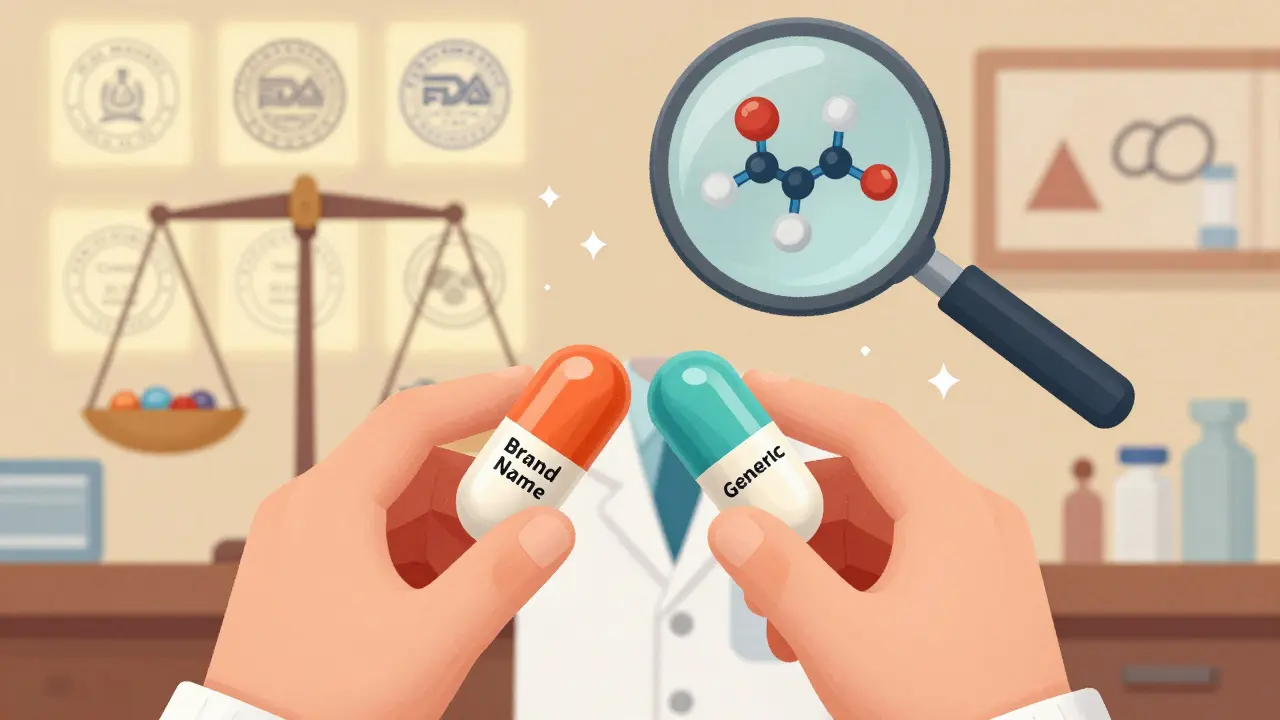
When you pick up a prescription and see a generic drug instead of the brand-name version, you might wonder: Is it really the same? The answer isn’t just "yes" - it’s backed by strict science, detailed regulations, and millions of doses tested every year. The U.S. Food and Drug Administration (FDA) doesn’t just approve generic drugs because they’re cheaper. They approve them because they must meet the same high standards as the original brand-name drugs - down to the last milligram.
What Makes a Generic Drug "Equivalent"?
It’s not enough for a generic drug to have the same active ingredient. The FDA requires two kinds of equivalence: pharmaceutical and bioequivalence. Pharmaceutical equivalence means the generic has the same active ingredient, strength, dosage form (pill, injection, cream, etc.), and route of administration (oral, topical, inhaled) as the brand-name drug. It also must have the same intended use - same labeling, same warnings, same instructions.
But here’s where most people get confused: even if two pills look identical and have the same active ingredient, they might not work the same way in your body. That’s where bioequivalence comes in. The FDA requires that the generic drug gets absorbed into your bloodstream at the same rate and to the same extent as the brand-name drug. This is measured using two key metrics: Cmax (the highest concentration in your blood) and AUC (how much of the drug is absorbed over time).
The rule? The 90% confidence interval for both Cmax and AUC must fall between 80% and 125% of the brand-name drug’s values. This isn’t a guess. It’s based on decades of clinical data and statistical modeling. If a generic doesn’t meet this range, it doesn’t get approved - no exceptions.
The ANDA Process: How Generics Get Approved
Generic manufacturers don’t start from scratch. Instead of running expensive, lengthy clinical trials like brand-name companies do, they file an Abbreviated New Drug Application, or ANDA. The "abbreviated" part doesn’t mean less work - it means they rely on the brand-name drug’s existing safety and efficacy data. Their job? Prove they can make an identical product, consistently, at scale.
The ANDA submission includes detailed information on:
- Chemistry of the active ingredient
- Manufacturing processes
- Stability testing over time
- Results from bioequivalence studies
- Quality control methods for every batch
The FDA reviews each application thoroughly. In 2022, they approved 892 original ANDAs and issued 478 complete response letters - meaning the application had issues that needed fixing before approval. That’s a rejection rate of over 35%. This isn’t a rubber stamp. It’s a rigorous gatekeeping system.
Under the Generic Drug User Fee Amendments (GDUFA), the FDA has set a review goal of 10 months for a complete ANDA. That’s faster than most new drug approvals. But speed doesn’t mean shortcuts. The same level of scrutiny applies.
Manufacturing Rules: cGMP Applies to Everyone
Whether you’re making the original brand-name drug or a generic version, you must follow Current Good Manufacturing Practices (cGMP), written into federal law as 21 CFR Parts 210 and 211. These rules cover everything: how raw materials are stored, how equipment is cleaned, how workers are trained, how each batch is tested before release.
Every batch of a generic drug must be tested for:
- Identity (is it the right drug?)
- Strength (does it have the correct amount of active ingredient?)
- Purity (is it free of harmful contaminants?)
- Quality (does it dissolve properly? Is it stable?)
The FDA doesn’t trust paperwork alone. They send inspectors to over 3,500 facilities each year - in the U.S. and around the world. These inspections are unannounced. Facilities that fail can be shut down. In 2023, the FDA issued warning letters to 187 manufacturing sites for violations related to generic drug production.
And here’s something many don’t know: about half of all generic drugs in the U.S. are made by the same companies that produce the brand-name versions. They use the same equipment, the same labs, and often the same workers. The difference? The label on the box.
Testing Complex Drugs: More Than Just Blood Levels
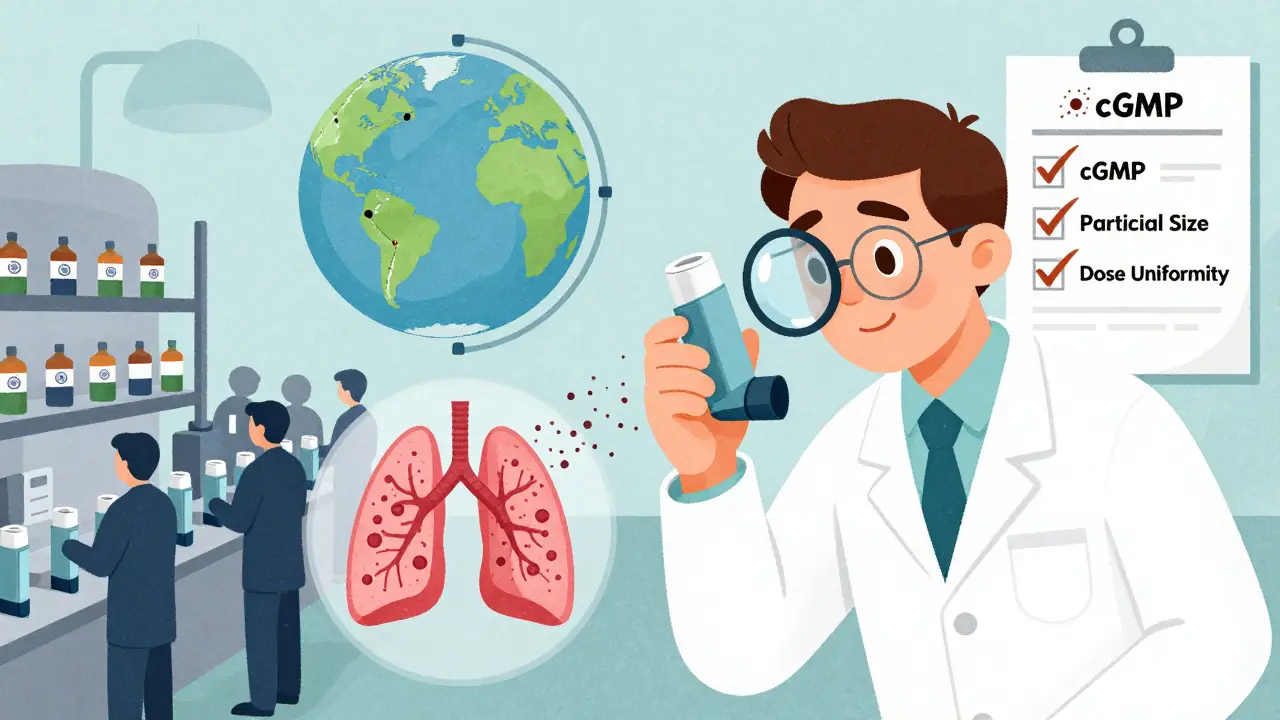
For simple pills, bioequivalence is measured with blood tests in healthy volunteers. But what about inhalers, injectables, or topical creams? These are called complex generics. For them, a blood test might not tell the whole story.
Take an asthma inhaler. Even if two inhalers deliver the same amount of drug into the bloodstream, one might deposit more in the lungs - where it’s needed - and the other might just sit in your mouth. That’s why the FDA requires additional testing: particle size, spray pattern, dose uniformity, and even how the drug sticks to the inside of the inhaler.
As of 2023, the FDA has published 2,143 product-specific guidances for complex generics. That’s a detailed playbook for each drug - from insulin glargine injections to topical acne creams. These guidances outline exactly what tests are needed, what equipment to use, and what data to submit. Without following these, approval is impossible.
Dr. Charles Ganley, former head of the FDA’s Office of Generic Drugs, pointed out in 2019 that for these complex products, "equivalence requires more sophisticated testing than simple blood level measurements." The FDA now spends $15.7 million annually on research to improve testing methods for these harder-to-replicate drugs.
Stability and Shelf Life: How Long Does It Last?
A generic drug doesn’t just have to work when it’s made. It has to work for years. That’s why manufacturers must run stability studies. These involve storing samples under different conditions - heat, humidity, light - and testing them over time.
Typically, they run:
- Accelerated testing: 40°C and 75% humidity for 6 months
- Long-term testing: at recommended storage conditions (usually 25°C) for 12 to 24 months
If the drug degrades too much, changes color, or doesn’t dissolve properly during these tests, the shelf life is shortened - or the product is rejected. The FDA requires manufacturers to prove their generic drug will remain safe and effective until the expiration date printed on the bottle.
Real-World Evidence: Do Generics Work?
Over 90% of prescriptions filled in the U.S. are for generic drugs. That’s not because doctors are pushing them - it’s because patients and insurers choose them. In 2022, generics saved the U.S. healthcare system $37 billion. They make up only 23% of drug spending, but they’re used in 9 out of 10 prescriptions.
A 2022 Consumer Reports survey of 1,200 adults found 89% were satisfied with generics. Most people report no difference in how they feel. But there are exceptions.
Some drugs have a narrow therapeutic index - meaning the difference between a safe dose and a harmful one is very small. Levothyroxine, used for thyroid conditions, is one. A 2021 study in JAMA found that 12.3% of patients who switched between different generic versions had changes in thyroid hormone levels that required dose adjustments.
On Reddit’s r/pharmacy community, a 2023 thread with over 1,400 responses showed 83% reported no difference between brand and generic. But 17% reported issues - mostly with seizure medications and blood thinners like warfarin. These aren’t flaws in the system. They’re reminders that biology is messy. For these drugs, doctors sometimes recommend sticking with one manufacturer.
That’s why the FDA encourages patients to tell their doctor if they notice a change after switching. It’s rare - but it happens.
Why This Matters
Generic drugs aren’t a compromise. They’re a carefully designed system that balances affordability with safety. Every pill, injection, or inhaler you take - whether it’s branded or generic - has been tested, inspected, and approved under the same rules. The FDA doesn’t lower standards for generics. They make sure the standards are met.
Behind every generic drug is a team of scientists, inspectors, and regulators who spend years reviewing data, running tests, and visiting factories. They don’t just check a box. They verify that every dose is safe, effective, and consistent - no matter who made it or where.
Are generic drugs as effective as brand-name drugs?
Yes. The FDA requires generic drugs to have the same active ingredient, strength, dosage form, and bioequivalence as the brand-name version. Studies show that 90% of patients experience no difference in effectiveness or side effects. The FDA’s approval process ensures that generics meet the same quality and performance standards.
Why do some generics look different from the brand name?
U.S. law requires generic drugs to look different from brand-name drugs to avoid trademark infringement. This means changes in color, shape, size, or scoring - but not in the active ingredient or how the drug works. These differences are cosmetic only and have no effect on safety or effectiveness.
Can generic drugs have different side effects?
The active ingredient is identical, so the main side effects should be the same. However, generics can use different inactive ingredients (like fillers or dyes), which may cause rare allergic reactions in sensitive individuals. If you notice new symptoms after switching, talk to your pharmacist or doctor. This is uncommon but possible.
Are all generic drugs made in the U.S.?
No. The FDA inspects manufacturing facilities worldwide. In fact, over half of all generic drugs sold in the U.S. are made overseas, primarily in India and China. The FDA holds these facilities to the same cGMP standards as U.S. plants. Inspectors visit foreign sites just as often as domestic ones.
Why do some doctors still prefer brand-name drugs?
For most drugs, there’s no medical reason. But for drugs with a narrow therapeutic index - like warfarin, levothyroxine, or certain seizure medications - small differences in absorption can matter. Some doctors prefer consistency and may recommend staying with one manufacturer. This isn’t about quality - it’s about minimizing variables in sensitive cases.
How does the FDA ensure quality in overseas manufacturing?
The FDA conducts unannounced inspections of foreign manufacturing sites just like domestic ones. In 2022, nearly 40% of inspections were overseas. Facilities must comply with cGMP, and failure to do so results in import alerts or bans. The agency also uses data from global inspections and lab testing to monitor trends and identify risks.
Cory L
February 23, 2026 AT 04:37Bhaskar Anand
February 24, 2026 AT 13:30William James
February 26, 2026 AT 04:56David McKie
February 26, 2026 AT 13:32Steven Pam
February 27, 2026 AT 23:45Khaya Street
March 1, 2026 AT 17:25Christina VanOsdol
March 2, 2026 AT 11:35Brooke Exley
March 3, 2026 AT 09:53Alfred Noble
March 5, 2026 AT 07:21Matthew Brooker
March 6, 2026 AT 03:41Emily Wolff
March 8, 2026 AT 00:14