
What Is CRPS, and Why Does It Hurt So Much?
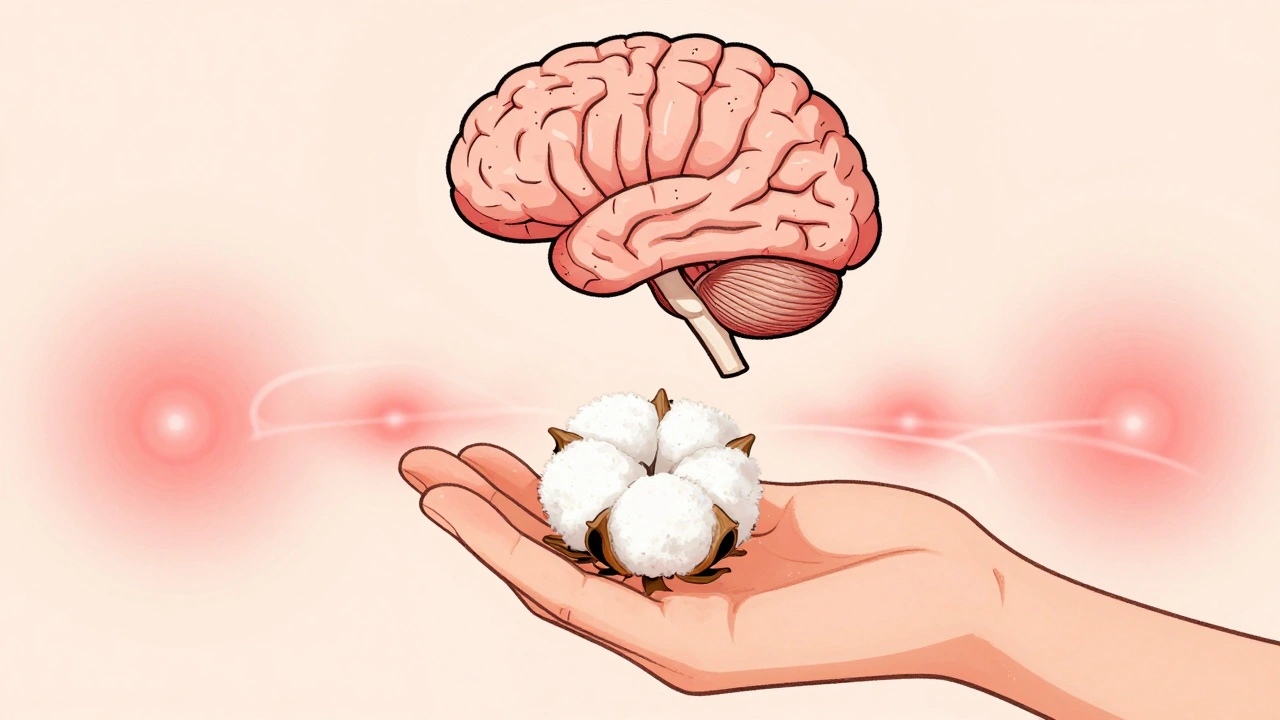
Complex Regional Pain Syndrome, or CRPS, isn’t just a bad ache that won’t go away. It’s a neurological glitch - your brain keeps screaming "danger!" even when the injury has healed. One moment you’re recovering from a sprained wrist or a minor surgery, and the next, your hand or foot feels like it’s on fire, swollen, and hypersensitive to the lightest touch. A breeze, a shirt sleeve, even a bedsheet can feel like sandpaper. This isn’t in your head. It’s in your nervous system.
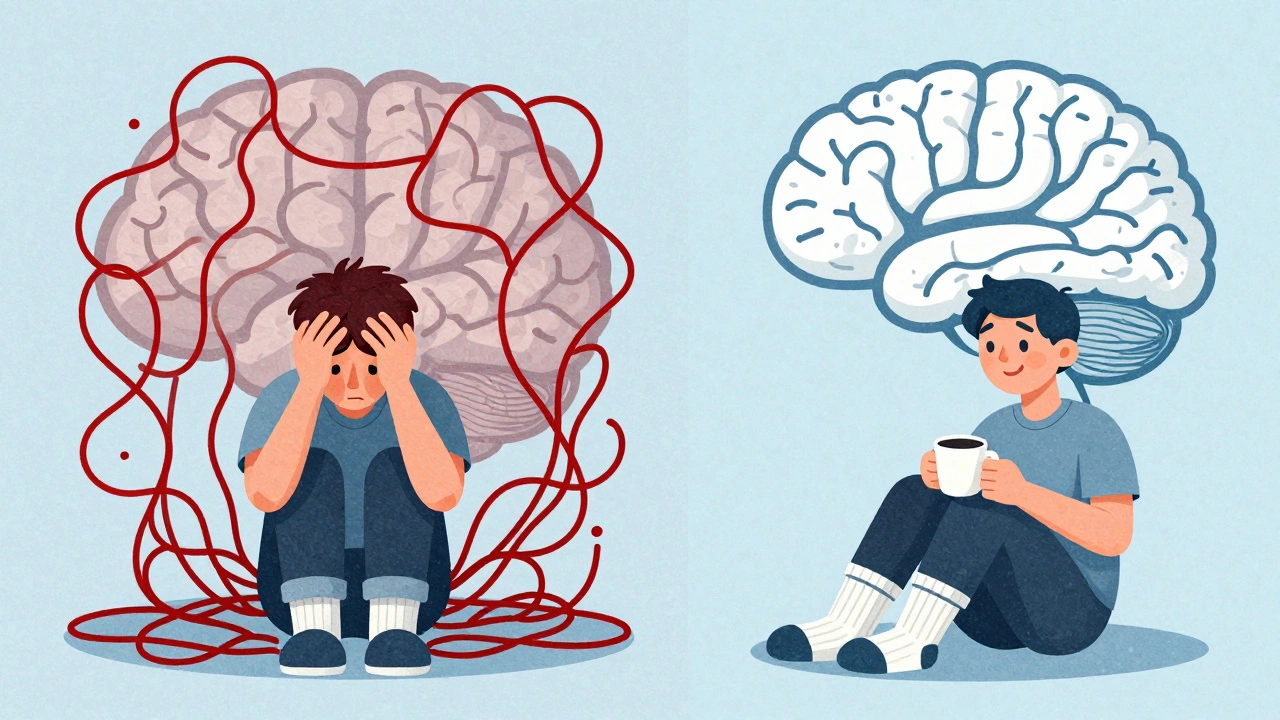
CRPS was first documented over 150 years ago, but modern science now knows it’s caused by abnormal signaling between nerves, skin, and the brain. The pain doesn’t match the original injury. It spreads. It lingers. And it rewires your brain’s map of your body. Studies show that in CRPS, the area of your brain that represents your painful limb becomes "smudged" - it bleeds into neighboring areas, making your brain lose track of where your limb ends and the rest of your body begins. This is why simple movements feel terrifying, and why even imagining moving your hand can trigger pain.
Traditional painkillers often fail. Opioids? Mostly useless. Nerve blocks? Temporary at best. That’s why rehabilitation focused on retraining the brain - not just the limb - has become the gold standard. Two techniques stand out: desensitization and Graded Motor Imagery (GMI). Together, they don’t just mask pain. They undo the damage it caused in your nervous system.
Desensitization: Relearning Touch Without Fear
One of the most disabling symptoms of CRPS is allodynia - pain from something that shouldn’t hurt. Light touch, temperature changes, even the feeling of clothes against your skin can trigger burning or stabbing pain. Desensitization therapy is built on one simple idea: if your brain thinks touch is dangerous, you need to show it, slowly and safely, that it’s not.
The process starts with something so gentle it barely registers - a cotton ball, a silk scarf, or a feather. You touch your skin with it for just 5 minutes at a time, three to five times a day. No pain should be above a 3 out of 10. If it goes higher, you stop and try again tomorrow with something even softer. Progress is measured in millimeters, not miles. It takes weeks to move from cotton to linen, then to denim, then to normal clothing.
Why does this work? Brain scans show that after 6 to 8 weeks of consistent desensitization, the overactive areas in the spinal cord and somatosensory cortex calm down by 30-40%. Your brain stops treating every touch like a threat. A 2021 study of 127 CRPS patients found those who did structured desensitization improved 42% more on functional hand tests than those who didn’t. One patient in Melbourne, after 10 weeks, finally wore socks again for the first time in 18 months. "It didn’t burn," she said. "It just felt... normal."
There are four phases:
- Phase 1 (0-2 weeks): Passive touch with eyes open. Just feel the texture. No movement.
- Phase 2 (2-4 weeks): Add slow, gentle movement while touching - wiggle your fingers, rotate your wrist.
- Phase 3 (4-8 weeks): Introduce temperature. Start with lukewarm water, then move to cool, then warm.
- Phase 4 (8+ weeks): Functional reintegration. Dressing, cooking, brushing your hair - all with normal clothing and objects.
Adherence is high - 79% of patients stick with it - but patience is everything. It takes an average of 47 days to go from cotton to normal clothes. Rushing it makes pain worse. Slow and steady wins this race.
Graded Motor Imagery: Rewiring Your Brain’s Pain Map
If desensitization teaches your skin it’s safe to be touched, Graded Motor Imagery (GMI) teaches your brain it’s safe to move.
Developed by Dr. G. Lorimer Moseley in the early 2000s, GMI is a three-step brain training program. It doesn’t involve heavy lifting or stretching. It’s mental. And it’s powerful.
Stage 1: Left/Right Discrimination
You look at pictures of hands or feet - some left, some right - and you have to identify them as fast as you can. No moving your limb. Just thinking. Digital apps like Recognise Online show you 50-200 images a day. You start slow. You aim for 90% accuracy at under 1.5 seconds per image. Why? Because CRPS scrambles your brain’s ability to tell left from right. Your brain thinks, "Is that my hand?" - and the confusion itself triggers pain. Training this skill untangles the mess.
Stage 2: Explicit Motor Imagery
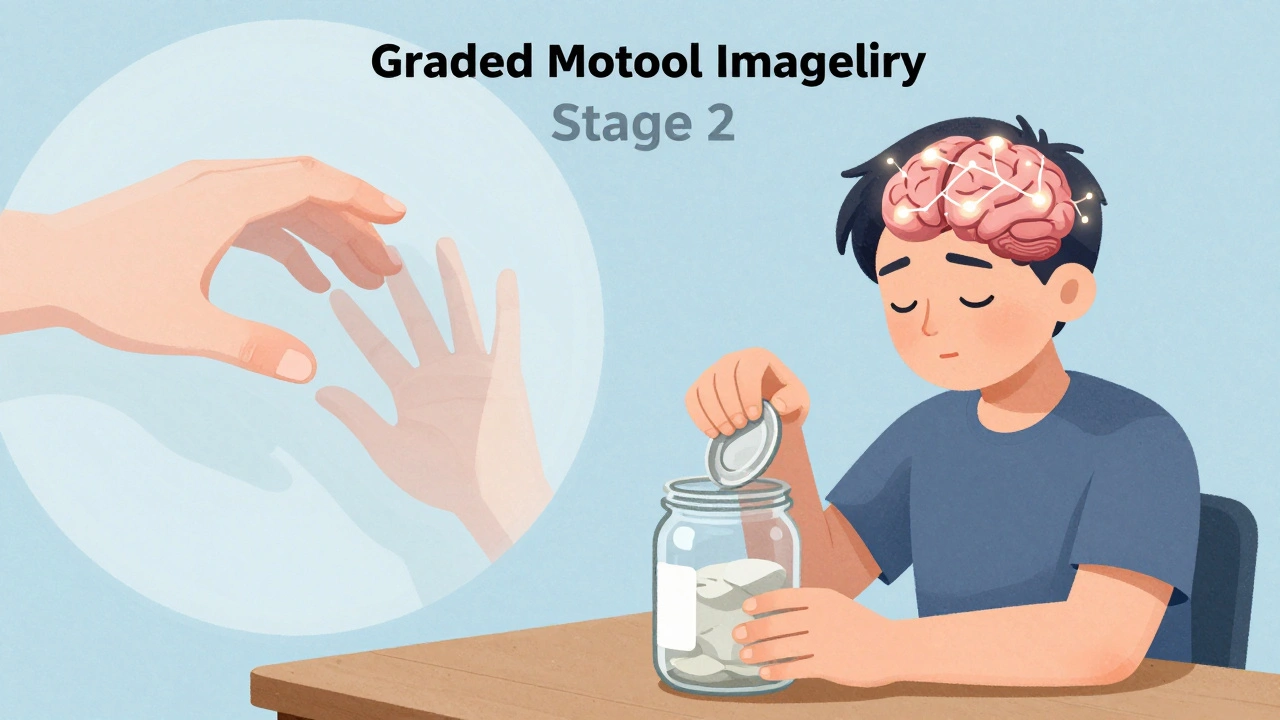
Now you imagine moving your painful limb - without moving it. Picture yourself opening a jar, picking up a cup, or typing on a keyboard. Do it in vivid detail. What does it feel like? What does your arm feel like? How does the weight shift? Do this for 5-10 minutes a day, then build up to 20-30. You’re activating the same brain areas as if you were actually moving - but without triggering pain. This rebuilds the neural pathways your brain abandoned.
Stage 3: Mirror Therapy
Place a mirror vertically beside your painful limb, hiding it behind the reflection. Move your healthy limb in front of the mirror. Your brain sees the reflection and thinks it’s your painful limb moving - smoothly, painlessly. Over weeks, your brain starts to believe the movement is safe. Pain drops. Swelling reduces. Temperature normalizes. One study showed 70% of patients had at least 50% pain reduction after just four weeks.
Brain scans confirm it. Before GMI, the brain’s map of the painful limb is stretched and blurry. After GMI, it shrinks back to its normal size. The "cortical smudging" reverses. You’re not just feeling better. Your brain is healing.
Why GMI Beats Traditional Physical Therapy
Many people with CRPS try physical therapy first - stretching, strengthening, range-of-motion exercises. But if your brain still thinks movement equals danger, forcing your limb to move often backfires. Pain spikes. Swelling flares. You lose motivation.
GMI works differently. It doesn’t force the body. It reprograms the brain. A 2023 review of 33 studies found GMI reduced pain scores by 2.8 points more than traditional therapy on a 10-point scale. That’s not small. That’s life-changing. Mirror therapy alone improved upper limb function 40% more than standard rehab in post-surgery CRPS patients.
But here’s the catch: GMI only works if done right. If you jump to mirror therapy too fast, or if you’re not trained, you can make things worse. One study found 15% of patients had symptom spikes because their therapist rushed the stages. That’s why certification matters. Therapists need at least 40 hours of specialized CRPS training. Look for those certified by the NOI Group or holding a Certified Pain Practitioner (CPP) credential.
And GMI isn’t a solo act. The best outcomes come when it’s combined with desensitization and psychological support. A 2022 study showed patients who got all three - GMI, desensitization, and CBT - had a 5.2-point drop in pain after 24 weeks. That’s nearly 70% pain reduction for many.
Real People, Real Results - And Real Challenges
Stories from patients tell the true story.
"After three months of GMI, my hand temperature went from 82°F to 96°F," wrote a Reddit user in March 2023. "I hadn’t worn socks in 18 months. Now I can sleep with them on."
Another YouTube creator, "CRPS Warrior," shared how the first two weeks were brutal. "My pain spiked 30%. I wanted to quit. But by week six, I picked up a coffee cup without my brain screaming. That was the day I believed I’d get better."
But it’s not all triumph. One in three patients experience a temporary flare-up in the first few weeks. Nearly 18% quit because it feels too slow, too mental, too frustrating. And it’s true - GMI doesn’t offer quick fixes. It demands daily discipline. You’re not just rehabbing your arm. You’re rehabbing your brain.
Success rates are high - 68% report meaningful pain reduction - but only if you stick with it. And early intervention is critical. If you start GMI and desensitization within three months of your injury, your chance of success is 83%. After 12 months? It drops to 42%. Time matters.
How to Get Started - And Avoid Common Mistakes
You can’t just watch a YouTube video and start GMI. It’s not a DIY project. You need a trained therapist - preferably one certified in CRPS rehabilitation. Ask your doctor for a referral to an occupational therapist or physiotherapist with specific GMI training. In Australia, clinics in Melbourne, Sydney, and Brisbane increasingly offer these programs.
Here’s what to avoid:
- Advancing too fast: Moving from cotton to sandpaper in a week? Big mistake. Pain spikes mean you’re overloading your brain.
- Skipping education: If you don’t understand why you’re doing this, you’ll quit. Make sure your therapist explains the science - it builds trust.
- Doing it alone: GMI works best with psychological support. Anxiety and fear fuel CRPS. Therapy that ignores this is incomplete.
- Waiting too long: The longer you wait, the harder it is to reverse the brain changes. Don’t delay.
Technology is helping. Apps like Miro Therapeutics, cleared by the FDA, guide you through GMI with AI feedback. They track your accuracy, pace, and pain levels - and they’ve improved adherence by 35% compared to paper-based methods.
What’s Next for CRPS Treatment?
CRPS rehabilitation is no longer experimental. It’s standard care. In the UK, the NHS now requires GMI to be offered within four weeks of referral. In the U.S., 78% of academic hospitals include it in their protocols - up from 32% in 2015. The International Association for the Study of Pain has made CRPS rehabilitation a top research priority, funding $15 million annually through 2030.
But access remains uneven. Only 42% of rural clinics in the U.S. have therapists trained in these techniques. That’s where telehealth steps in. A 2022 study found remote GMI coaching was 67% as effective as in-person - a game-changer for people in remote areas.
The future is digital, personalized, and brain-focused. We’re moving away from pills and injections toward tools that help your own nervous system heal itself. Desensitization and GMI aren’t just treatments. They’re proof that the brain can recover - even from the most stubborn pain.
Jaswinder Singh
December 3, 2025 AT 03:18Conor Forde
December 4, 2025 AT 17:54Bee Floyd
December 6, 2025 AT 12:17patrick sui
December 8, 2025 AT 03:31Jack Arscott
December 10, 2025 AT 00:35Adrian Barnes
December 10, 2025 AT 18:18Michelle Smyth
December 11, 2025 AT 07:46Irving Steinberg
December 11, 2025 AT 22:45Priyam Tomar
December 12, 2025 AT 07:05Declan O Reilly
December 14, 2025 AT 02:06Lydia Zhang
December 14, 2025 AT 02:57Kay Lam
December 15, 2025 AT 06:19Eric Vlach
December 16, 2025 AT 02:31Souvik Datta
December 17, 2025 AT 05:51