
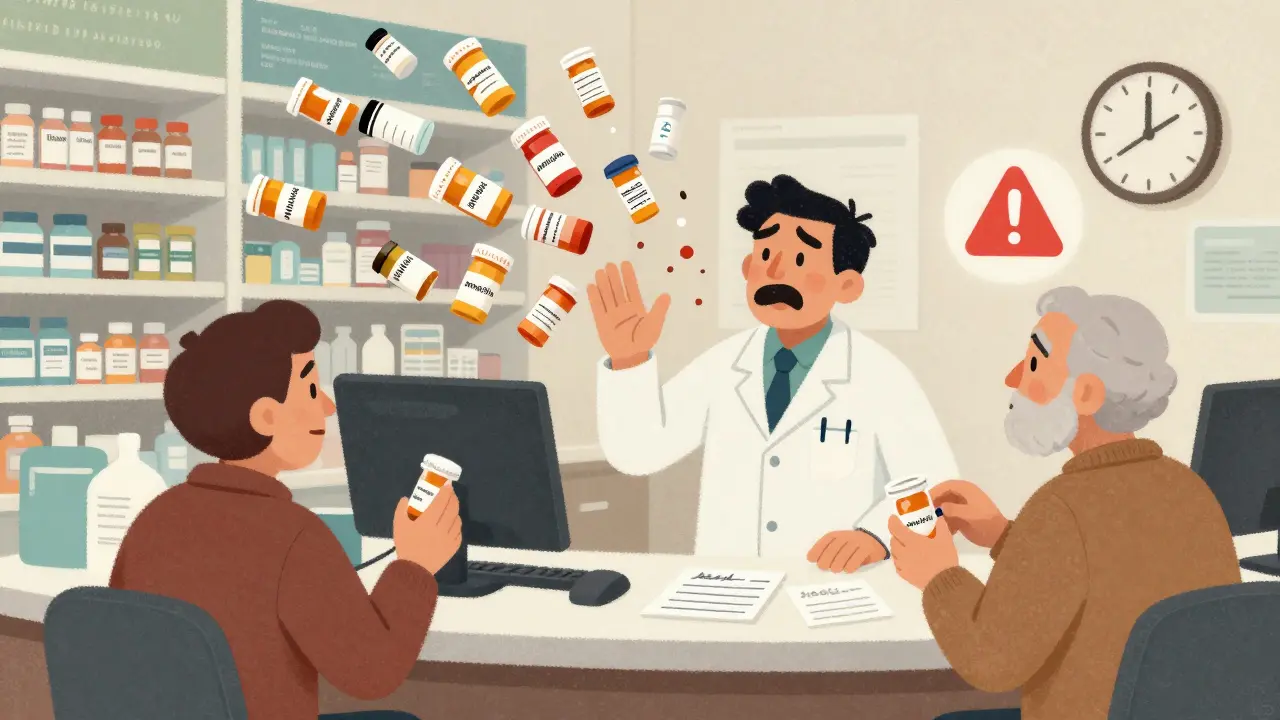
Every year, millions of people receive the wrong medication, wrong dose, or wrong instructions from their pharmacy. It’s not because pharmacists are careless-it’s because the system is overloaded, messy, and full of hidden traps. In Australia, we see these errors too: a patient gets amoxicillin instead of ampicillin because the bottles look alike. Someone takes double their usual warfarin dose because the label wasn’t checked. A senior citizen gets a drug that clashes with their kidney condition because no one reviewed their lab results. These aren’t rare accidents. They’re predictable failures-and they’re preventable.
What Are the Most Common Pharmacy Dispensing Errors?
Not all mistakes are the same. Some are simple mix-ups. Others are deadly. According to global data from 2023, the top three dispensing errors are:
- Wrong medication, strength, or form (32% of errors): This includes giving a 10mg tablet instead of a 5mg, or handing out a capsule when the prescription called for a liquid.
- Dose miscalculations (28%): Especially dangerous with children, elderly patients, or drugs like insulin, heparin, or chemotherapy agents. A tiny math error can mean hospitalization-or death.
- Missing drug interactions or contraindications (24%): Giving a patient an antibiotic they’re allergic to, or mixing blood thinners with NSAIDs they’re already taking. These errors don’t always show up until it’s too late.
Other frequent errors include dispensing expired drugs, giving the wrong duration (like 30 days instead of 7), or misreading handwritten prescriptions. In hospital settings, IV infusion rates are often wrong-vancomycin given too fast can cause a dangerous flush. In community pharmacies, it’s often about sound-alike names: hydroxyzine vs. hydralazine, or clonazepam vs. clonidine.
Some drugs are far more likely to cause harm when misdispensed. Anticoagulants like warfarin or apixaban are involved in over 30% of serious errors. Antibiotics make up nearly a third, mostly because allergies aren’t checked. Opioids? 24% of errors involve these. One study found that 41% of antibiotic errors happened because the pharmacist never looked at the patient’s allergy history.
Why Do These Errors Keep Happening?
It’s easy to blame the pharmacist. But the real problem is the system.
Workload is the biggest driver. Pharmacists in busy community pharmacies often process 200-300 prescriptions a day. That’s one prescription every 2-3 minutes. In that time, they must read a prescription, verify the drug, check for allergies, confirm dosage, match it to the patient’s history, label the bottle, and counsel the patient. No one can do that well under that pressure.
Then there’s the noise. Interruptions are everywhere: a nurse calling, a customer asking for a refill, a technician needing help. Studies show that if a pharmacist gets interrupted three times while filling a prescription, the chance of an error jumps by over 12%.
Handwritten prescriptions? Still a problem. Even in 2026, about 43% of errors start with a doctor’s scribble. Sound-alike drug names? They cause 22% of errors when prescriptions are called in over the phone. And let’s not forget the lack of access to full patient records. If a patient’s creatinine level isn’t in the system, the pharmacist can’t adjust a kidney-clearing drug. If their allergy history is missing? They’re flying blind.

What’s Being Done to Stop These Errors?
The good news? We know how to fix this. It’s not about working harder. It’s about working smarter.
Barcoding systems have become the gold standard. When a pharmacist scans the prescription, the drug, and the patient’s wristband, the system checks for matches. If something’s wrong, it alerts them. One survey of 127 hospitals found barcoding cut dispensing errors by nearly half. Wrong drug errors dropped 52%. Wrong dose errors fell 49%.
Tall Man lettering helps too. Instead of writing “prednisone” and “prednisolone” the same way, they’re labeled as PREDNISone and PREDNISolone. That visual difference cuts confusion. Pharmacies using this method saw a 57% drop in similar-sounding drug errors.
Double-checking for high-risk drugs is another winner. Hospitals that require two pharmacists to independently verify insulin, heparin, or morphine prescriptions reduced errors by up to 78%. One pharmacist in Melbourne told a colleague: “We used to have one error a month. Now, we haven’t had one in over a year.”
Computerized provider order entry (CPOE) systems-where doctors type prescriptions directly into a digital form-cut errors by 43%. But they’re not perfect. Some systems flood pharmacists with alerts: “This drug might interact with this other drug!”-even when the interaction is harmless. After a while, people start ignoring them. That’s called alert fatigue. One hospital found their CPOE system caused 18% new errors because staff tuned out the noise.
What Can Pharmacists Do Right Now?
You don’t need a million-dollar system to make a difference. Start with these five steps:
- Always verify the patient’s allergies-even if the record says “no known allergies.” Ask them. Say: “Can you tell me what drugs you’ve ever had a reaction to?” Sometimes, they’ll say, “I broke out in a rash after penicillin when I was 10.” That matters.
- Use the “Read Back” method for verbal prescriptions. When a doctor calls in “amoxicillin 500mg TID,” repeat it back: “You said amoxicillin 500 milligrams, three times a day?” That catches 80% of misheard names.
- Check renal and liver function before dispensing. If the patient’s on a drug cleared by the kidneys (like metformin or ciprofloxacin), look at their last creatinine level. If it’s high, the dose needs adjusting.
- Slow down for high-alert drugs. Insulin, warfarin, lithium, digoxin, and opioids should always be double-checked. Even if you’ve filled it 100 times before.
- Ask the patient when they pick up: “What’s this medicine for?” If they say, “I don’t know,” you’ve caught a problem before it leaves the pharmacy.

What’s Coming Next?
The future of pharmacy safety is digital-but not fully automated.
Artificial intelligence is being tested to predict which prescriptions are most likely to go wrong. One system in Melbourne flagged 17 high-risk prescriptions in its first month that staff had missed. It didn’t replace pharmacists-it made them better.
Robotic dispensing systems are rolling out in large hospitals. They can fill 1,000 prescriptions a night with near-zero error rates. But they cost $300,000-$500,000. Most community pharmacies can’t afford them.
The real game-changer? Fully integrated electronic health records (EHRs) that talk to pharmacy systems in real time. Right now, only 39% of community pharmacies have this. When they do, they see a 60-75% drop in errors. Why? Because the pharmacist sees the full picture: allergies, lab results, other prescriptions, even over-the-counter meds the patient is taking.
The World Health Organization is pushing for a global standard for reporting medication errors by 2025. That means we’ll finally be comparing apples to apples-not just guessing how bad things are.
What Patients Can Do
You’re not powerless. If you pick up a prescription:
- Check the label against what the doctor told you.
- Ask: “Is this the same as last time?” If it looks different, ask why.
- Ask the pharmacist: “What should I watch out for?”
- Keep a list of all your meds-prescription, OTC, supplements-and bring it to every appointment.
One woman in Geelong saved her own life this way. She noticed her new blood pressure pill looked different. She asked. Turns out, the pharmacy had filled her lisinopril as losartan. Same color. Same shape. Totally different drug. She asked. They caught it. No harm done.
Pharmacy errors aren’t inevitable. They’re symptoms of a system that’s been pushed too far. Fix the system-not the person.
What’s the most common pharmacy dispensing error?
The most common error is dispensing the wrong medication, strength, or dosage form-accounting for about 32% of all errors. This includes giving a patient a 10mg tablet instead of 5mg, or a capsule instead of a liquid. It’s often caused by similar-looking packaging, rushed work, or misreading prescriptions.
Which drugs are most often involved in dispensing errors?
Anticoagulants like warfarin and apixaban are involved in over 30% of serious errors. Antibiotics make up nearly 28%, mostly due to unverified allergies. Opioids, anticonvulsants, and antidepressants are also high-risk. Insulin, heparin, and lithium are especially dangerous if dosed incorrectly.
Can barcoding really reduce pharmacy errors?
Yes. Studies show barcoding reduces dispensing errors by nearly half. One 2021-2023 survey of 127 hospitals found it cut wrong drug errors by 52%, wrong dose errors by 49%, and wrong dosage form errors by 45%. It’s one of the most effective, low-cost tools available.
Why do pharmacists make mistakes even when they’re careful?
It’s not about carelessness-it’s about workload. Pharmacists often handle 200-300 prescriptions a day. With interruptions, unclear handwriting, missing patient data, and similar-looking drug names, even the most careful person will slip. The system is designed to fail, not the person.
How can patients help prevent dispensing errors?
Patients can ask: “Is this the same as last time?” “What’s this for?” and “Are there any side effects I should watch for?” Always check the label against what your doctor told you. Keep a list of all your medications and bring it to every appointment. If something looks off, speak up.
Randall Walker
March 12, 2026 AT 07:33So let me get this right-we’re telling pharmacists to slow down… while also expecting them to fill 300 scripts a day? That’s like asking a chef to cook a 5-star meal while juggling chainsaws. The system’s broken, not the people. I’ve seen this firsthand-my grandma got metformin instead of metoprolol. She’s fine now, but it took a hospital visit to catch it. We need better tech, not more blame.
Bridgette Pulliam
March 12, 2026 AT 08:56I work in a community pharmacy. Honestly? The barcoding system saved us. We went from 2-3 errors a week to zero in 6 months. But here’s the thing-nobody tells you how much time it adds to the workflow. You’re not just scanning. You’re waiting for the system to catch up. And when it glitches? You’re stuck. Still, it’s worth it. We’re not superheroes-we’re just trying not to kill anyone today.
Donnie DeMarco
March 12, 2026 AT 16:29Y’all are overthinking this. It’s not rocket science. You got a script? Read it. You got a pill? Look at it. You got a patient? Ask ‘em. That’s it. No AI. No robots. No $500k machines. Just basic human attention. The problem isn’t the system-it’s that we’ve turned healthcare into a factory. People aren’t widgets. Pills aren’t widgets. And pharmacists? They’re not robots. Stop treating them like one.
LiV Beau
March 13, 2026 AT 09:11OMG YES. I had a pharmacist catch my misfilled thyroid med because I asked ‘What’s this for?’ and I said ‘I think it’s for my anxiety?’ and she said ‘Nope, that’s your blood pressure pill. You’re on levothyroxine.’ I didn’t even know. She saved me. Please, everyone-ASK. Don’t just take it and go. It’s not rude. It’s smart.
Adam Kleinberg
March 14, 2026 AT 02:37Barcoding? CPOE? AI? You’re all falling for the tech solution trap. The real issue? The FDA and Big Pharma push similar-looking drugs on purpose so pharmacies keep ordering more inventory. It’s a profit scheme disguised as ‘innovation.’ And don’t get me started on EHRs-those systems are built to sell ads, not save lives. The system isn’t broken-it’s designed to fail. Wake up.
Denise Jordan
March 14, 2026 AT 09:18So what? People make mistakes. This isn’t NASA. You think we should stop giving meds because one guy misread a scribble? Let’s just stop all prescriptions. Everyone take a vitamin and chill. Problem solved.
Gene Forte
March 15, 2026 AT 15:44Every single one of these solutions works-but only if we stop blaming the pharmacist and start fixing the workflow. We need fewer scripts per shift. We need protected time. We need silence. We need training that isn’t just a 10-minute webinar on ‘medication safety.’ We need to treat this like aviation safety-not like a fast-food drive-thru. It’s not hard. It’s just not prioritized.
Mike Winter
March 16, 2026 AT 21:06It’s fascinating how we’ve engineered a system where human error is inevitable, then punished the humans for it. We design jobs that require 17 cognitive tasks per minute, then wonder why people mess up. It’s not negligence-it’s a failure of ergonomics. Imagine asking a surgeon to operate while being yelled at, interrupted every 90 seconds, and given 2 minutes per patient. We wouldn’t tolerate it in surgery. Why do we tolerate it in pharmacy? The answer isn’t more checks-it’s fewer demands.
Alexander Erb
March 17, 2026 AT 01:48My mom’s pharmacist does the read-back thing religiously. It’s the only reason she didn’t get crushed by a drug interaction. I swear, if every pharmacy did that, we’d cut errors in half. And yeah, it takes 10 extra seconds-but that’s 10 seconds that might save a life. Worth it. Also, emoji: 💉🩺❤️
Kenneth Zieden-Weber
March 17, 2026 AT 08:11So you’re saying if we just slow down and double-check, everything’s fine? Nah. That’s like saying ‘if drivers just pay attention, we won’t need seatbelts.’ The system needs guardrails. Not good intentions. Barcoding isn’t optional. It’s basic hygiene. And if your pharmacy doesn’t have it? Leave. Find one that does. Your life matters more than their convenience.
David L. Thomas
March 18, 2026 AT 14:19As someone who’s reviewed 1200+ dispensing logs: the biggest gap isn’t tech-it’s data integration. If the pharmacist can’t see the patient’s recent creatinine, their last HbA1c, or their OTC supplement use, they’re flying blind. CPOE helps-but only if the EHR talks to the pharmacy system. Right now? 61% of community pharmacies still rely on faxed labs. We’re in 2026. This is criminal negligence.
Miranda Varn-Harper
March 19, 2026 AT 14:29While I appreciate the earnestness of this post, I must point out that the entire premise is rooted in a flawed assumption-that errors are preventable through procedural diligence. History has shown that human systems, especially under stress, are inherently unreliable. The only true solution is to depersonalize the process entirely: robotic dispensing, AI-driven verification, and zero human involvement in the final step. Anything less is merely a placebo for moral responsibility.
Alexander Erb
March 21, 2026 AT 05:58@Miranda Varn-Harper - I hear you. But robots can’t ask a patient, ‘Did you take anything else today?’ or notice they’re sweating and confused. Sometimes the human touch is the last line of defense. I’ve seen it save lives. Not every error is in the data. Sometimes it’s in the silence. Let’s not throw out the baby with the bathwater.