

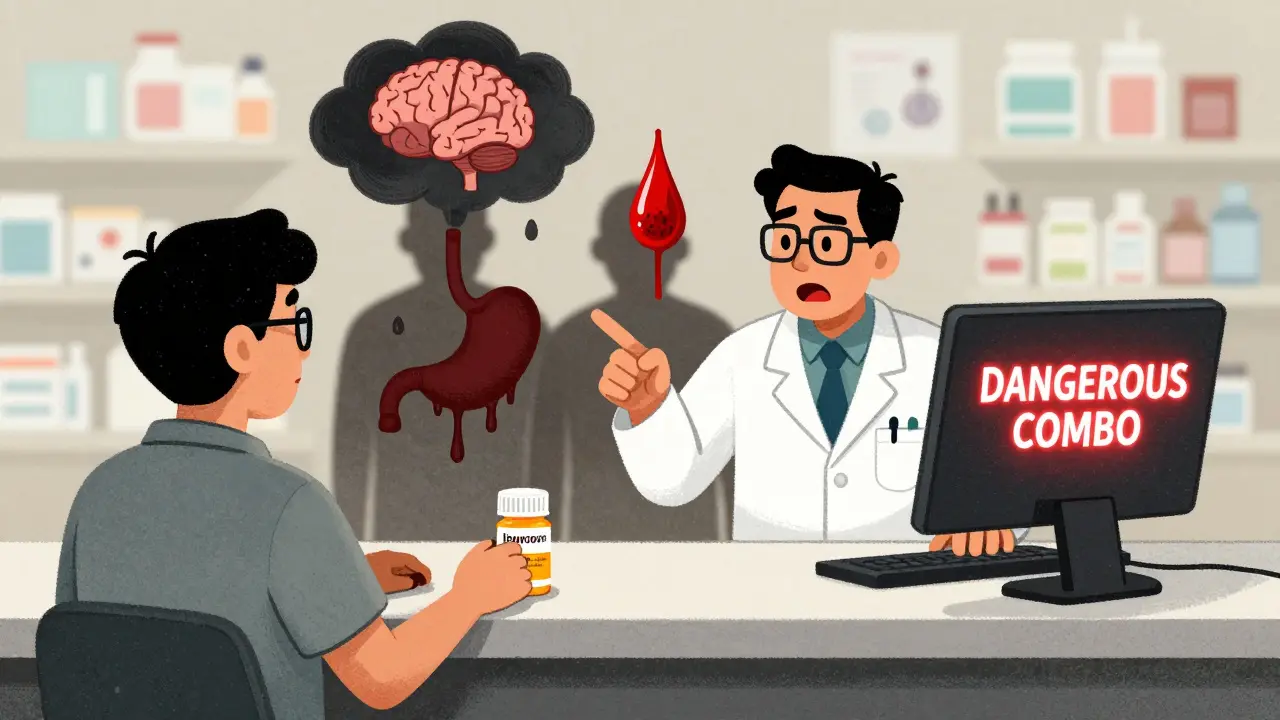
Every year, millions of people take blood thinners to prevent strokes, clots, or other dangerous conditions. At the same time, just as many reach for ibuprofen or naproxen for a sore knee, headache, or back pain. What most don’t realize is that combining these two types of meds isn’t just a minor caution-it’s a blood thinner and NSAID combo that can send you to the hospital, or worse.
What Happens When You Mix Them?
Blood thinners work in one of two ways: they either stop your blood from clotting as easily (like warfarin or rivaroxaban) or they keep your platelets from sticking together (like aspirin or clopidogrel). NSAIDs-drugs like ibuprofen, naproxen, and diclofenac-do something similar but in a different way. They block enzymes called COX-1 and COX-2, which reduces pain and swelling. But here’s the catch: COX-1 is also needed to protect your stomach lining and help platelets do their job. When NSAIDs shut that down, your body loses one of its natural defenses against bleeding.Put them together, and you’re essentially double-punching your body’s ability to stop bleeding. It’s not just a theory. A massive 2024 study in Denmark tracked over 51,000 people on blood thinners and found those who also took NSAIDs were more than twice as likely to be hospitalized for bleeding. Some NSAIDs were far worse than others. Naproxen? It raised the risk by over four times. Diclofenac? Three times higher. Even ibuprofen, often thought of as the "safer" option, still doubled the risk.
It’s Not Just Your Stomach at Risk
Most people assume the danger is only in the gut. That’s the most common place bleeding shows up-black stools, vomiting blood, or severe abdominal pain. But the Danish study showed something deeper: this combo doesn’t just hurt your stomach. It puts your brain, lungs, kidneys, and bladder at risk too.- Brain bleeding risk went up by 3.2 times
- Lung bleeding risk jumped 36%
- Bleeding in the urinary tract rose by 57%
- Anemia from blood loss became nearly three times more common
These aren’t rare side effects. They’re predictable outcomes. And they don’t wait for long-term use. Even taking an NSAID for three days while on a blood thinner can be enough to trigger a serious bleed. There’s no safe window.
All Blood Thinners Are Affected-Even the "Newer" Ones
A lot of people think newer blood thinners like apixaban (Eliquis) or dabigatran (Pradaxa) are safer than older ones like warfarin. That’s true in some ways-they don’t need constant blood tests, and they have fewer food interactions. But when it comes to NSAIDs? They’re just as vulnerable.The Danish study found no difference in bleeding risk between warfarin users and those on DOACs (direct oral anticoagulants) when NSAIDs were added. That means if you’re on Eliquis, Xarelto, or Pradaxa, you’re not protected. The combination still breaks your body’s clotting system the same way. The idea that newer = safer in this case is dangerously wrong.
Why Do So Many People Still Take This Combo?
Because they don’t realize they’re doing it.Many patients don’t think of ibuprofen or naproxen as "medications." They see them as pain relievers-like aspirin in the medicine cabinet. They grab a tablet for a headache, a sore shoulder, or menstrual cramps, and never mention it to their doctor. But in Denmark, where the study was done, 75% of ibuprofen use is prescription-based. In places like the U.S., Australia, and the UK, most ibuprofen is sold over the counter. That makes tracking this interaction nearly impossible.
Doctors don’t always ask. Patients don’t always volunteer. And when you’re in pain, you’re not thinking about drug interactions-you’re thinking about relief. That’s why this combo keeps happening, even though we’ve known about it for years.
What Should You Take Instead?
The answer is simple: acetaminophen (Tylenol). It’s the only over-the-counter pain reliever that doesn’t interfere with platelets or clotting. It doesn’t raise your bleeding risk. It’s not a miracle cure for inflammation, but for general pain-headaches, muscle aches, fever-it works just fine.If you have arthritis or chronic inflammation and need something stronger than acetaminophen, talk to your doctor about alternatives:
- Physical therapy or targeted exercises
- Heat or cold packs
- Topical creams with capsaicin or menthol
- Low-dose corticosteroid injections (if appropriate)
And if you absolutely must use an NSAID-say, for a sudden gout flare or severe tendonitis-use the lowest dose for the shortest time possible. Even then, your doctor might recommend a proton pump inhibitor (like omeprazole) to protect your stomach. But remember: that only helps your gut. It doesn’t protect your brain or lungs.
What If You’ve Already Taken Them Together?
If you’ve taken an NSAID while on a blood thinner, don’t panic-but don’t ignore it either.- Stop the NSAID immediately.
- Watch for signs of bleeding: unusual bruising, blood in urine or stool, severe headaches, dizziness, shortness of breath, or sudden weakness.
- Call your doctor or go to the ER if you notice any of these.
There’s no antidote. No reversal pill. Once the bleeding starts, it’s about stopping it fast. The sooner you get help, the better your outcome.

What Doctors Should Be Doing
This isn’t just a patient problem-it’s a system problem. Too many people are on this dangerous combo because no one’s checking.Doctors need to ask about OTC meds at every visit. Not just once. Every time. Patients forget. They assume it’s not important. Pharmacists should flag these combinations when dispensing blood thinners. Electronic health records should pop up warnings when an NSAID is prescribed alongside an anticoagulant.
Some hospitals are already doing this. They’ve built automated alerts into their systems. When a patient on rivaroxaban gets a prescription for naproxen, the pharmacy system stops it and notifies the prescriber. That’s the kind of safety net we need everywhere.
The Bigger Picture
This isn’t a niche issue. Over 3 million Americans take blood thinners. Billions of NSAID doses are sold every year. The overlap is huge. And with aging populations, more people are living with both atrial fibrillation and osteoarthritis. This combo isn’t going away unless we act.Health systems, pharmacies, and doctors need to treat this like a public health emergency-not a footnote in a drug guide. Patients need to be told, clearly and repeatedly: Don’t mix these.
If you’re on a blood thinner, your pain relief options are limited-but they’re not gone. Acetaminophen is safe. Physical therapy works. Topical treatments help. And sometimes, waiting it out is the best medicine.
There’s no shortcut to safety here. The risk isn’t worth it. Not for a headache. Not for a sore back. Not even for a bad flare-up. Your life depends on knowing this.
Can I take ibuprofen with warfarin if I only use it once in a while?
No. Even a single dose of ibuprofen while on warfarin or any other blood thinner increases your bleeding risk by nearly 80%. There’s no safe "occasional" use. The combination affects your body’s ability to clot immediately, and the risk doesn’t disappear after one pill.
Is aspirin safer than other NSAIDs when on blood thinners?
No. Aspirin is itself an antiplatelet drug. If you’re already on a blood thinner, adding aspirin doubles down on the bleeding risk. Many people take low-dose aspirin for heart protection, but combining it with anticoagulants like rivaroxaban or apixaban is not recommended unless specifically directed by a cardiologist after careful risk assessment.
What about Celebrex (celecoxib)? Is it safer because it’s a COX-2 inhibitor?
No. Even though celecoxib targets COX-2 more selectively, studies show it still increases bleeding risk when combined with blood thinners. It doesn’t protect your stomach lining enough to make it safe. The Danish study found no meaningful difference in bleeding risk between traditional NSAIDs and COX-2 inhibitors when used with anticoagulants.
Can I take Tylenol (acetaminophen) with any blood thinner?
Yes. Acetaminophen is the only over-the-counter pain reliever proven safe to use with all types of blood thinners, including warfarin, rivaroxaban, apixaban, and dabigatran. It doesn’t affect platelets or clotting factors. Stick to the recommended dose (no more than 3,000-4,000 mg per day) and avoid alcohol, as liver damage can occur with high doses.
What should I do if I accidentally took ibuprofen with my blood thinner?
Stop taking the NSAID right away. Monitor for signs of bleeding: unusual bruising, dark or bloody stools, vomiting blood, severe headaches, dizziness, or trouble breathing. If any of these occur, go to the emergency room immediately. If you’re unsure, call your doctor or pharmacist. Don’t wait for symptoms-bleeding can start without warning.
Are there any natural alternatives to NSAIDs for joint pain?
Yes. Heat packs, cold therapy, gentle stretching, and physical therapy are effective for many people. Turmeric and omega-3 supplements have mild anti-inflammatory effects and are generally safe with blood thinners, but always check with your doctor first. Topical creams with menthol, camphor, or capsaicin can relieve localized pain without affecting your blood’s clotting ability.
Final Takeaway
This isn’t about being overly cautious. It’s about survival. Blood thinners save lives. NSAIDs can end them when used together. The data is clear, the risks are real, and the alternatives exist. You don’t need to suffer in pain. You just need to know what’s safe.Ask your doctor before taking anything new-even if it’s sold on a pharmacy shelf. And if you’re already on both, talk to your pharmacist today. One conversation could prevent a hospital stay-or worse.
Ambrose Curtis
January 28, 2026 AT 12:19Man, I just found out my grandpa was taking ibuprofen with his Eliquis and didn’t even know it was a problem. He’s been popping two a day for his knees. I’m gonna call his doctor tomorrow. This post saved a life, honestly.
James Dwyer
January 28, 2026 AT 13:25Acetaminophen is the only OTC painkiller I use now after my stroke. No NSAIDs. Ever. It’s not glamorous, but it keeps me alive.
jonathan soba
January 28, 2026 AT 13:54Let’s be real-this isn’t a public health emergency, it’s a failure of pharmaceutical marketing. Companies push NSAIDs like candy while downplaying risks. The FDA’s asleep at the wheel. And don’t get me started on how pharmacies don’t even flag these combos. It’s systemic negligence dressed up as consumer choice.
Jess Bevis
January 28, 2026 AT 20:13Tylenol. That’s it. No drama.
Rose Palmer
January 29, 2026 AT 03:47As a registered nurse who works in cardiology, I see this exact scenario weekly. Patients come in with GI bleeds and are shocked-"I just took one Advil for my headache." We need standardized patient education at discharge, not just a pamphlet they throw away. This is preventable, and it’s heartbreaking.
Howard Esakov
January 30, 2026 AT 07:58Wow, so we’re supposed to suffer through chronic pain because Big Pharma doesn’t want us to mix drugs? How quaint. Meanwhile, in Europe, they’ve had warnings for decades. We’re still stuck in the Stone Age of patient education. Also, acetaminophen kills your liver if you drink. So... what’s the alternative? Suffer silently? Brilliant.
Mindee Coulter
January 30, 2026 AT 11:55My mom took naproxen for a week while on Xarelto and ended up in the ER with internal bleeding. No warning from her doctor. No alert at the pharmacy. She’s fine now but terrified of every pill. This needs to change. Like, yesterday.
Rhiannon Bosse
January 30, 2026 AT 11:55Ohhh so this is why my cousin died after "just taking one ibuprofen"? 🤡 They told her it was "just a headache." Meanwhile, the drug companies are laughing all the way to the bank. Did you know that the same people who wrote the guidelines for NSAID safety also sit on the boards of Pfizer and Merck? Coincidence? I think not. 🧠💣
Linda O'neil
February 1, 2026 AT 02:50For anyone reading this and thinking "but my pain is unbearable"-I get it. I’ve had degenerative disc disease for 15 years. I tried everything. Here’s what actually worked: daily stretching (YouTube has free routines), a heating pad before bed, and topical capsaicin cream. It’s not instant, but it’s safe. And if you’re on a blood thinner? Safety isn’t optional. It’s your lifeline. Talk to a physical therapist. They’re not just for athletes. They’re for people who want to live without risking a stroke or internal bleed. You’ve got this.