
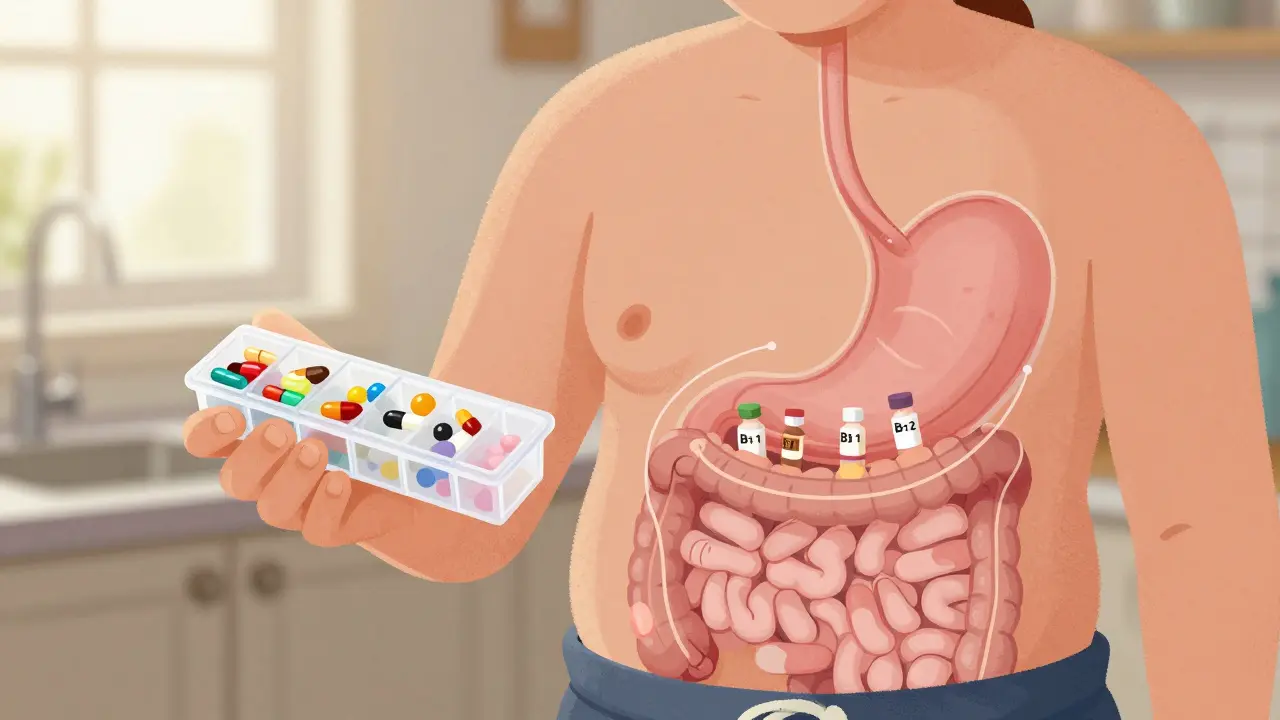
After weight loss surgery, your body doesn’t just lose fat-it loses its ability to absorb the nutrients it needs to stay healthy. That’s where bariatric vitamins come in. These aren’t your regular multivitamins from the drugstore. They’re specially formulated to fight off dangerous deficiencies that can creep in after procedures like gastric bypass or sleeve gastrectomy. Skipping them isn’t an option. Without proper supplementation, you could face nerve damage, bone fractures, or even life-threatening anemia.
Why Standard Vitamins Won’t Cut It
Before surgery, your stomach and intestines absorbed vitamins and minerals naturally. After surgery, that changes. In a gastric bypass, for example, part of your stomach and small intestine are bypassed. That means nutrients like iron, B12, calcium, and vitamin D don’t get the same path to your bloodstream. Even sleeve gastrectomy-where only part of the stomach is removed-reduces acid production, which is needed to unlock nutrients from food and pills.
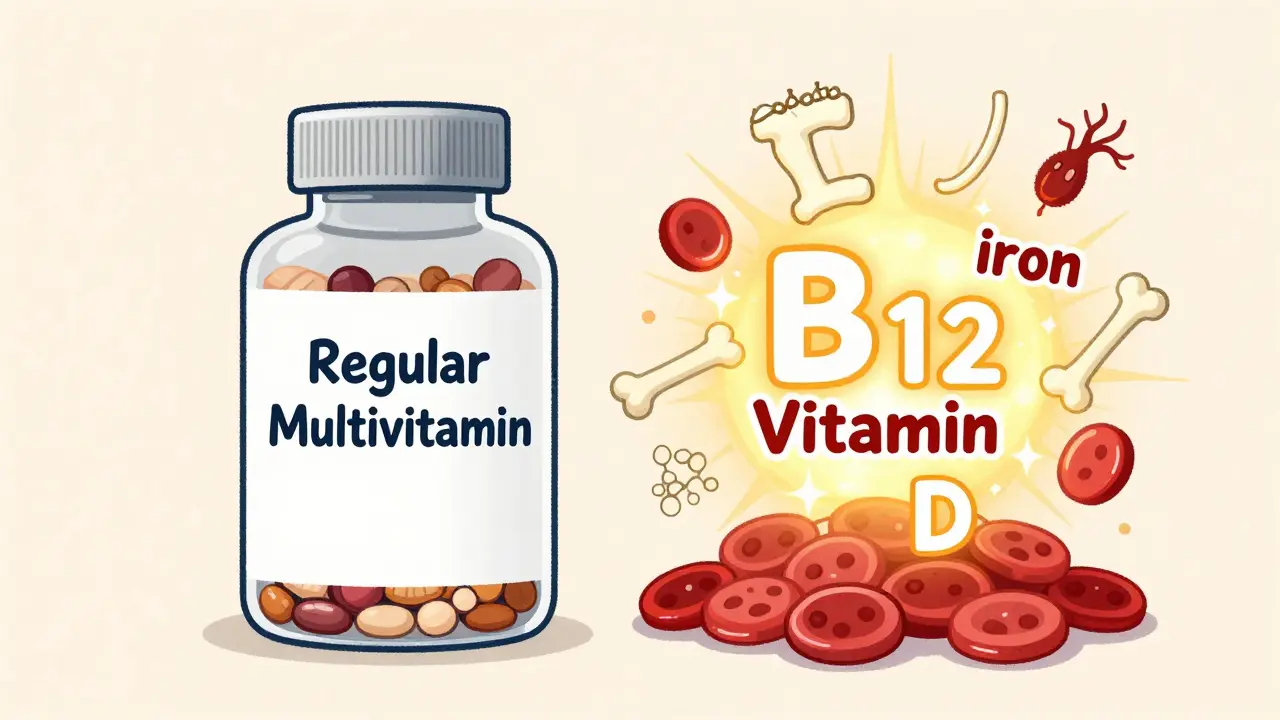
Standard multivitamins are designed for healthy people with normal digestion. They contain too little iron, too little B12, and the wrong form of calcium. Studies show that up to 60% of people who have had gastric bypass develop a B12 deficiency within the first year. Without intervention, that can lead to memory loss, tingling in hands and feet, and even permanent nerve damage.
The Critical Nutrients You Need
Not all deficiencies are the same. What you need depends on the type of surgery you had. Here’s what the American Society for Metabolic and Bariatric Surgery (ASMBS) recommends based on the latest guidelines:
- Vitamin B12: At least 500 mcg daily. Some patients need 1,000 mcg, especially after gastric bypass. Sublingual (under-the-tongue) or liquid forms work better than pills because they skip the stomach entirely.
- Vitamin D3: 3,000 IU daily. Over 70% of patients are already low on vitamin D before surgery. After surgery, your body struggles to absorb it from food or sunlight.
- Calcium: 1,000-1,200 mg daily, split into two or three doses. Only 500-600 mg can be absorbed at once. Calcium citrate is the only form recommended-it doesn’t need stomach acid to work.
- Iron: 18-45 mg daily, depending on gender and menstrual status. Women need more. Ferrous fumarate is easier on the stomach than ferrous sulfate.
- Folic Acid (B9): 400-800 mcg daily. Deficiency can cause anemia and raise the risk of birth defects in future pregnancies.
- Vitamin A, E, K: Fat-soluble vitamins are poorly absorbed after malabsorptive surgeries. Daily doses of 5,000-10,000 IU for vitamin A and 15-20 mg for vitamin E are often needed.
- Thiamine (B1): 50 mg daily. Often overlooked, but critical. Deficiency can cause Wernicke’s encephalopathy-a serious brain disorder.
Form Matters: Chewables, Liquids, and Why Pills Fail
After surgery, your stomach is the size of a walnut. Swallowing a large pill can feel like choking. Many patients gag or vomit. Even if they swallow it, the pill may not dissolve properly. That’s why chewable or liquid supplements are required for the first 3-6 months.
Even after that window, many patients stick with soft forms. A Reddit user who had sleeve surgery in 2022 wrote: “The liquid B12 saved me. I couldn’t swallow pills for two months. When I switched, my energy came back.”
Some newer bariatric vitamins now come in smaller, easy-to-swallow capsules. But if you’re still struggling, don’t force it. Ask your dietitian for alternatives. There are powders you can mix into water, and even injectable B12 for those who can’t absorb it orally.
How Your Surgery Type Changes Your Needs
Not all weight loss surgeries are the same. Your supplement plan should match your procedure.
| Nutrient | Gastric Bypass (RYGB) | Sleeve Gastrectomy | Adjustable Gastric Band |
|---|---|---|---|
| Vitamin B12 Deficiency Risk | 60% | 25-30% | 15-20% |
| Iron Deficiency Risk | 20-47% | 15-30% | 10-20% |
| Vitamin D Deficiency Risk | 12-73% | 20-50% | 10-30% |
| Calcium Absorption | Severely reduced | Moderately reduced | Mildly reduced |
| Fat-Soluble Vitamin Risk | High | Moderate | Low |
Malabsorptive surgeries like gastric bypass and duodenal switch are the most dangerous for nutrient loss. Restrictive surgeries like the gastric band or sleeve still require attention, but the risks are lower. That doesn’t mean you can skip supplements. Even a 15% risk of B12 deficiency is too high to ignore.
Adherence Is the Real Problem
Most patients start strong. In the first year, over 95% of people in accredited programs take their vitamins daily. But five years later? Only 30-50% still do.
Why? Pill overload. One patient on a bariatric forum said: “I’m taking six pills a day. I forget. I get nauseous. I feel like I’m on a full-time job just to stay healthy.”
Iron supplements cause constipation. Calcium can cause bloating. B12 liquids taste weird. It’s easy to quit. But the consequences don’t wait. A 2023 study in Clinical Obesity found that patients who stopped supplements were 8 times more likely to develop anemia or neurological symptoms.
Solutions? Use a pill organizer. Set phone alarms. Try once-daily formulas (they’re getting better). Talk to your dietitian about switching brands. Some newer products have fewer pills, better flavors, and no iron if you don’t need it.

Monitoring Is Non-Negotiable
You can’t guess if you’re deficient. Blood tests are your only reliable tool.
For the first two years after surgery, get blood work done every 3-6 months. Test for:
- Iron (ferritin, serum iron, total iron-binding capacity)
- Vitamin B12
- Folate
- Vitamin D (25-hydroxyvitamin D)
- Calcium and magnesium
- Thiamine (especially if you’ve had vomiting or poor intake)
After two years, annual testing is enough-if you’re still taking your vitamins. But if you’ve missed doses, go back to testing every 6 months.
Some clinics track your levels digitally and send alerts when you’re due for bloodwork. If your program doesn’t do this, take charge. Write it in your calendar. Set a recurring reminder. Your bones, nerves, and blood cells depend on it.
Cost and Access: The Hidden Barrier
A full bariatric supplement routine can cost $30-$60 a month. That’s $360-$720 a year. For many, it’s not covered by insurance. Amazon’s top-rated bariatric vitamin-Nature’s Bounty Bariatric Formula-costs about $25 a month. But it doesn’t have enough calcium. You’ll need to buy a separate calcium citrate pill. Now you’re at $40.
Some manufacturers offer discount programs. Bariatric Fusion, for example, has a patient assistance program. Ask your surgeon’s office. Many have partnerships with supplement companies and can give you a coupon or bulk discount.
If cost is a barrier, talk to your dietitian. Sometimes, you can reduce your regimen. For example, if your iron levels are normal, you might not need an iron supplement. But never stop B12 or vitamin D without a blood test.
What Happens If You Skip Them?
Let’s say you stop taking your vitamins. Here’s what could happen:
- B12 deficiency: Numbness in fingers, trouble walking, memory loss, depression. Can become permanent.
- Vitamin D deficiency: Bone pain, muscle weakness, fractures from minor falls. Osteoporosis can develop in your 30s or 40s.
- Iron deficiency: Constant fatigue, pale skin, shortness of breath, heart palpitations.
- Thiamine deficiency: Confusion, vision changes, vomiting, loss of coordination. Can lead to brain damage.
These aren’t rare. They’re common. And they’re preventable.
Do I need bariatric vitamins if I had a sleeve gastrectomy?
Yes. Even though sleeve gastrectomy is less invasive than gastric bypass, it still reduces stomach acid and limits food intake. You still need a high-potency multivitamin with iron, B12, calcium, and vitamin D. Studies show 15-30% of sleeve patients develop B12 deficiency within two years.
Can I take regular multivitamins instead?
No. Regular multivitamins have far too little iron (usually 18 mg is the max, but you may need up to 45 mg), not enough B12 (usually 2.4 mcg vs. 500-1,000 mcg needed), and use calcium carbonate, which won’t absorb without stomach acid. Bariatric vitamins are designed specifically for your altered anatomy.
How long do I need to take these supplements?
For life. Bariatric surgery permanently changes how your body absorbs nutrients. Even if you feel fine, your blood levels can drop silently. Stopping supplements after a few years puts you at risk for irreversible damage.
Why is calcium citrate better than calcium carbonate?
Calcium carbonate needs stomach acid to dissolve. After bariatric surgery, especially sleeve gastrectomy, acid production drops. Calcium citrate doesn’t need acid-it absorbs directly in the small intestine. That’s why it’s the only form recommended.
I’m pregnant after surgery. Do I need more vitamins?
Yes. Pregnancy increases demand for iron, folate, B12, and calcium. Your supplement needs will likely double. Work with a bariatric dietitian and OB-GYN who understands post-surgery nutrition. Folate deficiency can cause neural tube defects, and iron deficiency can lead to preterm birth.
Bariatric vitamins aren’t optional. They’re the foundation of your long-term health after weight loss surgery. Skipping them risks your future mobility, mental clarity, and physical strength. The good news? With the right supplements, consistent testing, and smart habits, you can live a full, active life-free from the dangers of deficiency. Start today. Keep going. Your body is counting on it.
Robert Bliss
March 9, 2026 AT 09:15Katy Shamitz
March 10, 2026 AT 23:12Janelle Pearl
March 12, 2026 AT 18:23And if you're out there struggling? You're not alone. Keep going.
rafeq khlo
March 13, 2026 AT 01:10Philip Mattawashish
March 13, 2026 AT 16:31Melba Miller
March 14, 2026 AT 09:44Judith Manzano
March 14, 2026 AT 14:24Ray Foret Jr.
March 16, 2026 AT 08:25Tom Sanders
March 16, 2026 AT 21:28Neeti Rustagi
March 18, 2026 AT 18:19APRIL HARRINGTON
March 19, 2026 AT 11:50Samantha Fierro
March 19, 2026 AT 23:16Morgan Dodgen
March 20, 2026 AT 15:26Peter Kovac
March 21, 2026 AT 09:47