
Every year, millions of people finish their antibiotic course early-because they feel better. That’s understandable. But here’s the truth: stopping antibiotics when symptoms disappear is one of the biggest reasons we’re losing the fight against superbugs. In Australia, and across the world, antibiotic resistance is rising fast. And much of it starts right in our kitchens, bathrooms, and medicine cabinets.
Why finishing your full course isn’t optional
Antibiotics don’t work like painkillers. You don’t take them until you feel okay. You take them to kill every last bacterium causing the infection. If you stop early, even if you’re 90% better, the strongest bugs survive. These survivors multiply. They pass on their resistance genes. Soon, the same antibiotic won’t work for you-or your neighbour, your child, or your elderly parent.The CDC says stopping antibiotics too early can lead to relapse or drug-resistant infections. Research shows incomplete courses increase resistance risk by 23-37%. That’s not a small number. That’s the difference between a simple infection and a hospital stay.
For seniors, who make up over a third of home antibiotic users, this is especially dangerous. Many take seven or more medications daily. Remembering to take one pill at 2 a.m. is hard. That’s why caregivers in Melbourne and beyond are using pill organizers with alarms, or apps like Medisafe, which send reminders and track doses. One study found caregivers who used these tools improved completion rates by 42%.
Don’t assume you know how long to take it. A 5-day course isn’t always shorter than a 10-day one. Some newer antibiotics are designed for shorter durations because they’re more potent. Only your doctor knows what’s right. Never guess. Never shorten it because you’re ‘feeling fine.’
What to do with leftover pills
You’ve finished your course. There are still pills left. What now?Don’t keep them. Don’t give them to someone else. Don’t flush them down the toilet. And don’t toss them in the trash bare. Each of these habits fuels the problem.
Leftover antibiotics are a major source of misuse. A CDC survey found 61% of people keep old antibiotics for future use. That’s dangerous. An old prescription for a throat infection won’t help with a urinary tract infection. Worse, it might make the next infection harder to treat.
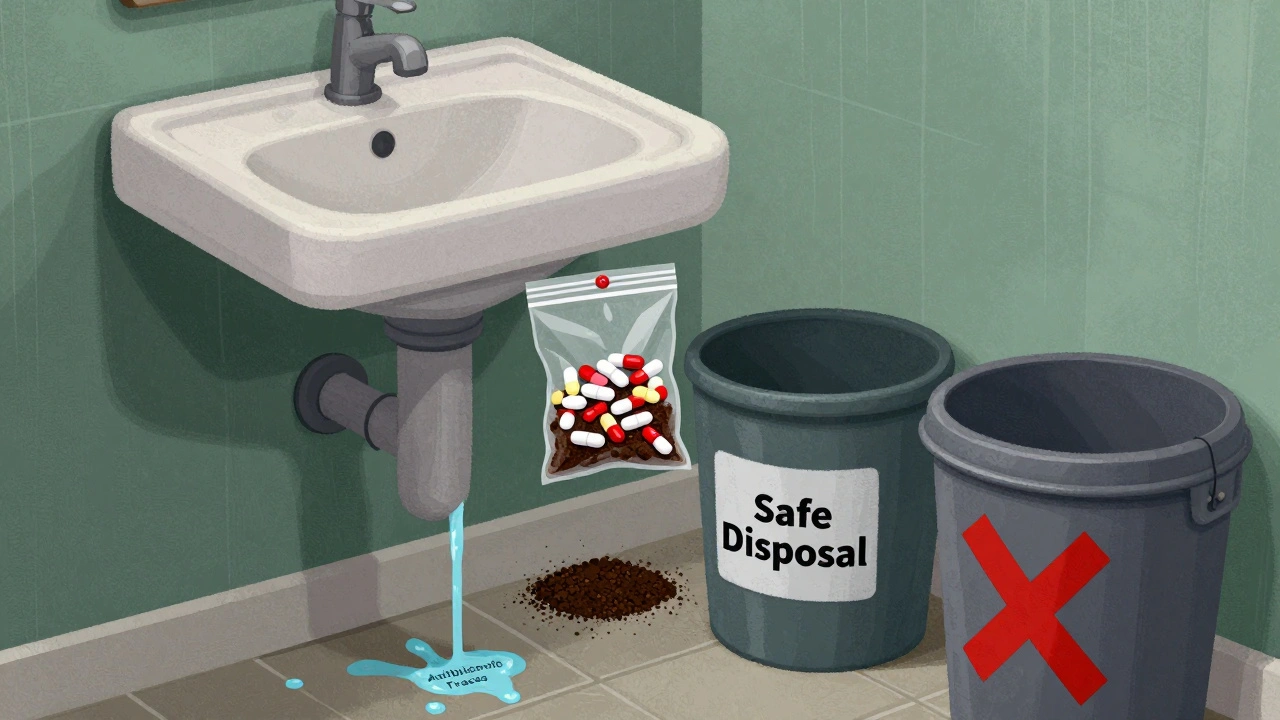
Flushing antibiotics pollutes our waterways. A 2022 study found antibiotic residues in 63% of U.S. water sources near cities. Australia’s water systems aren’t immune. These traces don’t disappear. They encourage resistant bacteria to grow in rivers, soil, and even drinking water supplies.
The safest way? Mix unused pills with something unappetizing-coffee grounds, cat litter, or dirt. Put them in a sealed container-a jar, a plastic bag, a used takeout container. Then throw them in the trash. This makes them unappealing to kids, pets, or people who might dig through bins.
Some pharmacies and councils offer take-back programs. In Melbourne, check with your local pharmacy or visit your council’s website. Some have drop-off bins for expired or unwanted medicines. If one’s nearby, use it. It’s the cleanest, safest option.
Why home stewardship is different from hospitals
Hospitals have teams of pharmacists, infectious disease specialists, and nurses watching antibiotic use. They review every prescription. They check if the drug is still needed after 48 hours. That’s called an ‘antibiotic timeout.’At home? You’re on your own.
Only 12% of home care settings have formal protocols to reassess whether antibiotics are still needed. In nursing homes, it’s 78%. That gap matters. When you’re not being watched, mistakes happen. A fever goes down, so you stop the pills. A cough lingers, so you give your partner the leftover amoxicillin from last year.
But home care has one advantage: you know the person better than any nurse ever could. You notice when they’re unusually tired. When they stop eating. When their skin changes. That’s valuable. If you see something off, call the doctor. Don’t wait. Don’t assume it’s ‘just a side effect.’
That’s real stewardship-not just finishing the bottle, but asking: Is this still needed?
How to build a simple home antibiotic plan
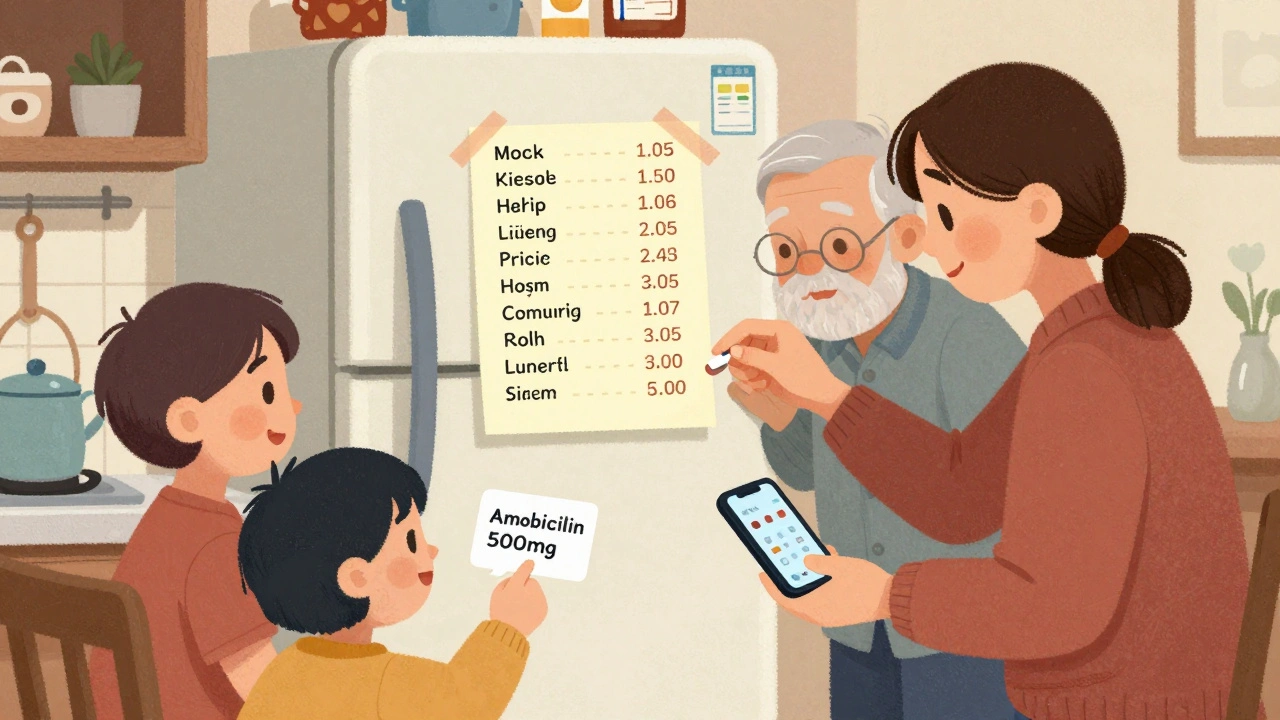
You don’t need a fancy system. Just three things:- Write it down. When the doctor prescribes an antibiotic, write the name, dose, frequency, and end date on a sticky note. Put it on the fridge.
- Set alarms. Use your phone. Set one for each dose. Label it: ‘Amoxicillin 500mg-take with food.’
- Plan disposal before you start. Right after you get the prescription, ask the pharmacist: ‘How do I safely dispose of what’s left?’ Write the answer down too.
Some families use a pill box with separate compartments for morning, afternoon, evening, and night. Fill it once a week. That way, if a dose is missing, you know immediately.
Apps like Hero (costing around $299 plus $25/month) automate this. They dispense pills on schedule and alert caregivers if a dose is skipped. They’re not for everyone-but if you’re managing meds for someone with dementia or multiple conditions, they’re worth considering.
What’s changing-and what’s coming
The good news? Awareness is growing. In 2024, the U.S. FDA updated its National Action Plan to specifically target home antibiotic misuse. Their goal: reduce inappropriate use by 15% by 2027.Australia is watching. While we don’t have formal home stewardship rules yet, the Therapeutic Goods Administration (TGA) and the Australian Commission on Safety and Quality in Health Care are reviewing guidelines. A new CDC Home Care Stewardship Toolkit is expected in early 2025-and it’s likely to influence Australian practices too.
Telehealth is helping. In trials, doctors are now doing virtual check-ins on day 2 or 3 of antibiotic treatment. If the patient is improving, they might shorten the course safely. If not, they switch drugs. This cuts unnecessary use by nearly 30%.
But change won’t happen unless we act at home. Hospitals can’t fix what we do in our kitchens.
Common mistakes-and how to avoid them
- Mistake: ‘I feel better, so I’m done.’ Fix: Finish every pill, even if you’re 100% better on day 3.
- Mistake: ‘I saved these for next time.’ Fix: Dispose of leftovers properly. Never reuse antibiotics.
- Mistake: ‘My friend took this for a similar infection.’ Fix: Antibiotics aren’t one-size-fits-all. What worked for them could harm you.
- Mistake: ‘I didn’t know how to dispose of them.’ Fix: Mix with coffee grounds, seal in a bag, trash it. Or find a take-back bin.
There’s no shame in asking for help. Call your pharmacist. Ask your GP. Even just saying, ‘I’m not sure how to take this right’ makes a difference.
What you can do today
1. Check your medicine cabinet. Are there old antibiotics? If yes, dispose of them properly today. 2. Set a reminder on your phone: ‘Finish all antibiotics, even if I feel fine.’ 3. Talk to someone you care for-parent, partner, sibling-about antibiotic use. Ask: ‘Do you know what to do with leftover pills?’ 4. Tell your doctor you want to be part of the solution. Say: ‘I want to take my antibiotics exactly as prescribed. Can we review the course length?’Antibiotic resistance doesn’t happen in labs. It happens in homes. Every pill you finish correctly. Every leftover you dispose of safely. Every time you say no to sharing meds. That’s how we protect the next generation.
What happens if I stop my antibiotics early?
Stopping early leaves behind the toughest bacteria. These survivors multiply and pass on resistance genes. That means the same antibiotic won’t work next time you need it-and could make future infections harder to treat for others too. Studies show incomplete courses raise the risk of drug-resistant infections by 23-37%.
Can I give my leftover antibiotics to someone else?
Never. Antibiotics are prescribed for a specific infection, at a specific dose, for a specific person. What works for one person could be ineffective-or dangerous-for another. Giving away antibiotics contributes to misuse and resistance. Always dispose of unused pills safely instead.
Is it safe to flush antibiotics down the toilet?
No. Flushing antibiotics pollutes waterways. Studies show antibiotic residues are found in 63% of U.S. water sources near cities-and Australia’s water systems face similar risks. These traces help resistant bacteria grow in the environment. Always mix leftovers with coffee grounds or cat litter, seal them in a container, and throw them in the trash.
Do I need to finish antibiotics if I’m feeling fine?
Yes. Feeling better doesn’t mean all the bacteria are gone. Antibiotics are prescribed for a full course to ensure every last harmful microbe is killed. Stopping early increases the chance of relapse and creates stronger, harder-to-treat infections. Always complete the full course unless your doctor tells you otherwise.
Where can I safely dispose of unused antibiotics in Australia?
Many pharmacies and local councils in Australia offer medicine take-back programs. Check with your local pharmacy or visit your council’s website. If no program is available, mix unused pills with an unappealing substance like coffee grounds or cat litter, seal them in a container, and place them in your household trash. Never flush or recycle them.
How can I remember to take my antibiotics on time?
Use a pill organizer with compartments for each time of day, or set alarms on your phone labeled with the medication name and dose. Apps like Medisafe track doses and send reminders. For complex regimens, devices like Hero automatically dispense pills and alert caregivers if a dose is missed. Consistency matters-missed doses lower effectiveness and raise resistance risk.
Are there new guidelines for antibiotic use at home?
Yes. In October 2024, AALLCare released updated guidelines for seniors and caregivers, stressing the need to complete full courses and avoid reuse. The CDC is also preparing a Home Care Stewardship Toolkit, expected in early 2025, which will provide clear, practical steps for families. These reflect a growing global push to treat home antibiotic use as a public health priority.
Antibiotics saved millions of lives. But they’re not magic. They’re tools. And like any tool, they only work when used right. Your next pill matters-not just for you, but for everyone around you.
William Chin
December 5, 2025 AT 23:59Let me be perfectly clear: if you don't finish your antibiotics, you're not just being lazy-you're endangering public health. This isn't a suggestion. It's a biological imperative. The CDC data is irrefutable. Every incomplete course is a ticking time bomb for superbugs. If you're too busy or too tired to take a pill, that's your problem-not the system's. Stop making excuses and start taking responsibility.
James Moore
December 6, 2025 AT 06:07Think about it: antibiotics are the last line of defense against the collapse of modern medicine-and yet, we treat them like over-the-counter candy. We live in an age where we can order a drone-delivered pizza at 2 a.m., but we can't remember to take a pill? We’ve outsourced our biology to convenience culture. The bacteria don’t care about your schedule, your mood, or your ‘feeling fine.’ They only care about survival-and they’re winning because we’re complacent. This isn’t just about health-it’s about civilizational decay. We’ve forgotten that discipline is the price of survival. And if we don’t reclaim it, we’ll be living in a pre-antibiotic world before we know it-where a scraped knee kills you.
Lucy Kavanagh
December 6, 2025 AT 17:30Did you know the government is using antibiotic resistance to justify mandatory biometric tracking? They’ve been quietly adding trace markers to prescriptions since 2022-linked to your Medicare ID. That’s why they push so hard about ‘finishing the course’-it’s not about bacteria, it’s about control. And flushing? That’s a distraction. The real threat is the data they collect when you ‘misuse’ meds. They’re building a behavioral profile. Don’t fall for it. Use pill organizers-but don’t register them. And if you see a ‘take-back bin’ at the pharmacy? That’s a trap. Burn your leftovers. In the fireplace. In secret.
Stephanie Fiero
December 6, 2025 AT 18:28Okay, real talk-I used to stop my antibiotics early too. Then my mom got a UTI that turned septic because of a resistant strain. She was in the ICU for three weeks. I feel awful. I didn’t know. But now I do. So I set 4 alarms a day. I write the dates on my hand. I keep the empty bottle until I’m 100% sure I’m done. And I tell everyone I know. You can do this. You’re not alone. Just start with one pill. One day. One life. You got this 💪
Laura Saye
December 7, 2025 AT 13:41The underlying epistemological tension here is fascinating: we are simultaneously empowered by medical science and rendered vulnerable by our own cognitive biases. The pharmacological intervention is objective, but the behavioral adherence is deeply subjective, embedded in cultural narratives of autonomy, bodily sovereignty, and the illusion of self-diagnosis. We mistake symptom resolution for microbial eradication-a phenomenological error with evolutionary consequences. The bacteria, operating on a Darwinian timescale, exploit our anthropocentric temporal myopia. To complete the course is not merely compliance-it is an act of interspecies humility. We are not the center of the microbial universe. Our health is a transient equilibrium, maintained only through disciplined deference to biological law.
Michael Dioso
December 7, 2025 AT 14:35Yeah right. Like the pharmaceutical companies haven’t been pushing longer courses to sell more pills. The whole ‘finish the course’ thing is a myth invented by Big Pharma to keep you hooked. I’ve stopped antibiotics after 3 days for 20 years. Never had a problem. Your ‘studies’? Paid for by Pfizer. Wake up. The real enemy is corporate greed-not a few leftover pills.
sean whitfield
December 8, 2025 AT 00:48Antibiotics? Please. You think a pill is going to stop evolution? Bacteria have been around for 3.5 billion years. You’ve been alive 40? You think you’re the first human to think you’re smart enough to outsmart nature? Flush them. Keep them. Give them to your dog. It doesn’t matter. The planet will survive. You won’t. But hey, at least you’ll die knowing you followed instructions.
Marvin Gordon
December 9, 2025 AT 03:00I love how this post breaks it down without shaming anyone. Seriously. We’re all just trying to get through life. I’ve forgotten doses. I’ve kept old pills. But now I know better. I use Medisafe. I write it on the fridge. I mix leftovers with cat litter. Small changes. Big impact. Thanks for the clarity. I’m telling my whole family.
Norene Fulwiler
December 9, 2025 AT 04:25In my community, we’ve started a ‘Medicine Swap Box’-people leave unused meds in a locked bin at the church, and we send them to clinics in rural areas. It’s not perfect, but it’s better than trash. We don’t flush. We don’t hoard. We share responsibly. Culture changes when we act together. This isn’t just American-it’s human.
Mark Ziegenbein
December 10, 2025 AT 19:41Let’s be honest-the entire concept of ‘antibiotic stewardship’ is a bourgeois construct designed to make middle-class Americans feel morally superior while ignoring the real drivers of resistance: industrial agriculture, global supply chains, and the lack of new drug development. You think your little pill organizer is going to fix systemic collapse? You’re not a hero. You’re a distraction. The real solution? Ban factory farms from using antibiotics. Fix the FDA. Stop treating symptoms and start treating systems.
Ada Maklagina
December 12, 2025 AT 15:26My grandma uses a pill box. She forgets sometimes. So I set a voice reminder on her Alexa: ‘Time for your amoxicillin, Margaret.’ She laughs. Then takes it. Simple. Human. Works.
Harry Nguyen
December 13, 2025 AT 16:24Oh great. Another guilt-trip from the health police. Next they’ll tell me to brush my teeth with a specific toothpaste or breathe only through my nose. I’m not a lab rat. I’ll take my pills when I feel like it. And if I get sick again? I’ll just get another prescription. Problem solved. Stop lecturing.
Kylee Gregory
December 14, 2025 AT 15:38I really appreciate how this post doesn’t just say ‘do this’ but explains why. I used to think antibiotics were like vitamins-you take them until you feel okay. Now I see it’s about protecting the future. My brother has cystic fibrosis. He’s on antibiotics all the time. If we mess this up, it could cost him his life. So we’re all on board now. We even have a family meeting every time a new script comes in. It’s not perfect. But it’s better than before.
Chris Brown
December 15, 2025 AT 07:17It is profoundly irresponsible to suggest that individuals bear the primary burden of antibiotic resistance. The responsibility lies with regulatory bodies, pharmaceutical conglomerates, and institutional healthcare systems that fail to provide accessible, evidence-based stewardship frameworks. To place the onus on the layperson-particularly those managing polypharmacy, cognitive decline, or socioeconomic hardship-is not stewardship. It is moral negligence dressed in wellness rhetoric.
Stephanie Bodde
December 17, 2025 AT 04:01I just started using Hero for my dad’s meds. It’s expensive but worth it. He has dementia. He used to take his antibiotics at 3 a.m. or not at all. Now it beeps, dispenses, and texts me if he misses one. I cried the first time it worked. This isn’t just about pills-it’s about dignity. Thank you for making this feel possible 💙